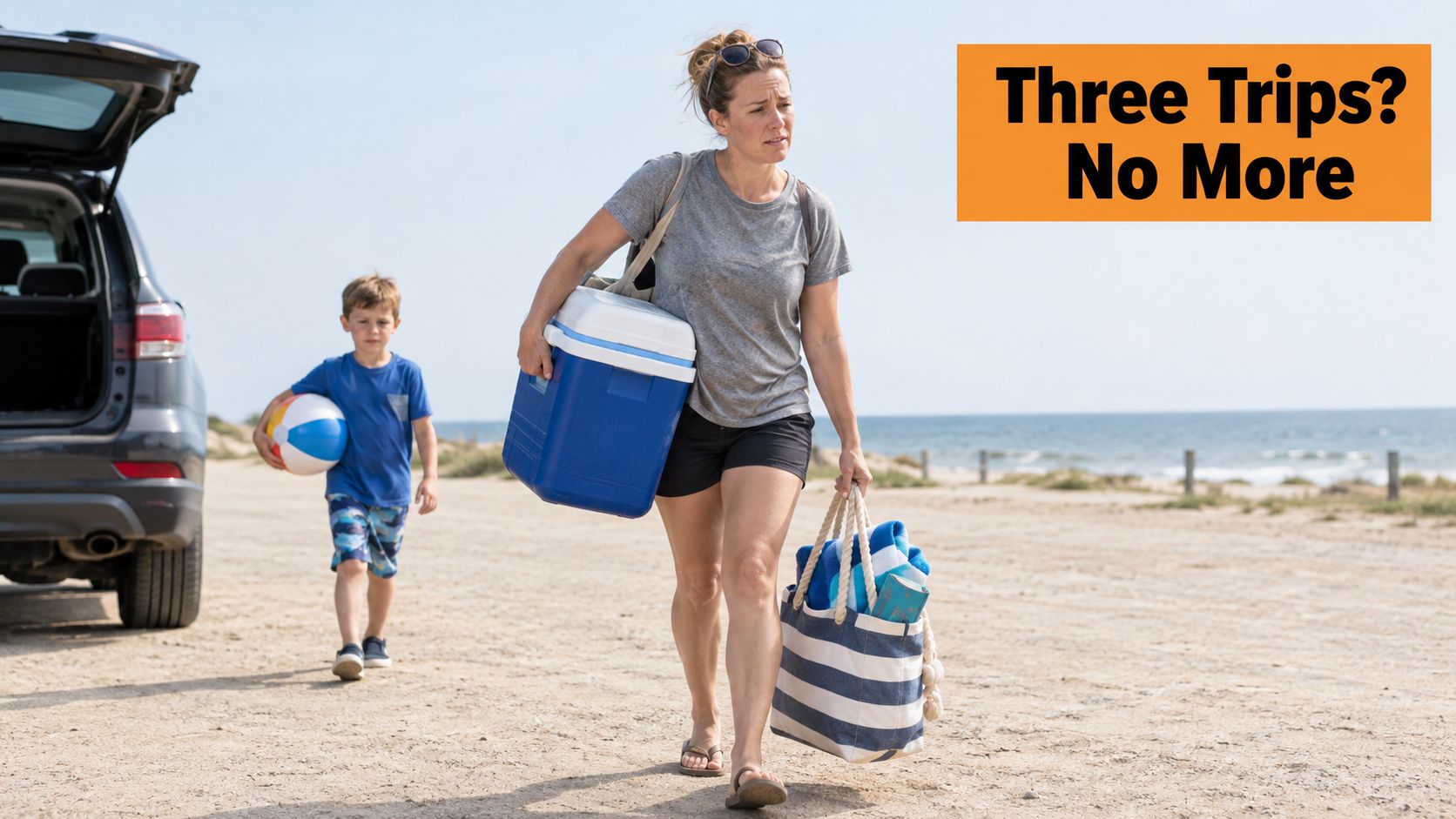
The exhausting three-trip walk from the car to the sand or sideline ruins the mood fast. Gear gets dropped, kids wander off, and your shoulders are done before the day starts. A push and pull wagon fixes that by moving the load and giving you a place to sit, so one trip can cover the cooler, bags, and a break.
If you want the quick version, a push and pull wagon makes sense when you need one cart for hauling and resting, especially on soft ground, crowded paths, and long outdoor days. The Lounge Wagon turns that idea into a practical setup with 500 lb capacity and 2-in-1 seating, so the same frame can handle gear first and comfort second. For a simple starting point, View the Beach Day Bundle before you head out.
A beach morning gets easier when you stop pretending every load is a short walk. Walking across dry beach sand takes substantially more effort than walking on firm ground, with mechanical work and metabolic cost reported at about 2.1 to 2.7 times higher at the same speed (Journal of Vision summary). That's why the first load feels fine and the second one feels like a punishment.
Practical rule: if you're carrying coolers, toys, shade, and snacks, a wagon should save steps, not create them.
The payoff is simple. You get the gear from the car to the shoreline or field edge in one run, then you keep the wagon with you as a seat, a stash spot, and a home base. If you're checking local rules for a beach trip, a practical guide like dogs allowed in Texas state parks can also help you plan the rest of the day around your route and your pet.
How Push and Pull Wagon Steering Actually Works
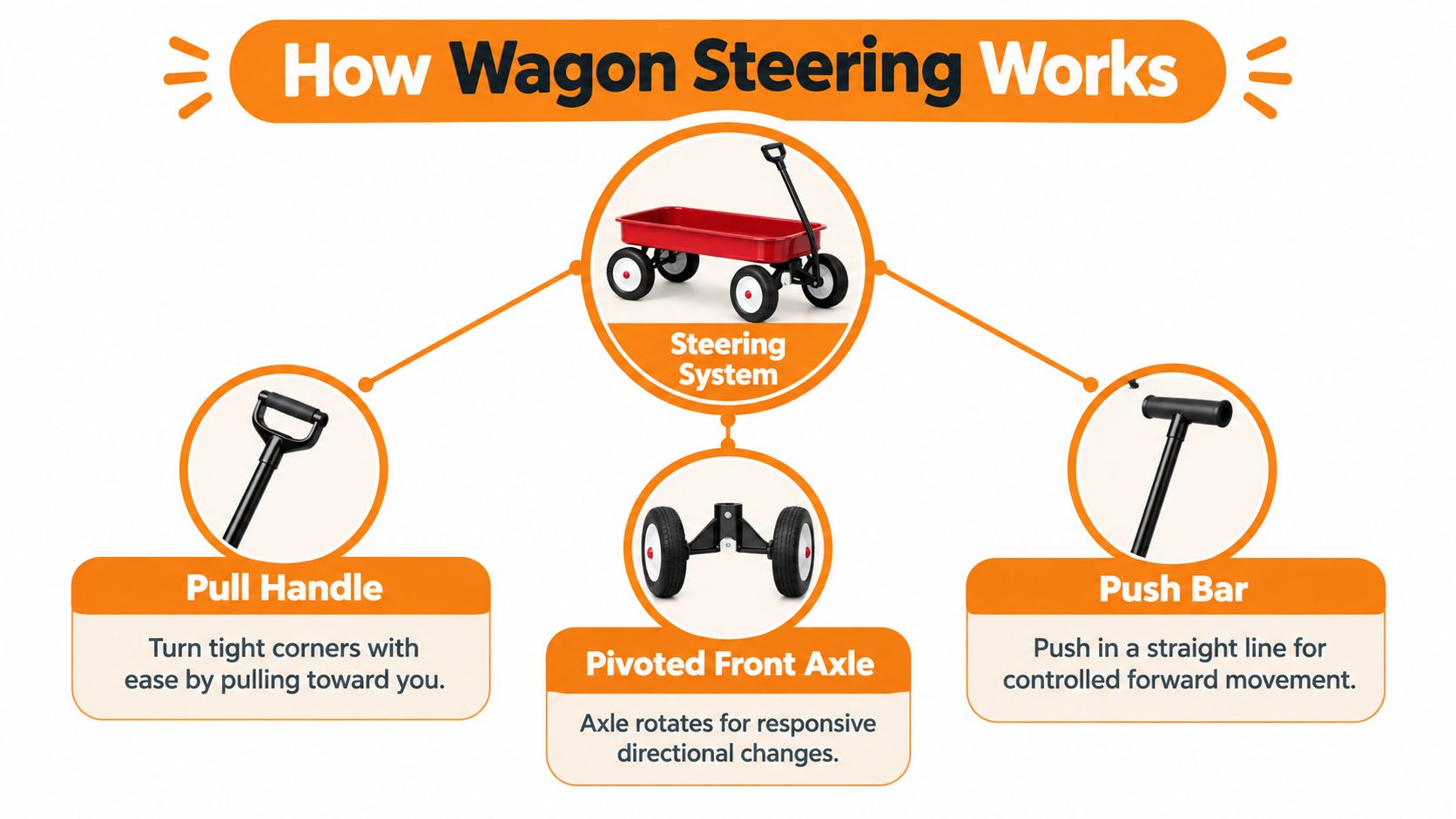
A push and pull wagon works because its steering controls let you choose between tighter turns and steadier forward control. Pulling is more natural in crowded spaces, because the handle gives you a direct line to the front end. Pushing makes more sense when you want the load to stay planted and track straight across open space.
Pull for tight spaces
Think of pulling like steering a suitcase through an airport line. Your hand is close to the wagon, so small body shifts translate into quick direction changes. That matters in parking lots, between beach chairs, and around event crowds.
The long arc of wagon design explains why this still works so well. Wagons are part of a transportation tradition that's more than 5,000 years old, and by the 1st century BCE some designs already used spoked wheels, undercarriages, and pivoted front axles for better maneuverability (Britannica Kids). In plain terms, the basic steering idea hasn't changed much, because it already solved a real movement problem.
Push when you want the load to behave
Pushing feels closer to moving a grocery cart with both hands steady on the frame. The wagon tends to stay in front of you, which helps on open paths, fields, and flatter stretches of sand. It also lets you keep more attention on the wagon's line instead of on how far you're leaning back.
Simple choice: pull when you need turning control, push when you need load control.
That's the difference most shoppers miss. Pulling helps you steer around people and obstacles, while pushing helps you keep the wagon from fishtailing or snagging when the surface is uneven. If you want a plain-language walkthrough, pull a wagon is a useful companion read.
The one-rule shortcut
Use pull when the path is tight. Use push when the path is open. If the ground is soft, heavy, or slightly sloped, the better mode is the one that keeps the front end from digging in and makes the load feel more stable in your hands.
Wheels Handles and Load Control That Prevent Drag
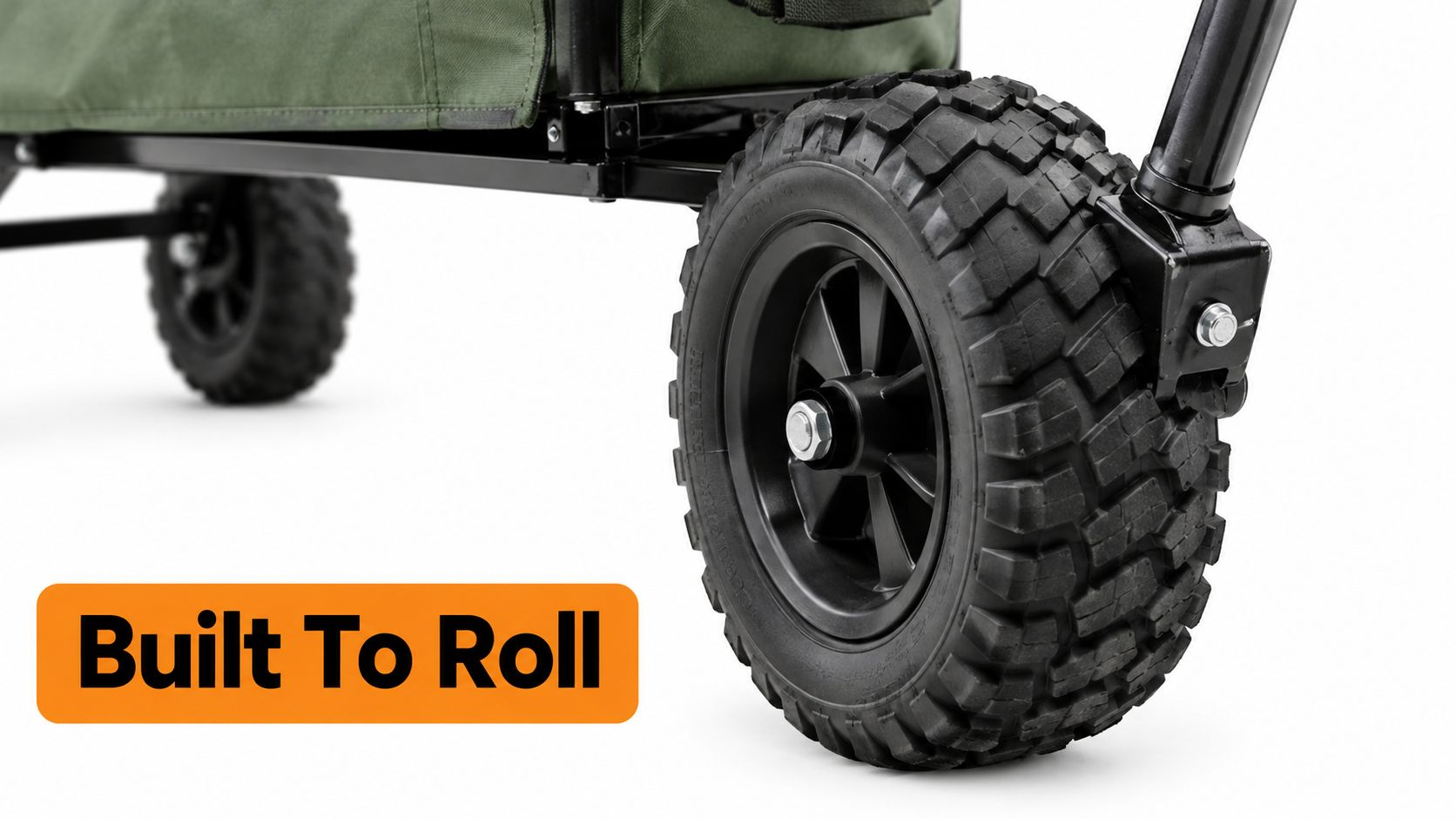
The wheel is where a wagon wins or loses the day. On soft sand, flotation depends on contact pressure and tire shape, not just wheel diameter. Research from Carnegie Mellon found that wider tires reduce ground-contact pressure and improve flotation and mobility in loose sand, although going too wide raises steering resistance (CMU mobility research).
What each feature changes in real life
10-inch puncture-proof wheels: good for rolling over rougher edges, which means fewer stops for stuck wheels.
Wider, compliant tread: spreads the load better, which means less sinkage in loose sand.
Powder-coated steel frame: gives the wagon a tougher structure, which means less flex when the load shifts.
1000D Polyester body: handles outdoor use better than flimsy fabric, which means the wagon stays usable after messy trips.
Adjustable handle height: helps different adults control the wagon, which means less awkward wrist angle and less fighting the frame.
Braking or parking stability: keeps the wagon from rolling away, which means safer stops on grass or sloped ground.
A wagon's weight rating only matters if the load stays balanced. A heavily loaded 500 lb frame can still bog down if the contact patch is too small or the weight sits too far to one side. That's why a beach test should look at wheel track depth, not just whether the wheel spins in the driveway.
Here's the practical version from the field.
Loaded wagons should feel like they're gliding, not plowing. If the sand piles up in front of the wheels, the setup is asking for a wider tread or a lighter load.
An actual gear page helps when you want the moving parts in one place, so heavy-duty wagon wheels is worth bookmarking if you're comparing wheel setups. One real customer-style comment that captures the point is this: “It rolled through the lot without the usual drag.” That's the kind of feedback that matters more than marketing language.
A good handle also changes how the wagon behaves under load. Longer reach and better angle control make it easier to keep one adult in command, especially when the wagon is full and the surface changes from pavement to grass to sand. The goal isn't just movement, it's movement that doesn't feel like a wrestling match.
Choosing Push or Pull on Sand Grass and Gravel
Beach days, soccer sidelines, and gravel lots each punish a wagon in a different way. That's why “all-terrain” only means something if you can describe what happens on each surface, with a real load, in real hands. A wagon that feels fine on pavement can feel stubborn the moment the wheels hit dry, loose sand or a rough field edge.
Match the mode to the surface
The outdoor-recreation gap is real, because generic content often lists wheel size and capacity without telling you how the wagon handles dry loose sand, wet sand, grass, gravel, or slopes (NCOAE outdoor recreation note). That leaves families guessing when they really need a field-ready answer.
Terrain
Best Mode
Control Tip
Dry loose sand
Push if the load stays centered, pull if steering feels heavy
Keep the front end light and watch for plowing
Wet sand
Either, depending on crowding and slope
Test straight-line tracking first
Grass
Push for steady travel, pull in tight areas
Avoid sharp turns under load
Gravel
Pull for finer steering, push for long straight runs
Keep both hands ready for small corrections
Gentle slope
Push if you need load control, pull if you need turn control
Watch for drift and tipping
A useful test is simple. Load the wagon the same way every time, then measure how deep the wheels track and how straight the wagon holds on each surface. If it wanders or sinks badly, the problem isn't the label on the side, it's the combination of surface, handle control, and weight placement.
Field check: the wagon should track without constant correction. If one adult is fighting it the whole time, the setup is wrong for that surface.
A lot of families get fooled by the phrase “all-terrain” and assume it means no tradeoffs. It doesn't. On a youth soccer field, for example, the better choice often comes down to whether you need tighter steering near benches or steadier movement across open grass. For a more specific comparison, wagon vs beach cart for soft sand helps frame that decision.
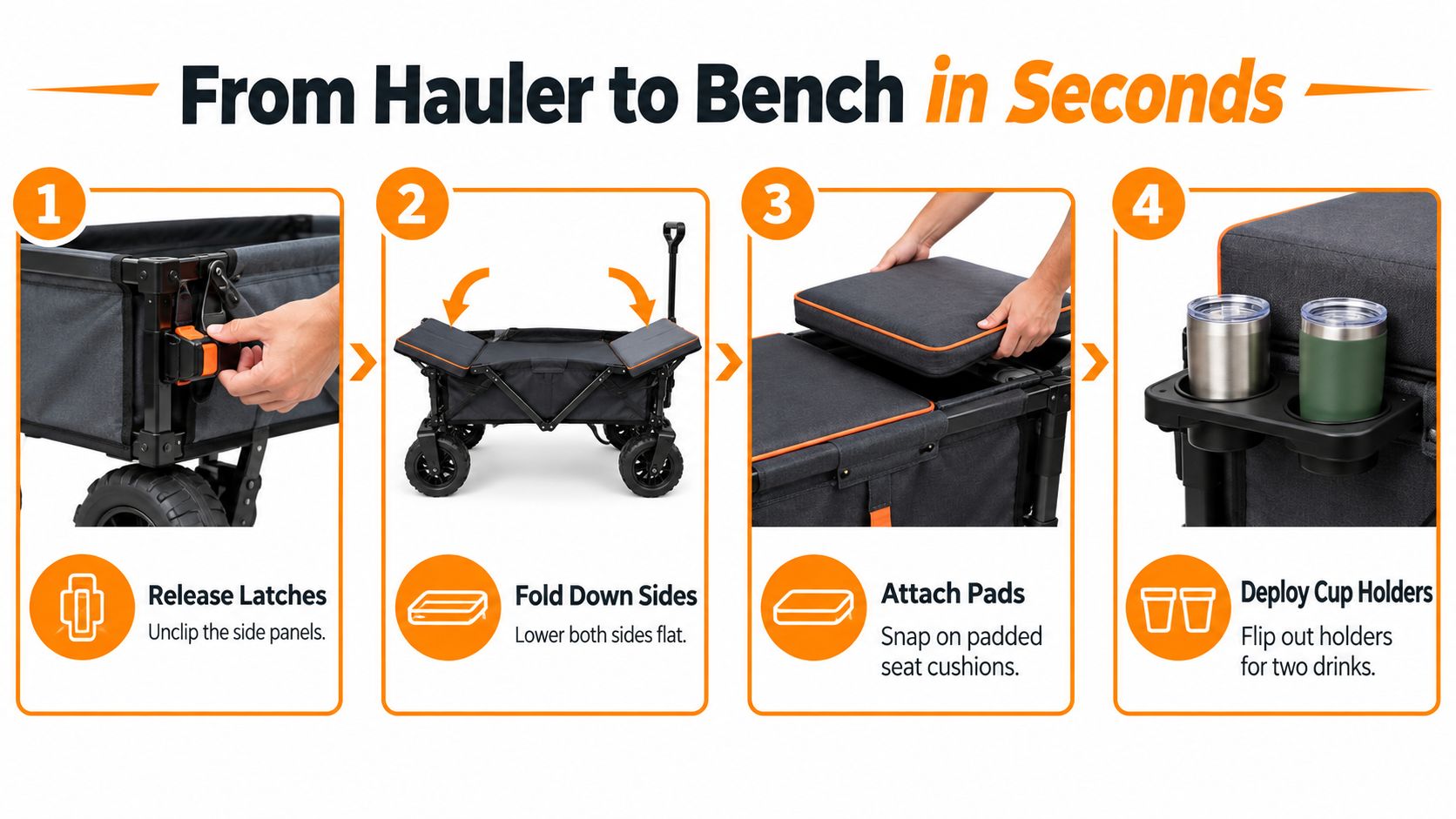
From Heavy Hauler to Double Seater Bench in Seconds
A wagon becomes much more useful when the resting spot is built in. Converting a utility wagon into seating means treating the bench like an outdoor chair, not a padded afterthought. That matters because seat height, back angle, and stability change whether adults can rest and get back up without a struggle.
The Lounge Wagon's 2-in-1 seating matters because it separates travel mode from rest mode without asking you to carry a second chair. It also preserves the logic of 500 lb capacity for hauling, while seating still needs its own stability check. Those two jobs are not the same, and the numbers shouldn't be treated as interchangeable.
ASTM chair testing makes that separation obvious. Outdoor-chair evaluations include weathering, impact, static load, and rear-leg testing, and chair-with-back guidance adds seat-and-back loading, arm testing, impact, and weathering (ASTM F1838/F1858). In plain English, a bench needs to stay steady when someone sits down hard, leans back, or shifts toward the edge.
What comfort looks like for adults
Seat height that fits the user: helps adults stand with less strain.
Stable back support: makes sideline sitting feel restful instead of slouched.
Even weight distribution: reduces the chance of edge-tip wobble.
Clear entry and exit space: keeps getting in and out from feeling awkward.
Parking stability: matters as much as movement, because a bench that rolls is not a bench.
Ergonomic research for older adults found comfort was best around a seat height equal to popliteal height or 25 mm below it, paired with a 105-degree backrest (Applied Sciences study). Another study of adults 65 and older found that 59.4% reported difficulty standing from public seating, with seat height the most common issue (Taylor & Francis study). That's why a wagon bench can't just look padded, it has to sit and rise like a real seat.
For grandparents, that matters on its own. For sideline parents, it matters because a bench that supports the body well turns downtime into real recovery instead of a standing break. If you want to see the layout idea in product form, wagon that converts to chairs is the right place to look.
Real Outings From Beach Days to Game Days
A good wagon earns its keep in ordinary outdoor chaos. At a Florida Gulf Coast beach, one family can load umbrellas, snacks, towels, and toys, then push the wagon across the widest stretch of sand and keep the handle ready for the return trip. On the way back, the wagon becomes the place to sit while the kids rinse off and the cooler stays within reach.
The same logic works at youth sports complexes. Coaches and tournament parents need deliberate recovery time between games, especially in heat, and guidance on hydration and thermal strain says organizers should provide sufficient rest between same-day competitions (GSSI guidance). That makes a mobile gear hauler and bench a practical sideline tool, not a novelty.
For team parents, the load often looks like a cooler, folding tent, extra water, and a bag of backup gear. For a festival goer, it might be blankets, snacks, and a small home base in a crowded field. For a mobile angler, it's tackle, bait, and the ability to sit between casts without dragging another piece of furniture around.
A useful way to think about custom outdoor setups is to browse options that fit the event, not just the look. If you're comparing ways to build a branded or team-specific setup, browse custom outdoor merchandise can spark ideas for what belongs in a field kit or beach kit.
One wagon, one trip, one place to rest. That's what changes the day.
Make It a One Trip Walk to the Shore
The cleanest way to choose a push and pull wagon is to ask three questions. Does it move well on the surface you face. Does it stay controllable when loaded. Does it give you a real seat when the day runs long.
The answer is strongest when the wagon handles all three jobs without pretending every surface is the same.
Choose push or pull by terrain, not habit.
Treat sand performance as a real test, not a label.
Separate hauling capacity from seating comfort.
That's where the Lounge Wagon's 500 lb capacity and 2-in-1 seating matter most, because the same frame can move gear and then turn into a place to sit. If you want one setup that's built around fewer trips, better control, and a usable bench, start with the Lounge Wagon. Ready to stop hauling and start lounging?
Choosing a selection results in a full page refresh.
This pad is perfect for kids or dogs to be comfortable inside the moving wagon, and very nice after you set everything up and want to sit for extra padding.
Having the umbrella this summer has been easy to use and a must to make sitting and watching the parade so nice when there isn't any shade. My dogs laid on the wagon padding and enjoyed the day without getting too hot. I enjoyed the shade too.