TL;DR: Choose a high folding chair by seat fit and ground conditions, not by the biggest capacity number. For most adults, portable seating around 16-19 inches helps standing. Wider bases, anti-tip design, durable fabric, and manageable folded bulk matter more than flashy extras. Pair seating with gear hauling when events demand it.
Last Updated: October 2026
Meta description: Find the right high folding chair for tournaments, beaches, festivals, and fishing, then simplify every trip with Lounge Wagon.
The One-Trip Walk That Changes Game Day
Saturday morning at a soccer complex rarely starts with soccer. It starts with a cooler in one hand, a chair scraping your shoulder, a tent bag dragging behind you, and a child asking where the snacks are. By the time you've gone back to the car for the umbrella, blanket, and extra water, the first whistle is almost an afterthought.
That repeated haul is the core problem with many folding chairs. The chair may be comfortable once it's open, but it becomes awkward cargo before you reach the sideline. A high seat doesn't solve that by itself. You need a chair or seating system that fits the person, the terrain, and the rest of the equipment moving with you.
At crowded sports complexes, I'd rather carry one balanced load than make several trips for separate seating and storage. A compact folded chair with a proper handle can work well for a light setup. A gear hauler that converts into seating can make more sense when the cooler, tent, blankets, and sports bags are already coming along.
Field rule: If setting up the chair requires a separate trip, its comfort advantage may not survive contact with the parking lot.
Before buying another chair, consider this practical guide to carrying chairs and umbrellas. The useful question isn't just, “How high is the seat?” It's, “Can I move the chair with everything else I need?”
A high folding chair earns its place when it gives an adult easier access without becoming a bulky burden. It should open securely, stand firmly on the intended surface, and fold into a shape you can transport. That last point gets ignored in online listings, yet folded depth and carry weight determine whether the chair reaches the beach, field, festival, or pier.
For tournament parents, the winning setup is usually simple:
-
One balanced load: Carry seating, drinks, shade, and personal gear together.
-
Fast deployment: Open the chair without tools, loose parts, or complicated locks.
-
A useful resting height: Sit down and stand up without dropping into a deep squat.
The goal isn't to own the tallest chair at the event. The goal is to arrive once, sit comfortably, and keep your attention on the game.
What High Folding Chairs Actually Are
At a weekend tournament, the wrong “high” chair reveals itself quickly. Your knees sit too high, the armrests block the table, or the legs sink into grass while the person beside you stands comfortably. A high folding chair is a fit decision, not a marketing label. Seat height, knee position, seat depth, armrest clearance, and frame stability determine whether it works outdoors.
Start with the distance from the ground to the seat. Portable models commonly fall around 16-19 inches, but that range matters only when it suits the user's leg length and the surface under the chair. Compare the seat-height guidance for folding chairs before treating a product title as a measurement. A chair that feels correct on firm pavement may sit differently on sand or soft turf as its feet settle.
Seat height changes knee alignment. A suitable chair keeps your feet planted, places your hips at a workable level, and avoids forcing your knees sharply upward. The depth matters just as much. A seat should support your thighs without pushing the front edge behind your knees, while the backrest should meet your back instead of leaving you perched forward.
A useful benchmark is IS 3763 (1983), which specifies a metal folding-chair seat height of 430 ± 5 mm from the floor. Treat that as a reference for a standard folding chair, not proof that a product marketed as high fits your body. Check the manufacturer's actual floor-to-seat measurement and the open dimensions.
Children's seating requires separate attention. Consumer safety guidance uses 15 inches or less as a threshold for children's folding and non-folding chairs and stools, as described in the children's chair safety guidance. Do not substitute an adult high chair for seating designed for children.
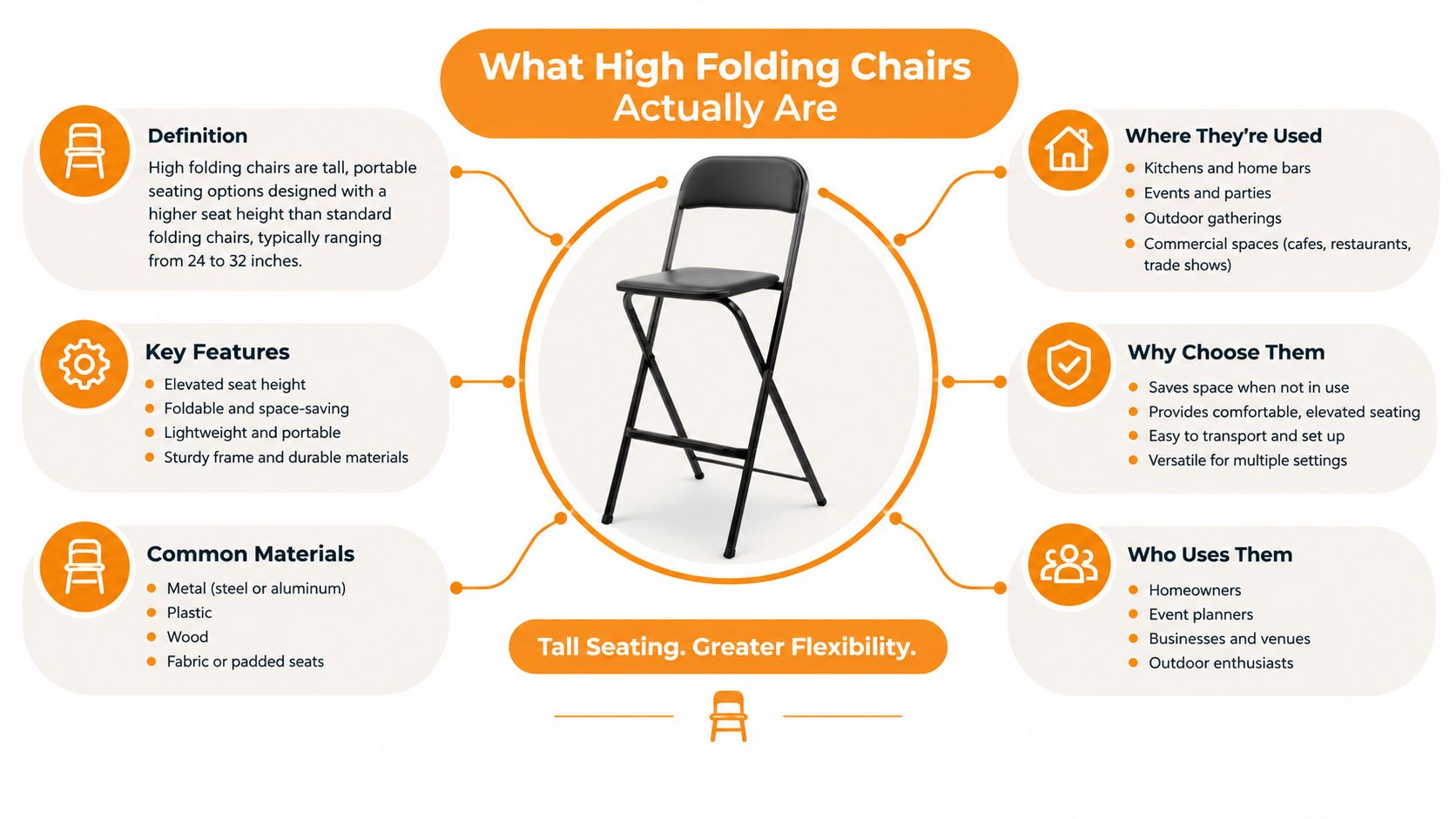
The fit matters more than the label
Check these points before you buy:
-
Knee alignment: Keep both feet supported, with no dangling legs or forced forward slide.
-
Usable seat depth: Support the thighs without making shorter users lean back awkwardly.
-
Armrest clearance: Armrests should assist standing and leave room to pull toward a table.
-
A stable open position: The locking mechanism must engage fully before anyone sits.
A director's chair may share a raised seat and folding frame, but it usually favors upright event seating and fixed armrests. A bar-height stool is taller in a different way. It generally lacks the broad folding base and back support needed for grass, sand, or long sessions. For a grounded comparison, compare outdoor folding chair formats.
Choose the chair that matches your knees and the ground beneath it. Then check whether its stability justifies the extra frame weight and folded bulk. The tallest option is often the wrong one.
Specs That Matter When You Buy
The useful specification sheet is shorter than most product pages suggest. Seat height, capacity, construction, and folded bulk decide whether a high folding chair feels secure at an event or becomes garage clutter.
Seat height and load rating
Start with the actual floor-to-seat measurement. Portable outdoor models commonly sit around 16-19 inches, while the IS 3763 benchmark provides a standard reference of 430 ± 5 mm. Taller users may prefer the upper part of the portable range, but the correct choice depends on leg length and whether the chair sits on firm ground or compressible terrain.
Capacity is a safety boundary, not a comfort score. Some current product listings advertise capacities from 300 to 650 pounds, but those figures vary by design and should be checked against the manufacturer's testing and instructions. The folding-chair category listings illustrate why buyers should compare the complete chair, not capacity alone.
Steel tends to favor structural toughness, while aluminum favors lower carry weight and corrosion resistance. Polyester, mesh, and Textilene each make different tradeoffs between airflow, drying speed, cushioning, and long-session support.
A thick padded seat may feel better at a tailgate but can take longer to dry after rain. A mesh sling handles water better but may feel firm after extended sitting. Powder coating or anodized finishes are more meaningful than decorative colors because outdoor chairs face moisture, grit, sunscreen, and repeated folding.
The folded shape deserves the same attention as the open dimensions. Measure the trunk, closet, hatch, or storage corner before buying. A chair that fits the body but not the vehicle won't become part of your regular kit.
| High Folding Chair Spec Comparison |
Budget Tier |
Mid Tier |
Premium Tier |
| Seat fit |
Basic adult height, limited adjustment |
Better seat geometry and support |
Refined fit, stronger back and arm support |
| Frame |
Basic steel construction |
Treated steel or lighter aluminum |
Reinforced, weather-resistant construction |
| Seat material |
Polyester or basic fabric |
Mesh, Textilene, or improved polyester |
Reinforced sling, padding, or advanced weather-resistant fabric |
| Folded form |
Often bulky or awkward |
Manageable for regular transport |
Designed around carry, storage, and repeated setup |
| Best use |
Occasional extra seating |
Tournament, patio, and travel use |
Frequent outdoor use and demanding conditions |
Ignore marketing language such as “executive,” “luxury,” or “extra tall” unless the listing provides measurements. A built-in cup holder is useful. A flashy finish isn't. For shoppers who need more room and support, review the plus-size folding chair options before settling for a narrow frame with an impressive label.
Matching the Chair to the Event
The same high folding chair that works at a soccer complex can be a poor choice on dry sand. Terrain changes the stability equation, and transport distance changes which features you'll appreciate.
Soccer tournament sidelines
A sideline chair needs a firm stance, a comfortable upright back, and enough seat height to make frequent standing easy. Grass can hide dips and soft spots, so a broad four-leg footprint matters more than an oversized tube diameter.
Bring a chair that lets you lean forward to watch play, turn toward another parent, and stand quickly when your child checks in. A side pocket is useful for keys and sunscreen. A cup holder is useful only when it doesn't weaken the armrest or make the folded frame awkward.
For field logistics, pair seating decisions with a guide to folding football goals from SoccerWares. Tournament gear works best when every item has a transport plan.
Beach days
Dry sand punishes narrow feet. A chair can have an excellent seat height and still sink, tilt, or become frustrating to carry if its feet concentrate weight in small contact points.
Choose corrosion-resistant materials, a breathable sling, and feet that spread pressure across the sand. Salt and chlorine residue should be rinsed away after use. A taller beach chair can improve visibility and make standing easier, but it also deserves a wider, more deliberate base.
Festivals and markets
At a festival, folded bulk becomes the deciding feature. A shoulder strap, carry handle, and slim profile matter more than thick padding if you're moving through a crowded entrance or walking between stages.
Keep the chair simple. A lightweight frame, quick setup, and compact folded shape beat a collection of extras you won't use. If you're also carrying blankets, food, or purchases, a seating option that integrates with gear transport can eliminate the second awkward load.
Tailgates
Tailgates reward comfort and organization. Armrests, a reliable cup holder, and a side pocket turn a basic chair into a workable base for a long afternoon, especially when the chair sits on pavement or packed grass.
Avoid a recline mechanism that feels loose when you shift position. The chair should remain stable when you reach for a plate or stand to greet someone. Padded fabric feels welcoming, but let it dry completely before storage.
Pier fishing
A pier requires a different profile. Wet wood and narrow walkways call for rubberized feet, a stable four-leg stance, and a supportive back that doesn't encourage excessive rocking.
Keep the chair low enough to feel planted while still giving the user an easier rise than a ground-level stool. Leave room for tackle and rods without allowing bags to catch on the folding joints.
| High Folding Chair Profiles by Outdoor Event |
Seat Height |
Capacity |
Frame |
Chair Weight |
Key Feature |
| Soccer tournament |
Moderate to moderately high |
Adult-duty |
Treated steel or aluminum |
Manageable for repeated setup |
Wide stance |
| Beach day |
Higher portable profile |
Adult-duty |
Corrosion-resistant aluminum |
Light enough for the walk |
Sand-friendly feet |
| Festival |
Fit-focused portable height |
Standard adult use |
Lightweight aluminum |
As light as practical |
Carry strap |
| Tailgate |
Table-compatible height |
Adult-duty |
Steel or reinforced aluminum |
Comfort prioritized |
Armrests and storage |
| Pier fishing |
Stable moderate height |
Adult-duty |
Treated metal |
Easy to position |
Gripping foot caps |
For parents managing a cooler, shade, and multiple chairs, see the folding sports chair setup. Select the chair for the event you attend most, then add a transport solution rather than expecting one design to excel everywhere.
Why Taller and Stronger Is Not Always Better
The spec-sheet arms race creates bad buying decisions. A taller seat can make standing easier, and a high capacity can provide structural margin, but both features can add weight, bulk, and instability when the ground is difficult.
A high center of mass matters on slopes, soft sand, loose gravel, and uneven grass. A narrow base can wobble even when the frame itself feels heavy and rigid. Stability comes from the relationship between the seat, the leg spread, the feet, and the surface. Raw tube thickness doesn't replace good geometry.
ASTM F2613 focuses on pinch-point protection and anti-tip stability in the opened, folded, and unfolding states. It also requires chairs to resist backward tipping during stability testing, an important consideration for taller seating profiles. Read the ASTM F2613 safety requirements when a listing provides standards information instead of vague “heavy-duty” language.
The festival test
At a music festival, the tallest chair often looks like the obvious winner at setup. After hours of shifting, reaching for a drink, and standing on uneven ground, a slightly lower chair with a wider base can feel more secure and less tiring.
That's the tradeoff most reviews miss:
-
More height: Easier access for some users, but potentially more strain on the base.
-
More capacity: Greater structural margin, but often more frame weight to carry.
-
More padding: Better initial softness, but slower drying and increased bulk.
-
More mechanisms: More positions, but more joints to inspect and maintain.
A capacity rating of 500 pounds can be useful for buyers who need that margin, but it isn't automatically the right choice for every adult. If the chair is carried across a field or down a beach path, unnecessary frame weight becomes a daily penalty.
Use a mid-height chair with a wide stance when the surface is unpredictable. Choose the sturdier design when the user really needs its capacity or when the chair will face demanding, repeated use. The best high folding chairs are purpose-built, not merely oversized.
Buying Checklist and Care Tips
A chair can look solid beside the shipping box and still feel wrong once your feet meet the ground. Test it as soon as it arrives. Sit in it for at least 60 seconds, place both feet firmly on the floor, and check whether your knees stay comfortable. The front edge should support your legs without pressing sharply behind them.
Shift from side to side, then move forward as if you are standing. Pay attention to movement in the frame, not just the comfort of the fabric. A chair that feels loose on a level floor will feel less secure on grass, sand, or uneven pavement.
What to verify before purchase
Use this checklist before keeping the chair:
-
Measure the seat: Confirm the actual floor-to-seat height. “Tall” and “director” are descriptions, not measurements.
-
Check the load rating: Select a rating with useful margin above the heaviest intended user.
-
Inspect the frame finish: Powder-coated steel or anodized aluminum suits repeated outdoor exposure.
-
Examine the sling: Look for double-stitched polyester, Textilene, or another reinforced outdoor fabric.
-
Measure the folded form: Compare the folded height, width, and thickness with your trunk, closet, or storage rack.
-
Test the feet: Rubber or reinforced caps should sit evenly, with no splitting or looseness.
-
Confirm the lock: Every hinge and brace should engage fully without excessive play.
Confirm stability on your most common surface before relying on any capacity rating. A chair can meet its listed load specification and still be a poor fit if its base shifts on soft ground or its height leaves the user reaching awkwardly for the floor.
ASTM F1235 includes drop testing from 36 inches, with a folding chair dropped on each of six faces in both folded and erect configurations. Those requirements apply to the portable hook-on chair standard, so they do not certify every folding chair. They do show why folded-state durability deserves attention when a listing provides safety documentation. Review the ASTM F1235 testing reference
Keep outdoor chairs serviceable
Beach and pool use leave salt, chlorine, and grit on every exposed surface. Rinse the frame and fabric, wipe the joints, and let the chair dry completely before folding it into a carry bag. Moisture trapped around pivots can turn a minor maintenance issue into corrosion.
Inspect pivot bolts and joints every three months. Check the foot caps whenever the chair has crossed asphalt, gravel, or boardwalks. Store it indoors or under cover, and avoid leaving it balanced on one leg for extended periods.
A practical maintenance routine includes:
-
After wet use: Rinse the chair, wipe the joints, and air-dry it fully.
-
Before storage: Check the sling, welds, hinges, and foot caps.
-
At season's end: Clean the fabric, clear grit from the pivots, and store the chair off the ground.
-
Before the next event: Open and lock the frame, then sit briefly to confirm stability.
Replace the chair when the fabric becomes see-through, a weld cracks, or the feet wear flat. Stop using any frame that shifts under load. If seating and a work surface need to travel together, explore the folding camp chair with table before packing separate furniture. Lounge Wagon combines gear hauling with a 2-in-1 bench for two adults, giving the setup a practical use beyond transport.
Match seat height to your knees, match the base to the ground, and match the folded size to the way you travel. A larger rating or extra seating function matters only when it solves a real transport problem. Confirm that the chair remains stable, manageable to carry, and easy to maintain before choosing those features.
Stop making separate trips for chairs, coolers, and event gear. Lounge Wagon offers a gear hauler that converts into seating for two, so you can carry more and sit at a practical height without adding another bulky chair to the load. Visit Lounge Wagon for a one-trip setup for tournaments, beach days, and festivals.


