You're dragging a cooler through soft sand while everyone waits. An electric beach cart helps when propulsion matters, but sand-rated capacity and battery safety matter more than advertised range. Choose a heavy-duty wagon when hauling and stationary seating matter most, without adding charging chores or saltwater battery worries to weekends.
Last Updated: 2026
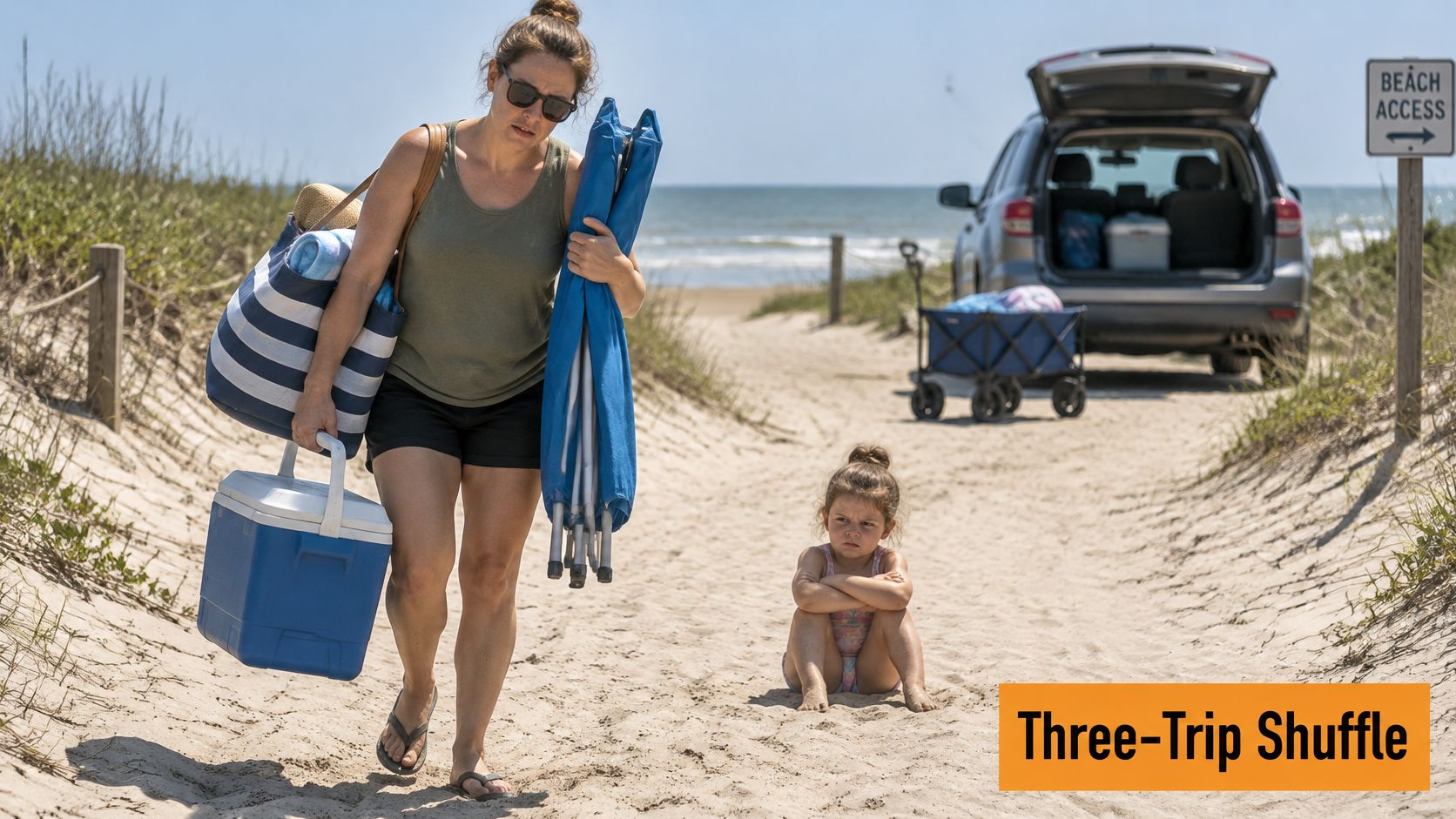
Why the Walk From the Car Wears You Out
By the second trip back to the trunk, the beach has stopped looking like a break. The umbrella keeps sliding, the cooler handle twists in your palm, and the dry bag you swore was light now bangs your shin every step. Kids get impatient in the heat. Adults start calculating which item can be abandoned without ruining the day.
The tiring part is repetition. Carry, drop, return, repack, carry again. Soft sand turns every mistake into more effort, and a badly balanced load makes even a short access path feel longer. Before you shop for a motor, count the jobs you are doing by hand.
Solve the packing problem before buying propulsion
A cart should replace armloads, not become another oversized item you struggle to manage. Start with what leaves the car: shade, refreshments, towels, toys, and somewhere to sit. Keep loose essentials together so unloading doesn't become a scavenger hunt.
For sunscreen, phones, snacks, keys and wet clothes, the guide to the best tote bags for NZ beaches helps you corral the small stuff before you choose wheels. A tote organizes the little things; the cart carries the bulky load.
If you usually handle setup by yourself, work through how to haul heavy gear to the beach alone and plan around what one adult can load, steer, unload, and return to the vehicle. My blunt advice: choose capacity and balance first. Buy assistance only when the route still defeats a well-packed load.
Practical rule: Buy for the least pleasant part of your route, not the smooth pavement beside the parking space.
Aim for fewer separate jobs
The best setup reduces jobs. A hauler that becomes stable seating can replace a pair of chairs, while powered help makes sense when the approach is long, deep, or steep enough to punish every extra pound. A badly packed pile still fails either way.
Leave the garage queen at home. Pack dense items low, keep sharp or sandy things away from towels, and make the unloading order match how you set up camp. If two people can sit when the hauling is done, you may not need a motor, extra charging habits, or another thing to rinse after salt air. You need one trip, a steady cart, and energy left for the water.
What an Electric Beach Cart Actually Is
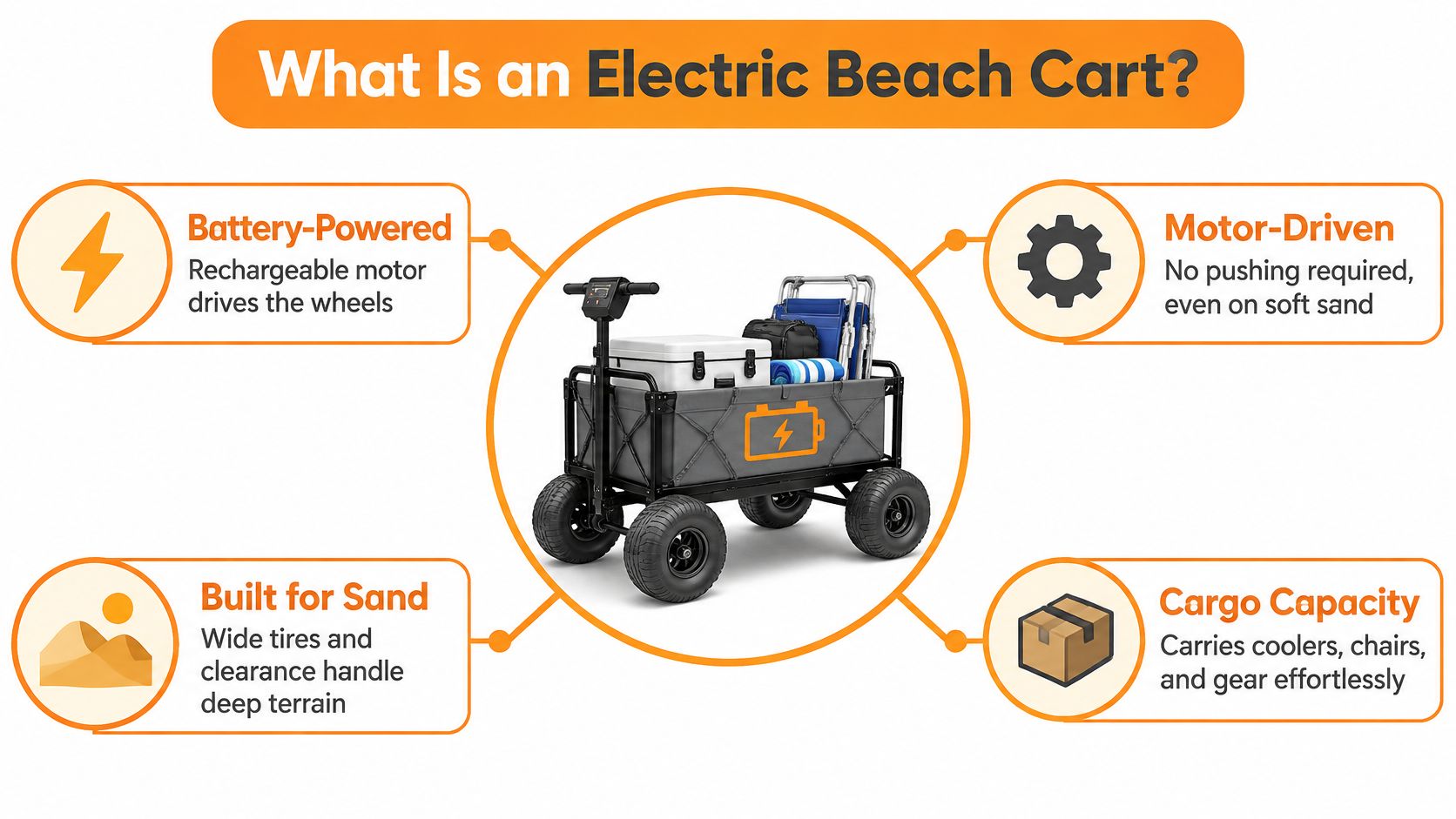
An electric beach cart uses a battery and motor-driven wheels to help move cargo over beach terrain. Unlike a folding fabric wagon, it adds a drivetrain, controls, wiring, and a charging routine. Its purpose is assistance with moving a load, not merely providing a bigger container.
Don't confuse it with a golf cart. You're shopping for equipment that must negotiate a beach access route, fit your transport arrangements, and carry the supplies you bring.
The components are straightforward once you separate their jobs.
Understand what the drivetrain does
The battery stores energy. The controller regulates how the motor delivers assistance, while the drivetrain transfers that effort to the wheels. For the owner, those components should translate into predictable starts and manageable movement, not sudden surges.
Wide, low-pressure wheels can help limit sinking, but the infographic's effortless-hauling language shouldn't replace a loaded demonstration. Ask whether the particular model uses removable batteries, what its controls require, and how it behaves when assistance stops. Don't assume every powered cart has the same equipment.
The category sits within a broader beach-cart market that one industry forecast valued at approximately USD 2.32 billion in 2024, with projected growth of about 5.5% annually; that forecast also describes a second-generation electric launch in July 2025 and a resort-focused introduction in May 2025, rather than establishing when all electric carts first appeared commercially (beach-cart market forecast).
Treat those estimates as directional. A market forecast tells you manufacturers see an opportunity; it doesn't tell you which cart will cross your beach.
Separate hauling from personal mobility
A powered cargo cart isn't automatically a mobility device. Before anyone rides, the manufacturer must explicitly authorize passenger transport and explain its operating limits.
Ask the seller to demonstrate:
Starting under load: You need controlled movement rather than a lurch.
Stopping and turning: You need to maneuver around people and beach entrances.
Unpowered recovery: You need a realistic way back if assistance fails.
Finally, define the job before comparing products: haul gear, move a person, or do both. A cart that converts into seating after arrival serves a different purpose from equipment approved to transport someone while moving.
Electric Cart vs Heavy-Duty Beach Wagon
Buy propulsion when pulling is the problem. Buy multifunctionality when separate equipment is the problem. Those are different purchases, and neither deserves an automatic recommendation.
Accessibility makes that distinction especially important. Approximately 13.7% of U.S. adults report a mobility disability, and about 3.3 million people use wheelchairs, while conventional beach wheelchairs commonly require another person's assistance (Sierra Club's beach-accessibility overview).
A manual wagon isn't an accessibility substitute because it has substantial wheels. Equally, adding a motor to a cargo platform doesn't establish that it safely transports people.
Electric beach cart vs heavy-duty wagon at a glance
Feature
Electric beach cart
Heavy-duty multifunctional wagon
Main advantage
Motor assistance with moving loads
Hauling and stationary seating in shared equipment
Weight capacity
Check the model's sand-specific rating
Check the manufacturer's rating and terrain limitations
Seating
Model-dependent; never assume passenger approval
Look for explicitly approved bench conversion
Wheel size
Evaluate width and contact area, not diameter alone
Apply the same terrain-specific scrutiny
Ownership requirements
Charging, battery inspection, drivetrain care
Frame, wheel, fabric, and hardware care
Best reason to buy
You need help moving cargo
You want fewer separate items to pack
Where each choice earns its place
An electric cart makes sense when you routinely cover a demanding route with substantial gear and can manage the battery safely. The benefit is reduced pulling effort, not permission to ignore terrain or load limits.
A heavy-duty wagon makes sense when you can handle the route manually but dislike carrying separate chairs. A reinforced steel frame provides structural support for the intended load; a padded bench provides somewhere to sit once you've unloaded. Neither feature proves effortless performance in deep sand.
The trade-offs are worth stating plainly:
Choose powered assistance: Your main obstacle is moving the load, and you've verified operation on comparable terrain.
Choose multifunctional equipment: Your main obstacle is packing a hauler plus seating into the vehicle.
Reject either option: You can't lift it into your vehicle, control it comfortably, or store it properly.
A motor solves an effort problem. A convertible bench solves an equipment problem. Buy the solution to the problem you actually have.
My recommendation is to resist upgrading merely because electric sounds premium. Pay for assistance when you need assistance. Otherwise, put your attention into handling, transport fit, seating usefulness, and a manageable load.
The Specifications That Matter on Sand
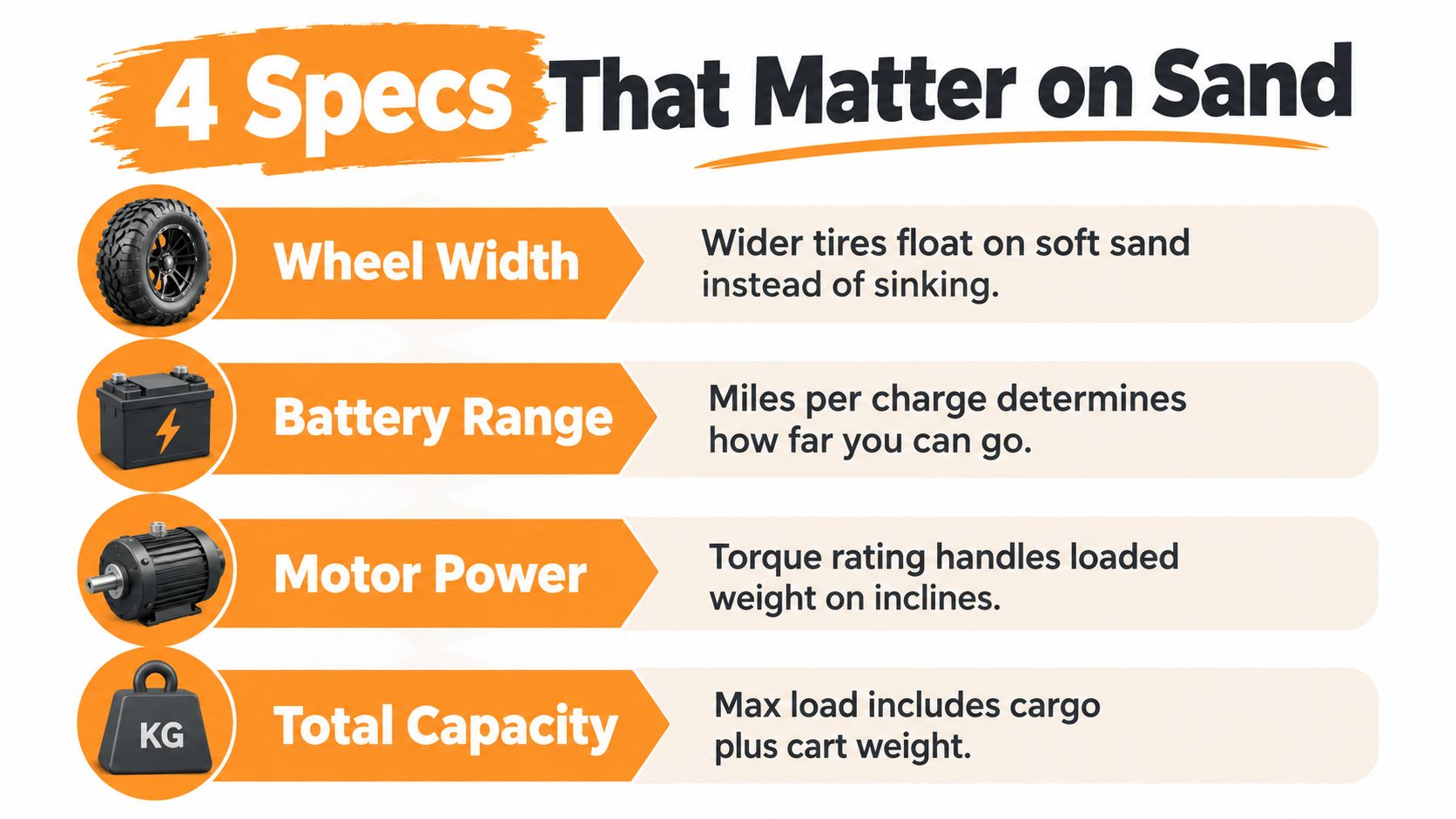
Start with sand-rated capacity, not motor wattage. A powerful motor can still struggle when the wheels dig in or the total load exceeds the manufacturer's operating assumptions.
The useful question isn't whether the cart moves unloaded on a demonstration path. It's whether it starts, turns, and stops with your equipment on terrain resembling your access route.
Read motor and battery specifications together
One documented design uses dual 350 W motors and a removable 36 V, 31.5 Ah lithium-ion battery, equivalent to approximately 1,134 Wh, alongside a 300 lb maximum recommended gross capacity (EKRTUS specifications). The dual-drive arrangement distributes propulsion across driven wheels, while the energy figure helps you understand the battery beyond an isolated amp-hour claim.
Nominal battery energy isn't a promise of usable range. Controller losses, wheel slip, slopes, and sand deformation consume energy that won't become forward travel.
Ask for range under a defined load and surface condition. A distance achieved on firm ground doesn't establish what you'll get dragging a cooler through loose sand.
Check gearing, contact area, and loaded weight
A separate powered platform lists 13-inch-wide tires, 21:1 gearing, and capacities of 400 lb on sand versus 650 lb on hard, level ground; it also specifies sealed batteries with approximately 288 Wh nominal energy and a 3–6 hour recharge time (Power Beach Platform Cart specifications). The wider footprint helps manage sinking, while reduction gearing trades speed for useful wheel torque.
That difference between surface ratings is the warning buyers should remember. A headline capacity without terrain conditions can tell you less than you think.
For any specification described as gross capacity, establish exactly what's included: cart, battery, accessories, cargo, and any authorized occupants. Don't treat a gross limit as cargo allowance.
Demand these details before paying:
Hard-ground capacity: Establish the baseline operating limit.
Sand capacity: Check the separate allowance for beach conditions.
Tire width: Evaluate the footprint that supports the load.
Maximum grade: Confirm whether your access slope is permitted.
Battery energy in Wh: Compare energy storage on consistent terms.
Recharge time: Decide whether the charging schedule fits your outings.
Review the all-terrain cart wheel guide before treating wheel diameter as a shortcut for beach capability. Puncture resistance addresses punctures; it doesn't establish flotation, traction, or low pulling effort.
Buying test: Ask the seller to show the cart carrying a representative load on representative sand. A specification sheet is a starting point, not the whole decision.
Matching the Cart to Your Beach Day
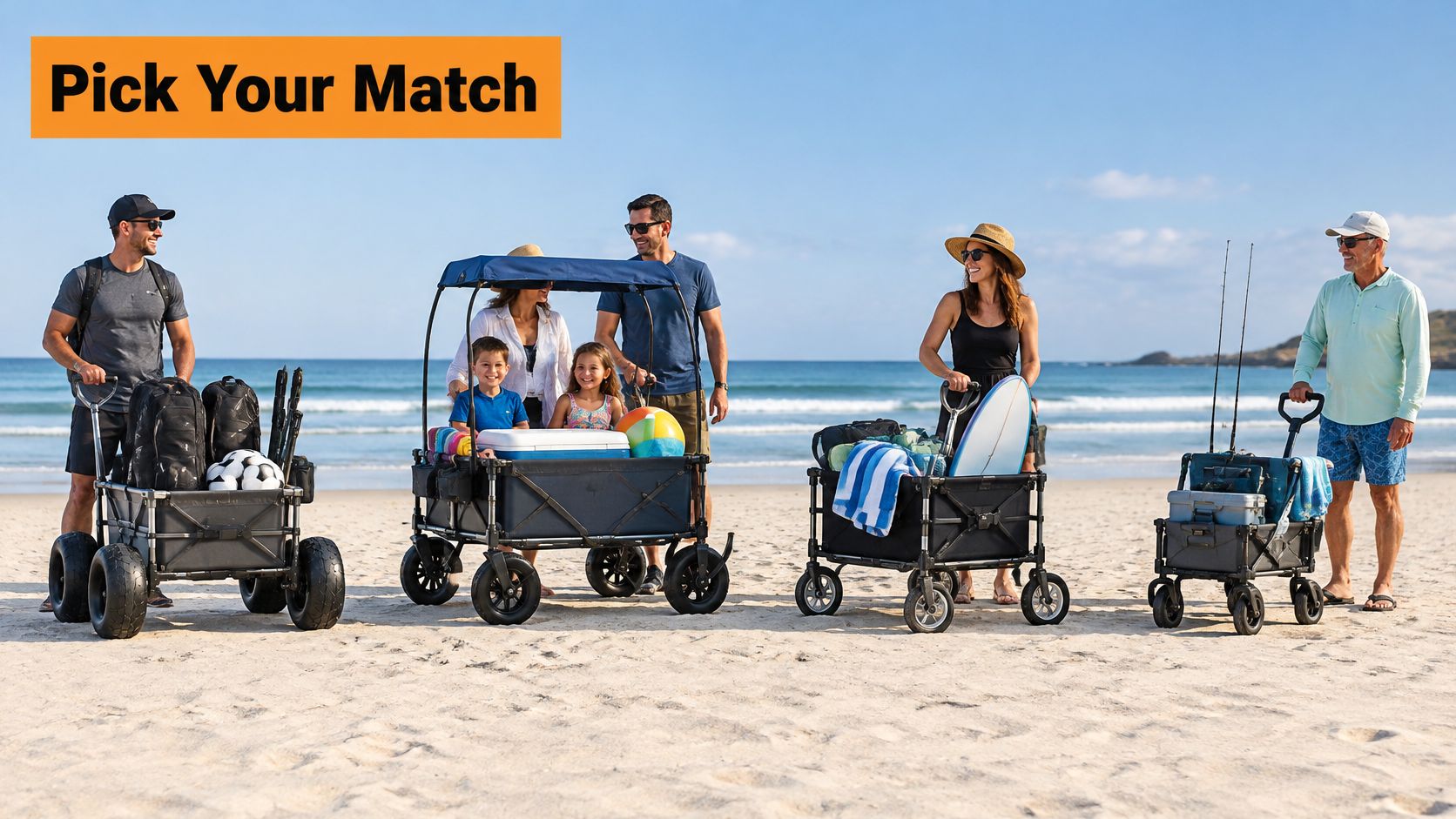
A tournament parent hauling a canopy and cooler has almost nothing in common with a shore angler walking a jetty, even though both end up shopping in the same category. Match the cart to the outing you repeat every weekend, not the ambitious trip you take once a year.
Families and people who stay awhile
Sideline Elite tournament parents should weigh seating before propulsion. If your day is one long pull in, six hours parked, and one pull out, a hauler with an approved bench conversion earns its space twice. Spend on a motor only when the walk itself is the hard part.
For Sand-Sovereign coastal families, the access route decides everything. A boardwalk that ends in a short stretch of soft sand is a manual-wagon job. A long haul through loose dunes justifies verified powered assistance. Walk your actual route before you buy anything.
Grand-Packer multigenerational travelers need the sit-down test. Watch the person who will use the bench get on and off it. If standing back up is a struggle, the convertible wagon is the wrong choice no matter how well it hauls.
For these groups, revisit the one-trip packing principles from the start of this guide before choosing a cart.
Anglers, regulars, and working crews
Front-Row Regular festival and market goers want one piece of gear that does two jobs. A multifunctional wagon replaces a cart plus separate chairs, but only if the venue permits it and the deployed footprint fits your spot.
Mobile Anglers should judge the route before the cargo deck. Long paved approaches can justify propulsion. An uneven jetty with no safe stopping space rules out both cart types, so plan to carry less or fish somewhere else.
Weekend Warrior tailgaters and campers get the most from gear that pulls double duty. When trunk space is the constraint, a hauler-and-seat beats a powered cart plus folding chairs.
Event Pro outdoor coordinators should buy for the busiest day on the calendar. Repeated heavy hauling on a schedule favors a powered platform. If your crew also needs somewhere to sit between runs, the convertible manual wagon is the smarter spend.
Before you measure any cart against your setup, count what you unload and rearrange at the far end.
Then run the decision filter:
Manageable route, shared seating needs: Choose a multifunctional manual wagon.
Demanding route, heavy solo hauling: Investigate powered assistance.
Personal mobility needs: Buy equipment explicitly approved for that purpose only.
Saltwater, Batteries, and the Maintenance Nobody Talks About
An electric beach cart isn't the simpler choice merely because it's easier to pull. You're exchanging some physical effort for equipment that requires charging, inspection, and careful treatment around water.
The safety concern is specific. Guidance published by Cocoa Beach relays the National Fire Protection Association's advice not to charge or repair submerged or visibly damaged lithium-ion batteries, alongside the U.S. Coast Guard's warning that saltwater intrusion can create an extreme fire risk (saltwater-damaged battery safety guidance).
A battery that appears dry or still operates isn't necessarily safe after exposure. Don't use a successful power-on test as permission to recharge it.
Water resistance isn't permission to enter the surf
Ask what the manufacturer's water-resistance rating covers, whether the battery enclosure is independently protected, and which cleaning procedures are allowed. Don't interpret a rating as blanket permission for saltwater immersion.
Research involving 14 people with mobility limitations identified practical beach-access constraints involving propulsion, storage, assistance, and device suitability, including difficulties using motorized equipment in wet, salty environments (beach assistive-technology research). That's a useful reminder that real independence includes getting equipment home safely, not just reaching the water.
My view is that maintenance is the most overlooked ownership cost. If you won't reliably follow the care procedure, buy less complicated equipment.
A post-trip checklist worth keeping
Follow the manufacturer's instructions first, especially after any suspected battery exposure.
Check before cleaning: Look for damage, moisture, and salt residue around connectors and the battery compartment.
Isolate normal cleaning: For an undamaged system, remove the battery only as the manufacturer directs before cleaning the cart.
Clean approved surfaces: Use fresh water only where permitted, without directing a hose into electrical parts.
Dry the compartment: Don't reinstall an undamaged battery until approved areas are fully dry.
Store correctly: Follow specified temperature, location, and charge-level guidance rather than inventing a universal storage routine.
Stop after suspected exposure: Don't charge, operate, or attempt repairs on a submerged or damaged battery; seek manufacturer and appropriate fire-safety guidance.
If a battery is hot, swelling, smoking, or otherwise reacting, keep people away and contact emergency services. Don't carry it into your vehicle or home to investigate.
For non-electrical upkeep, follow the wagon-maintenance guide. A manual cart still needs care, but it removes the battery-specific hazard and charging routine from your beach-day responsibilities.
Your One-Trip Decision Checklist
Ask what you're carrying, how difficult the route is, and whether the equipment needs to provide seating after arrival. Those answers should decide the purchase before advertised range or appearance enters the conversation.
Don't buy more capacity than you can sensibly handle. Even within a manufacturer's rating, a loaded cart must remain manageable for the person steering it.
Check before you purchase
Rated sand capacity: Look for terrain-specific limits, not a single headline claim.
Tire width: Ask how the footprint performs under a representative load.
Battery energy and water protection: Understand both the energy specification and the stated exposure limits.
Frame material: Check construction, protective finishes, and required care.
Gross payload definition: Establish precisely which weights count toward the limit.
Recharge time: Include charging and safe storage in your ownership plan.
Seating approval: Distinguish stationary bench use from permission to carry passengers.
Use the family beach-trip guide to build a load around the people coming, rather than packing every outdoor item you own.
Pack for the day you'll actually have
Keep the essentials organized and accessible:
Shade: Your umbrella or other permitted shelter.
Cooler: Refreshments packed securely.
Towels: Together in a manageable bag.
Seating plan: Chairs or an approved cart-to-bench alternative.
Water: Accessible without unpacking the whole load.
Sun protection: Where you can reach it throughout the day.
Dry bag: For belongings you need to protect.
My recommendation is straightforward. Choose a multifunctional manual wagon when hauling and stationary seating are the priorities and you want to avoid battery-specific maintenance. Choose an electric beach cart when verified motor assistance solves a genuine route-and-load problem.
Stop carrying a hauler and separate seating when one setup can do both. Lounge Wagon offers a reinforced steel gear hauler that converts into a padded bench, giving you an alternative to powered equipment when multifunctionality matters more than propulsion. Visit Lounge Wagon to explore the hauler-and-seat setup and make your next walk to the shore a one-trip plan.
Choosing a selection results in a full page refresh.
This pad is perfect for kids or dogs to be comfortable inside the moving wagon, and very nice after you set everything up and want to sit for extra padding.
Having the umbrella this summer has been easy to use and a must to make sitting and watching the parade so nice when there isn't any shade. My dogs laid on the wagon padding and enjoyed the day without getting too hot. I enjoyed the shade too.