TL;DR: The right all-terrain cart wheels for sand need more than diameter. Choose a wide, low-pressure or puncture-proof design with enough contact area to reduce sinkage, then verify axle diameter, hub width, load rating, and frame clearance before installation. For mixed beach, grass, gravel, and sports-field use, match the wheel system to the route.
Proven All Terrain Cart Wheels Guide for Choosing and Installing
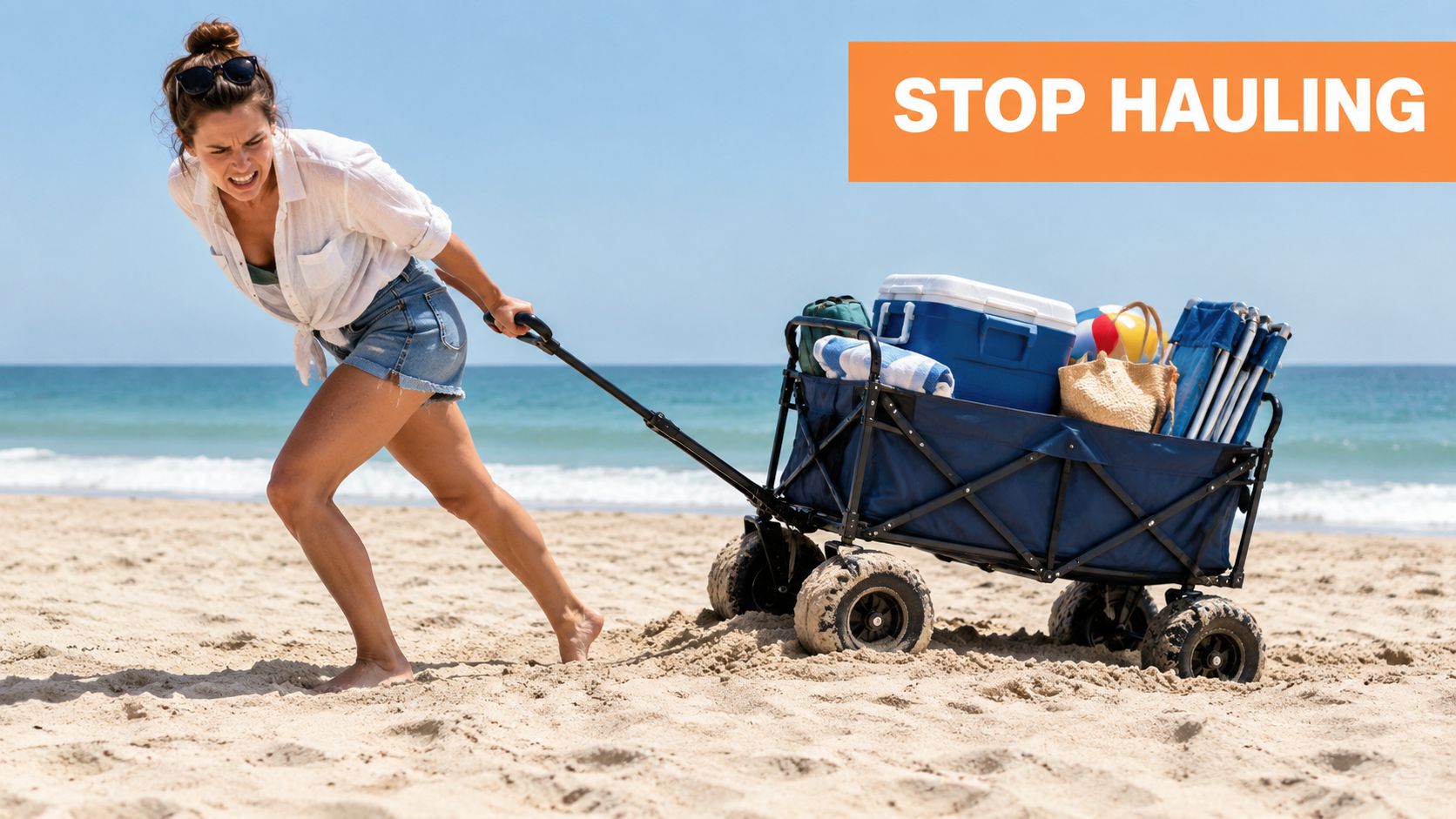
The exhausting three-trip walk from the car to the beach starts with a familiar mistake. The wagon looks capable in the parking lot, but its narrow wheels bury themselves as soon as they reach loose sand, leaving the cooler, chairs, towels, and toys stranded halfway to the shoreline. By the time everything arrives, the morning already feels like work.
The same problem appears at youth soccer complexes and festival grounds. Small hard wheels catch on grass edges, gravel, and uneven pavement, forcing you to pull harder while the cart wanders under an uneven load. A properly matched wheel system can turn that struggle into a practical one-trip haul, especially when the wagon also provides seating.
The Lounge Wagon combines a reinforced frame, 1000D Polyester, powder-coated steel, a 500 lb capacity, and 2-in-1 seating that converts the gear hauler into a double-seater bench. You can view the Beach Day Bundle when your route includes sand, grass, and parking lots.
Last Updated: May 2026
Stop Hauling and Start Lounging With the Right Wheels
Why the first pull tells you everything
In our testing across Florida beach access points and crowded sports complexes, the first few yards reveal whether a cart is all-terrain or fitted with larger-looking casters. A narrow wheel cuts into dry sand, while a wider wheel spreads the load and keeps more of the tire on the surface. That difference determines whether you glide forward or repeatedly stop to yank the wagon free.
The underlying idea goes back to the evolution of pneumatic tires. Scottish inventor Robert William Thomson patented the pneumatic tire in 1845 to reduce drawing force, improve motion, and cut noise, while John Boyd Dunlop later popularized pneumatic tires in 1888, first for bicycles, as described in this history of tire technology. Modern all-terrain cart wheels apply the same basic logic through air-filled or low-pressure construction, larger contact patches, and lower rolling resistance on uneven ground.
A cart designed for a 500 lb capacity also needs wheels that can manage concentrated loads without collapsing into soft ground. That's where 2-in-1 seating becomes useful rather than decorative. The wagon carries the cooler, team bags, shade tent, and beach gear, then gives two adults a place to sit without adding separate chairs.
Field rule: Buy for the surface that causes the most trouble, not the surface that looks easiest in a product photo.
The mixed-use wagon advantage
A deep-sand specialist can be excellent at flotation but awkward on hard paths. A standard utility wagon may roll well across pavement and fail as soon as it reaches loose beach sand. Mixed-use hauling calls for a balance of width, construction, axle strength, and frame clearance.
For shoppers comparing cart hardware more broadly, Solana EV's complete wheel guide for golf carts is a useful reference for understanding how wheel dimensions and fitment affect handling. The same principle applies here. Wheel choice isn't just a terrain label. It's an engineering decision involving the surface, the load, and the hardware holding everything together.
How All Terrain Cart Wheels Work on Sand Grass and Gravel
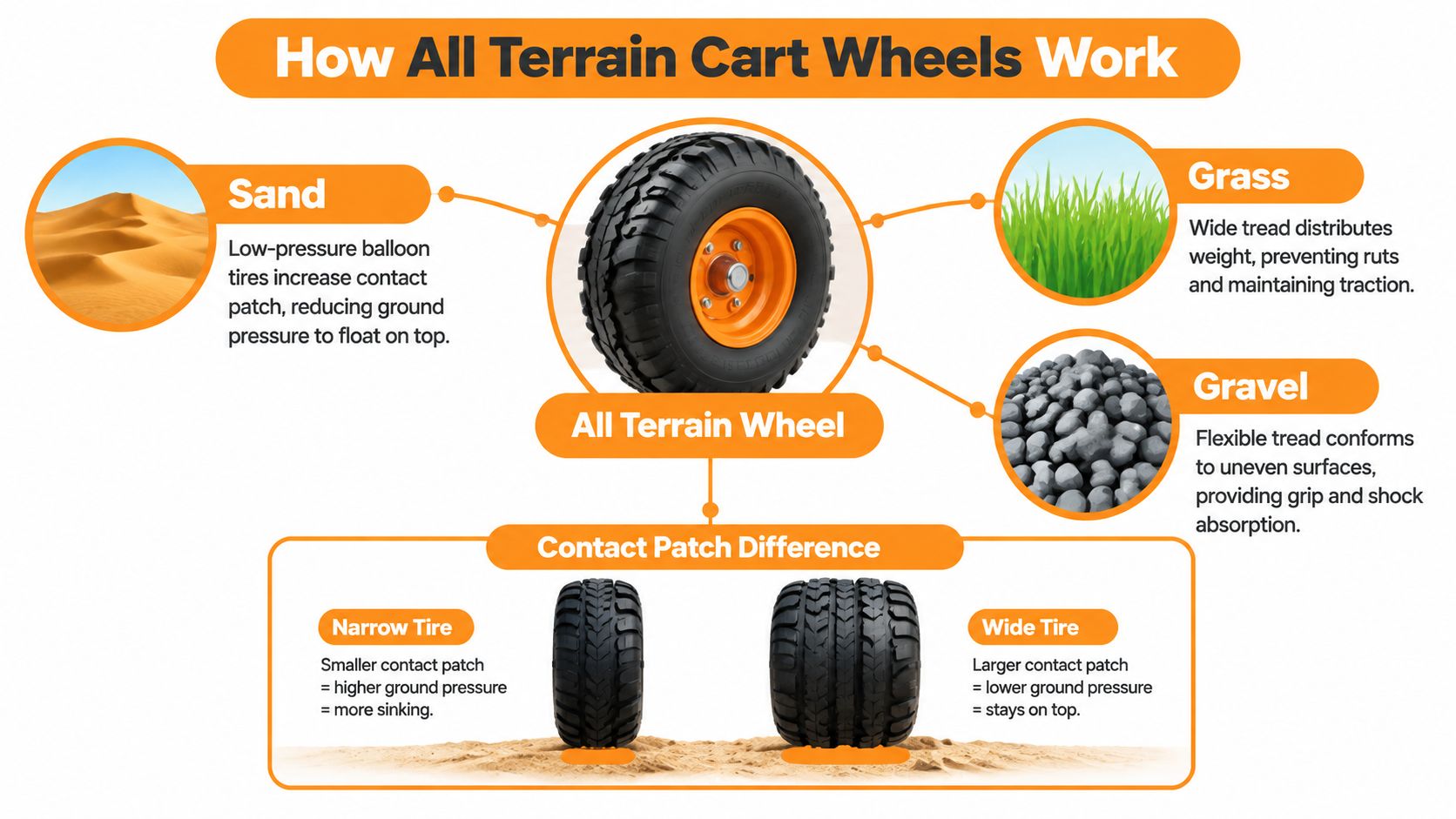
A wheel rolls efficiently when it keeps its contact with the surface without forcing the ground to absorb more pressure than it can support. On pavement, the ground barely deforms. On loose sand, the wheel sinks, pushes sand forward, and creates a trench that increases resistance with every foot.
Air-filled and low-pressure wheels address that problem by increasing contact area. Ground pressure equals load divided by contact area, so a larger footprint distributes the same cargo over more sand. An engineering lecture on pneumatic-wheel rolling resistance explains that lowering inflation pressure increases contact area and reduces compaction resistance on soft ground (engineering lecture on pneumatic wheels).
Sand rewards flotation
Diameter helps a wheel climb over small ruts and uneven transitions, but diameter alone doesn't guarantee sand performance. A 10-inch wheel with a narrow, rigid profile can still sink because its contact patch remains too small. Width and operating pressure often determine whether the wheel floats or plows.
For soft-sand use, common upgrade sizes include 24 cm and 30 cm, roughly 9.4 inches and 11.8 inches, while larger 42 x 20 cm wheels, roughly 16.5 x 7.9 inches, target especially difficult sand conditions (beach-cart wheel comparisons). Practical buying guidance identifies 9 to 12 inch low-pressure balloon wheels as a useful range for soft sand. Wheels from 7 to 8 inches are more suitable for firm packed sand, while anything under 7 inches tends to sink in dry sand.
Grass and gravel need control
Grass favors a wheel that spreads weight without tearing ruts. A broad tread can maintain traction while keeping the wagon from sinking into damp or soft turf, which matters at soccer complexes where narrow wheels leave deep tracks.
Gravel calls for a different balance. A flexible or air-filled tire can conform to uneven stones and reduce vibration through the handle, while an overly soft tire may feel vague under a heavy, uneven load. When comparing all-terrain trailer wheels, pay attention to the complete wheel system rather than tread appearance alone.
For more examples of how wheel diameter changes cart behavior, see carts with big wheels. The useful takeaway is simple. Sand needs flotation, grass needs distribution, and gravel needs compliance and control.
Choosing the Right Tire Type and Size for Your Wagon
The best wheel depends on the route and the kind of maintenance you'll tolerate. Pneumatic, balloon, solid puncture-proof, and plastic caster wheels each solve a different problem.
Compare the main wheel types
Tire Type
Best Terrain
Key Benefit
Pneumatic air-filled
Grass, packed dirt, uneven paths
Cushions bumps and allows pressure tuning
Low-pressure balloon
Loose beach sand
Creates a broad contact patch for flotation
Solid puncture-proof
Mixed sand, grass, gravel, pavement
Removes flat-tire risk and simplifies upkeep
Hard plastic caster
Smooth indoor or paved surfaces
Low cost and basic durability on flat ground
Pneumatic tires provide a smoother ride because air absorbs surface changes. They can work well on grass and hardpack, but punctures and pressure checks become part of ownership.
Balloon tires are the sand specialists. Their wide, low-pressure profile reduces ground pressure, so they're less likely to dig into dry beach sand. The trade-off is bulk and less precise handling on hard surfaces, particularly with an uneven load.
Solid puncture-proof tires make sense for families and event crews that cross several surfaces in one outing. They don't offer the same flotation as oversized balloon wheels, but they remove a common failure point and stay ready after rolling over gravel or pavement debris.
Plastic casters belong on smooth paths. Standard 5- to 7-inch plastic wheels are generally inadequate for soft sand, while 9-inch-or-larger balloon or pneumatic designs are the practical beach choice, according to independent beach-wagon guidance (beach wagon wheel guidance).
A practical size decision
For soft, loose beach sand, multiple guides identify about 9 inches as a practical minimum, with 9 to 12 inches often described as an effective range (soft-sand beach wagon guidance). Larger wheels can improve obstacle clearance and reduce the stop-start feeling, but a wide contact patch still matters. That's why some narrow 10-inch wheels perform worse than a smaller but broader low-pressure tire.
The Lounge Wagon uses 10-inch puncture-proof wheels and lists a 500 lb capacity, while its 2-in-1 seating converts the wagon into a bench for two adults. That setup targets mixed-use hauling, where a family may cross sand, grass, gravel, and pavement during the same day. You can compare the wheel approach in the guide to tires for a wagon.
Before buying, check:
Diameter: Confirm the full outside diameter, not just the rim size.
Width: Measure the tire at its widest point because width controls sand contact.
Axle and hub: Match the bore, hub width, and axle diameter.
Clearance: Make sure the tire won't rub the frame during turns or compression.
Load rating: Confirm the wheel and axle can support the intended cargo together.
How to Measure Wheels and Check Axle Compatibility Before You Buy
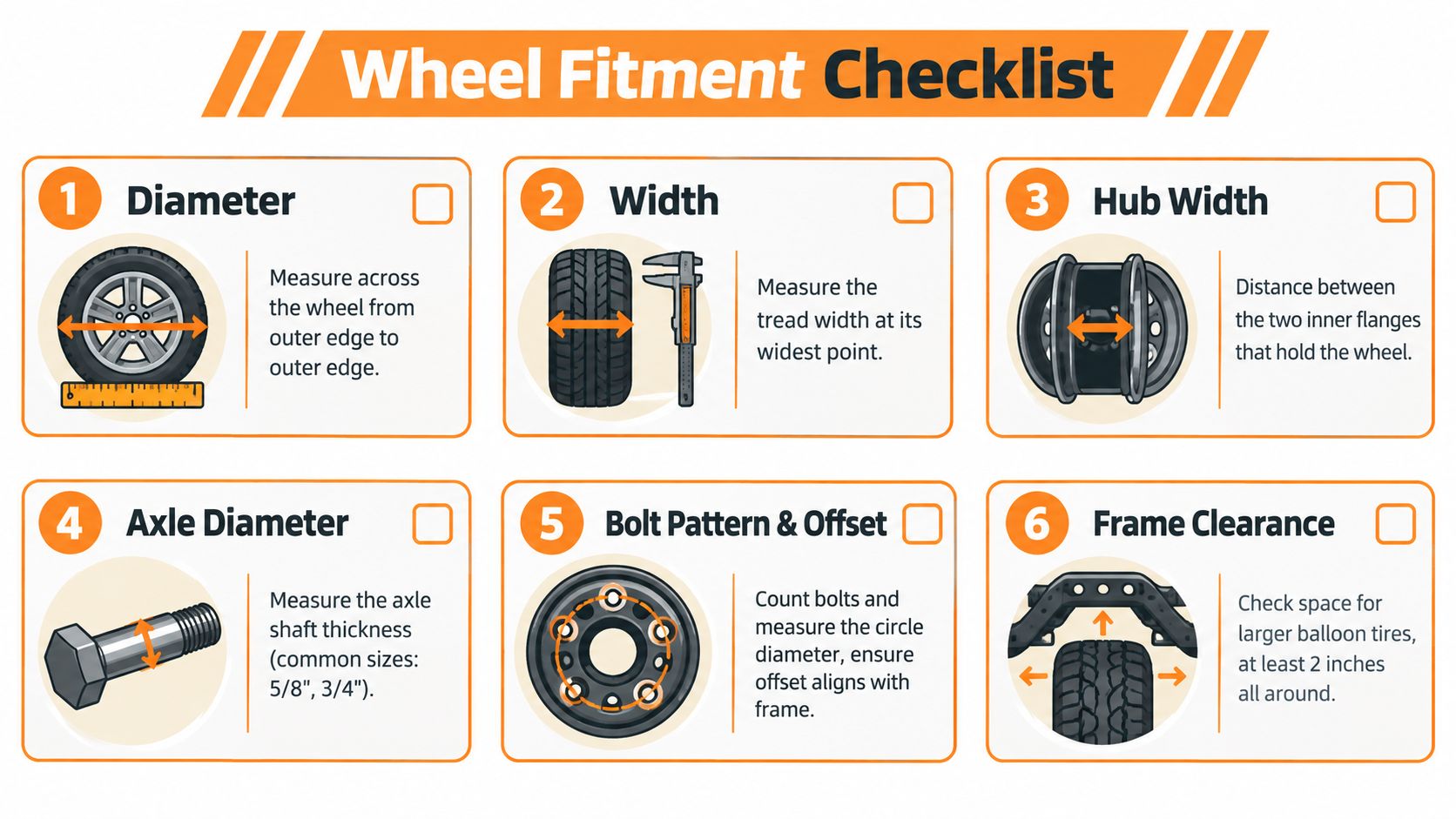
Wheel replacement fails most often because the buyer measures only diameter. A wheel can look correct and still wobble, bind, rub the frame, or refuse to fit because the hub width or axle bore is wrong.
Measure the wheel and mounting hardware
Remove the existing wheel if possible, then record each dimension before ordering. A tape measure works for diameter and width, while calipers make axle and hub measurements more reliable.
Diameter: Measure from one outside edge across the wheel to the opposite outside edge.
Width: Measure the tire at its widest point, not just the visible tread.
Hub width: Measure the distance between the inner flanges that sit against the cart.
Axle diameter: Measure the axle shaft thickness where the wheel rides.
Bolt pattern: Count the bolts and measure the circle they occupy if the wheel uses a bolted mount.
Offset: Check how far the wheel's centerline sits from the mounting face.
Frame clearance: Turn the wheel through its full travel and check for rubbing.
Larger balloon wheels need special attention around the frame. A wheel can clear the stationary bracket and still contact the side rail when the wagon turns or carries a heavy load.
Axle standard: Many all-terrain wheels use 1-inch axle compatibility, while heavy loads of 400+ lb generally call for 12-inch-plus tires, sealed bearings, and at least a 3/4-inch axle, according to current fitment guidance (all-terrain caster and load guidance).
Check rating before installation
A wheel rating isn't the same as the cart's total capacity. The full system includes the wheel, bearing, axle, frame, and load distribution. One supplier lists a 297 lb rating per wheel for an all-terrain caster (caster load-rating reference), but you still need to confirm that the cart frame and axle can safely carry the intended load.
Compare the replacement wheel with the original hardware, then inspect the axle for bends, corrosion, burrs, or flattened ends. If the shaft is damaged, a new wheel won't correct wobble or uneven tracking.
This folding cart wheel guide is useful when deciding whether a replacement is worthwhile or whether the cart's frame and mounting system are the limitation.
For a visual walkthrough before you remove anything, use this wheel-installation reference:
Installing and Maintaining Your All Terrain Wheels for Long Life
Installation should leave the wheel centered, secure, and free-spinning. Work on a flat surface, remove loose cargo, and stabilize the wagon before lifting an axle. If the frame isn't stable, don't rely on the wheel or handle to hold it in place.
Replace the wheel safely
Use a suitable jack or support under the frame, not a thin axle component. Lift only enough to remove weight from the wheel, then secure the cart so it can't shift.
Remove the cotter pin, washer, push cap, or retaining nut and keep the parts in their original order. Slide the old wheel off slowly, because bearings, spacers, or washers may remain on the axle. Inspect those parts before installing the replacement.
Clean the axle with a rag and remove sand or corrosion. Seat the new bearing or hub fully against the mounting surface, slide the wheel into place, reinstall the washers and retainer, and tighten the hardware without crushing the bearing. The wheel should spin freely with minimal side play.
For general tire-handling context, these e-bike scooter tire installation tips provide a useful reminder that seating and alignment matter as much as the tire itself.
Tune pressure for the surface
Low pressure can increase the contact patch and reduce sinkage on soft ground, but pressure must remain within the wheel maker's safe operating range. A sand test found motion resistance increased by 49% when inflation pressure rose by 58% under a constant 6 kN load, showing why pressure changes can materially affect soft-ground performance (soft-soil tire testing).
Solid puncture-proof wheels remove this pressure-management task. That's one reason they suit families using the wagon weekly across Florida sand, grass fields, gravel lots, and pavement.
Keep sand and salt from shortening wheel life
Rinse the wheels and axle area after beach use, then let everything dry before storage. Fine sand acts as an abrasive around bearings and retainers, while salt can accelerate corrosion on exposed metal.
Use this wagon maintenance guide as a routine reference, and check the following before regular trips:
Wheel rotation: Spin each wheel and listen for grinding or scraping.
Bearing condition: Replace bearings that feel rough, loose, or contaminated.
Hardware security: Check cotter pins, washers, nuts, and axle retainers.
Tire condition: Look for cuts, deformation, uneven wear, or embedded debris.
Storage position: Keep the cart dry and out of prolonged direct sun.
Troubleshooting Common Problems and Your One Trip Upgrade
A wagon that sinks, wobbles, rubs, or pulls to one side usually gives you a useful clue. Diagnose the wheel system before replacing random parts.
When the cart behaves badly
Sinking in dry sand usually means the contact patch is too small, the wheel pressure is too high, or the load is concentrated over one axle. A wider low-pressure tire can reduce ground pressure, while a narrow hard wheel tends to dig and plow. If the cart must cross deep loose sand regularly, consider a sand-wheel bundle rather than relying on diameter alone.
Wobble at the hub points toward an incorrect axle bore, excessive hub clearance, worn bearings, or missing washers. Remove the wheel and compare the hub width and axle diameter with the original measurements.
Rubbing against the frame often follows a size upgrade without a clearance check. Confirm the wheel's full width, offset, and turning path before using the cart under load.
Pulling to one side can come from uneven packing, a bent axle, mismatched tire pressure, or one worn bearing. Load dense items low and near the center, then inspect both sides for equal wear and alignment.
If punctures are the recurring problem, review the differences in puncture-proof wheels before choosing another air-filled setup.
The practical upgrade
For mixed routes, the Lounge Wagon offers a 500 lb capacity, 10-inch puncture-proof wheels, and 2-in-1 seating that turns the hauler into a double-seater bench. That combination doesn't replace a dedicated balloon-wheel cart in the loosest sand, but it addresses the broader routine of beach access, sports complexes, grass, gravel, and pavement without requiring separate chairs.
Ready to stop hauling and start lounging? Visit Lounge Wagon to choose a 500 lb, 2-in-1 gear hauler with all-terrain wheels, then make your next beach or sideline trip a one-trip walk.
Choosing a selection results in a full page refresh.
This pad is perfect for kids or dogs to be comfortable inside the moving wagon, and very nice after you set everything up and want to sit for extra padding.
Having the umbrella this summer has been easy to use and a must to make sitting and watching the parade so nice when there isn't any shade. My dogs laid on the wagon padding and enjoyed the day without getting too hot. I enjoyed the shade too.