TL;DR: Wagon big wheels can make outdoor hauling easier because a larger diameter clears ruts and small obstacles more readily. Diameter alone won't carry a loaded wagon over deep, dry sand. Match wheel width, tread, and tire compliance to the route, keep heavy cargo low, and treat a 500 lb capacity as a frame rating, not a promise of effortless pulling.
Last Updated: October 2026
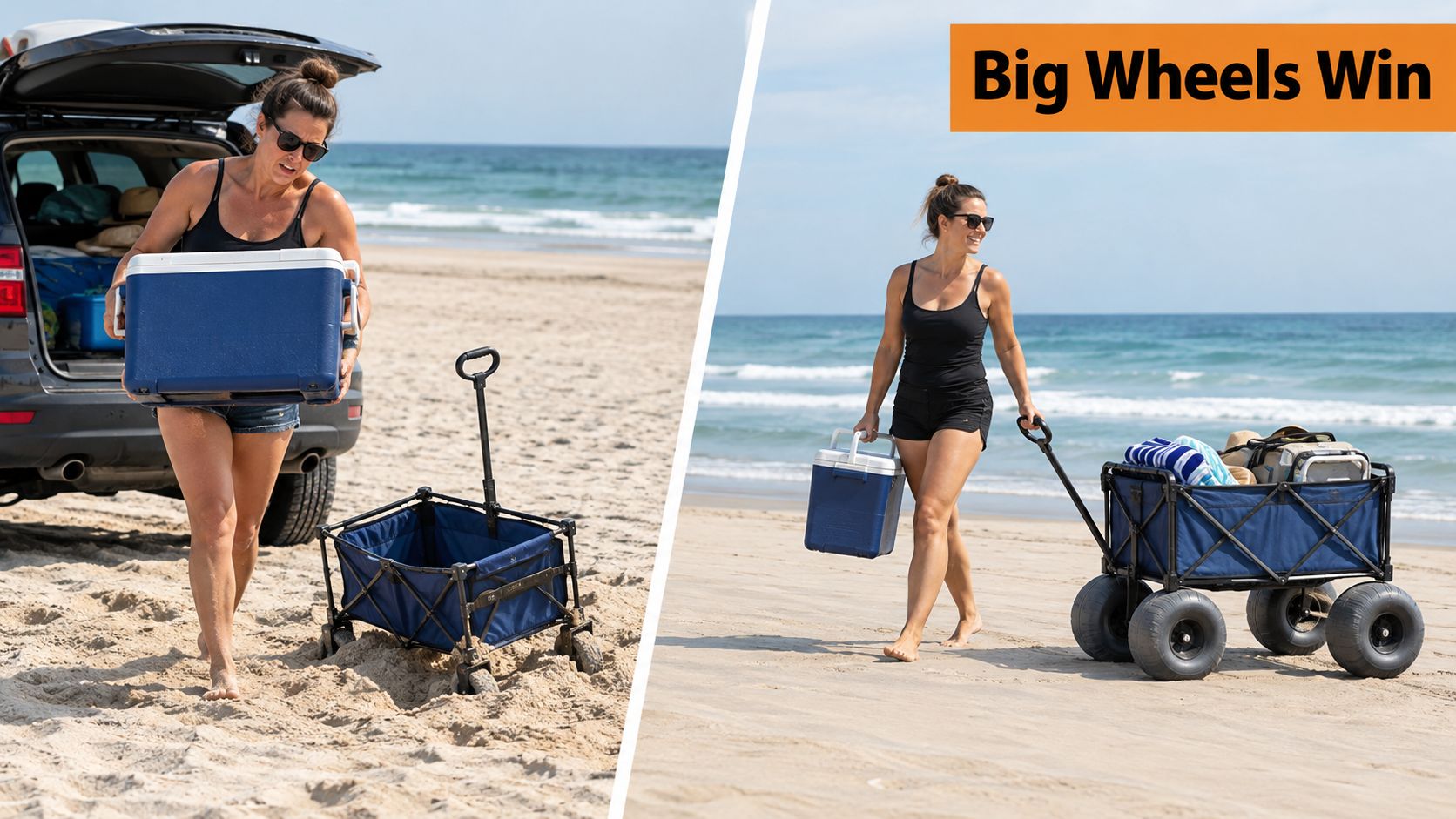
The cooler is packed, the chairs are awkward, and the beach or sideline is still a long walk from the car. One trip for bulky gear can become two, and the day starts with more carrying than you planned. A wagon can reduce that load, but wheel design matters: diameter helps with obstacles, while width, tread, and tire compliance affect how the wheels behave on sand, grass, and gravel. Wider wheels can help on soft sand, though they may feel less nimble on firmer ground.
The Lounge Wagon pairs a gear-hauling frame with 2-in-1 seating for two adults. Its listed features include 10-inch puncture-proof wheels and a 500 lb capacity. Those specifications describe the design, not how easily every load will roll across every surface. A frame rating does not account for the extra effort that soft sand, slopes, or a heavy load can demand.
Why Big Wheels on a Wagon Matter in the First Place
Small wheels can turn an ordinary walk from the car into a stop-start struggle. On grass, a rut can catch the wheel; on a rough path, a stone can halt it; on sand, a loaded wagon may drag rather than roll. By the time you reach the sideline or shoreline, the gear has arrived, but the day already feels like work.
Oversized wheels have served a practical purpose in hauling for centuries. During the 1847 Mormon migration, William Clayton used a rear wagon wheel measuring 14 feet 8 inches in circumference and about 4 feet 8 inches high. The wheel was unusually large, while an average wagon wheel was probably nearly a foot shorter. Larger wheels helped wagons pass over ruts and obstacles because each obstacle took up a smaller share of the wheel's diameter. American Heritage's account of the prairie schooner also describes a steering trade-off: smaller front wheels helped a wagon turn, while larger rear wheels supported travel over rough ground.
That same principle matters on a modern utility wagon, though the scale and job are different. A larger wheel is an engineering choice that can improve obstacle clearance, not a decorative upgrade or a promise that every surface will feel smooth.
The Conestoga wagon shows how wheel design balanced cargo and steering. National Park Service historical material describes a wagon that could carry up to 8 tons, or 16,000 pounds, with front wheels about 3 feet 6 inches in diameter and rear wheels about 4 feet 8 inches. The National Park Service material on the Conestoga wagon notes that the smaller front wheels allowed turning, while larger rear wheels helped move heavy cargo over uneven roads.
For today's beach trips, tournament fields, and festival paths, the useful takeaway is straightforward: wheel size matters because the ground pushes back. A wagon with 10-inch wheels can be a capable mixed-terrain hauler, but the design only earns its keep when the rest of the setup suits the route.
How Wagon Big Wheels Actually Roll
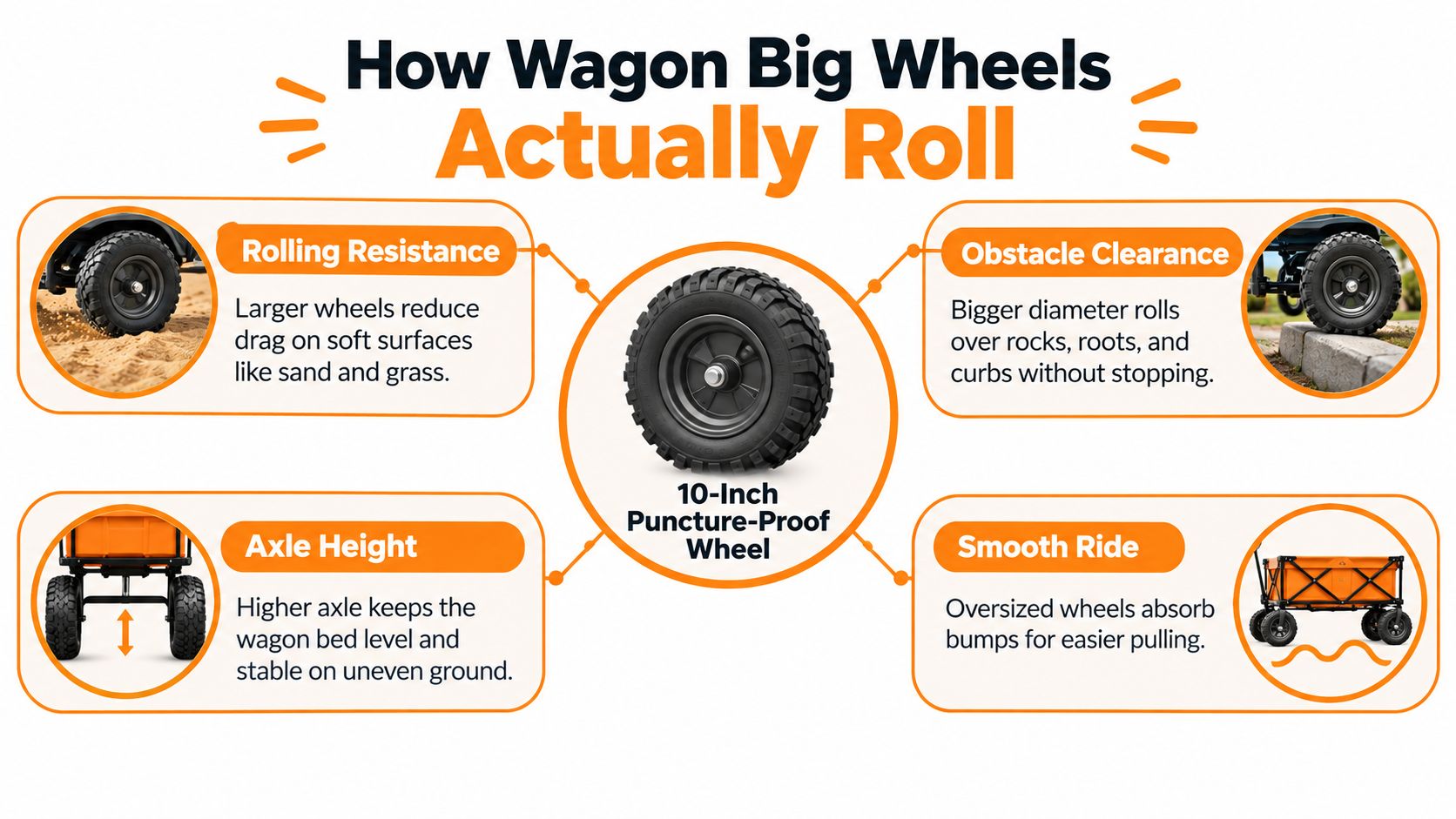
A larger wheel handles small obstacles differently from a small one. It reaches a rut edge or root at a shallower angle, so the wagon doesn't have to climb as abruptly. An engineering review from the World Bank on rolling resistance describes rolling resistance as inversely proportional to wheel diameter and notes that larger wheels can overcome small obstacles more easily on rough ground.
A 10-inch puncture-proof wheel can therefore help a wagon move across ordinary outdoor irregularities, including grass, gravel, and compacted paths. Puncture resistance also means less worry about a sharp piece of debris stopping the trip. Neither feature eliminates the effort of moving a heavy load, and neither makes a narrow wheel ideal for loose sand.
Diameter and axle height
Diameter is only part of the geometry. Raising the axle can provide ground clearance, but an excessively high axle can raise the load's center of gravity and make the wagon less stable. A low, wide chassis helps keep the load grounded; a well-supported axle and handle aligned with the wagon's centerline can also make pulling feel more controlled.
On a grass field, a larger wheel may roll over small dips that would interrupt a compact wheel. On gravel, clearance helps with scattered stones, while the wheel's material and tread still affect grip and feel. On packed beach sand, diameter can help the wagon keep moving, but loose, dry sand brings a different problem: the wheel may sink.
Practical rule: Treat diameter as an obstacle-clearance feature. Stability, load placement, wheel width, and the surface determine how manageable the wagon feels.
Matching Wheel Design to the Terrain You Actually Use
The phrase “all-terrain” doesn't tell you how a wheel will behave on soft sand. Diameter helps with obstacles; width affects the footprint; tread affects grip; and tire compliance influences how the wheel meets the ground. Each has a role, and none can compensate for every weakness in the others.
A puncture-proof wheel may suit a mixed route where gravel, grass, and pavement all feature. But a 10-inch wheel isn't automatically the answer to deep, dry beach sand. Wider wheels can spread the load, while very soft sand may call for balloon-style tires wider than an ordinary all-terrain wheel. Rubber generally grips better than plastic, but a better grip doesn't necessarily stop a narrow wheel from sinking. For more on planning the pulling effort around your route, see how to pull a wagon.
How wheel design performs across common outdoor terrains
Terrain
Diameter Matters
Width Matters
Tread Matters
Best Load Strategy
Packed beach
Helps roll over shallow ruts and uneven patches
Moderate width can balance flotation and portability
Useful for grip where sand meets a firmer path
Keep the load balanced and avoid unnecessary cargo
Dry upper beach
Helps with clearance, but can't prevent sinking by itself
A wider footprint is more forgiving than a narrow wheel
Supports traction but doesn't replace width
Reduce cargo; use a second person if the wagon bogs down
Grass
Larger wheels can move through ordinary surface irregularities more readily
Width may help spread the load on soft ground
Useful on uneven or damp patches
Put the heaviest gear low and avoid overloading
Gravel
Diameter helps roll across small stones and rough patches
Width can improve stability, depending on the wagon
Helpful when the surface is loose
Keep cargo from shifting and pull at a controlled pace
Pavement changes the equation. The obstacle-clearance advantage matters less on smooth, hard ground, so a larger wheel doesn't automatically produce an easier pull there. A good mixed-surface wheel is a compromise: convenient on firm paths, capable over common outdoor bumps, and not necessarily the best choice for deep sand.
The practical test is simple. Ask whether your route is mostly packed ground or loose sand, then consider the loaded wagon, not just its empty wheels. A large, puncture-proof wheel is a useful generalist; deep sand plus a full cooler may still call for a lighter load or another pair of hands.
What a 500 lb Capacity Really Means on a Hill
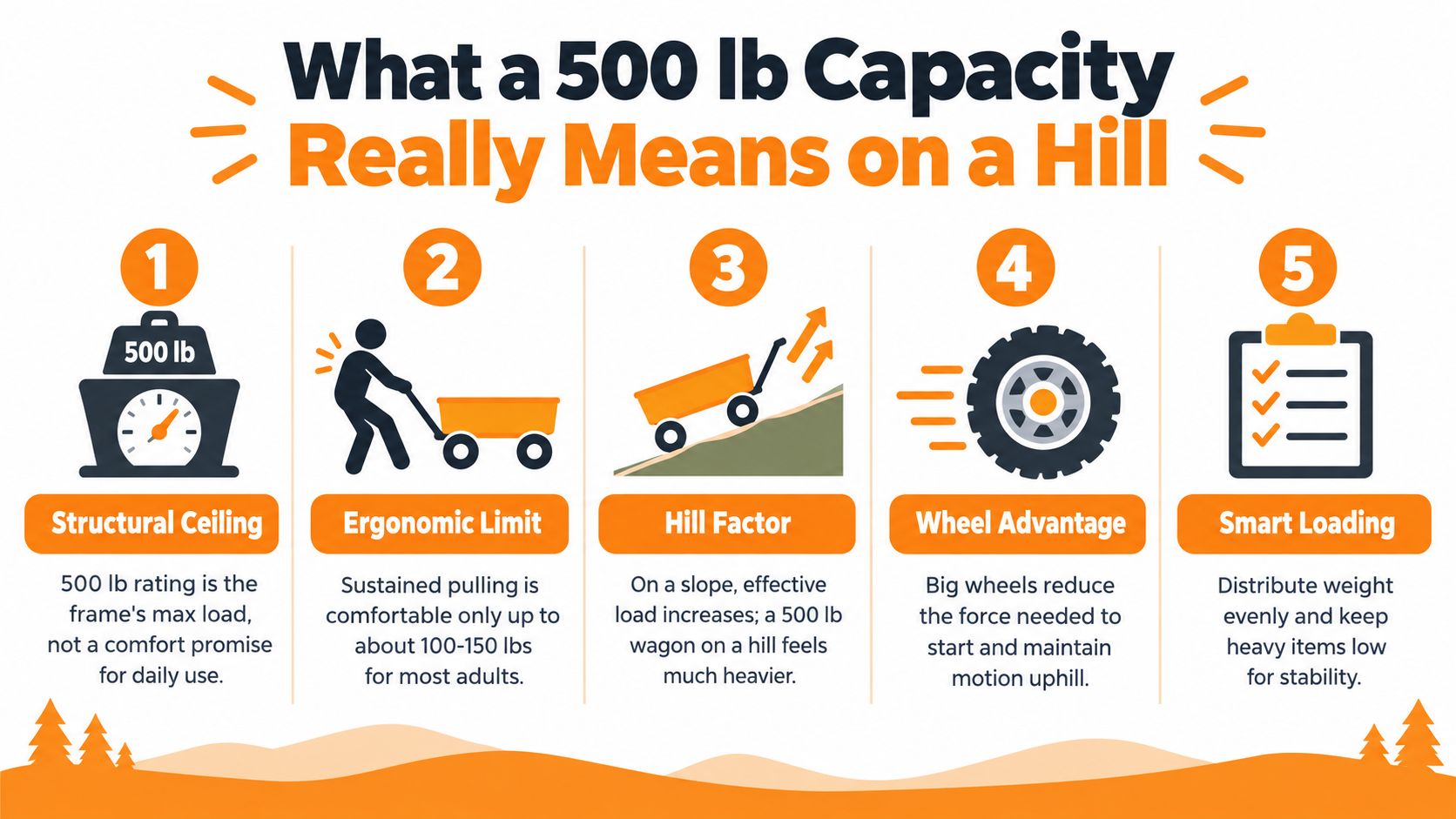
A 500 lb capacity tells you what a frame is rated to carry, not how comfortable the wagon will be to pull at that load. A level path, a hill, and loose sand all ask different things of the wheels and the person handling the wagon. The same cargo can feel manageable on firm ground and stubborn on a slope.
Manual-cart guidance helps put the human side of capacity in perspective. The Canadian Centre for Occupational Health and Safety's cart-handling guidance gives recommended maximum forces for starting and sustaining movement, and cites a practical upper load of 200 kg, approximately 450 lb, for three- and four-wheel hand carts. Those figures aren't a personal limit for every user or a rating for a particular wagon. They do underline why a high frame capacity doesn't erase the effort involved in moving a loaded cart.
Check the load before you set out
Match cargo to the surface. A load that rolls on firm grass may take more effort across gravel or sand.
Keep heavy items low. A low, evenly distributed load helps avoid a top-heavy feel, especially when the route changes slope.
Lighten the wagon when it bogs down. Remove nonessential gear before adding more pulling force.
Ask for help when the terrain demands it. A second person can help manage a stubborn load or a difficult stretch.
Choose a route you can control. Don't treat a wheel upgrade as a reason to push a loaded wagon over stairs or difficult level changes. Ergonomics guidance from EHS Today on cart selection and handling discusses wheel, handle, and surface considerations and recommends ramps rather than pushing carts over curbs or stairs.
A handle's position also affects how your body works. Treston's mobile-ergonomics guidance explains that pulling a lighter cart with arms extended can create more compressive force on the lower back than pushing a heavier cart with the arms closer to the body. Rolling cargo can reduce repeated lifting, but it doesn't remove the need for a comfortable posture and controlled force.
For a closer look at interpreting a rating, use Lounge Wagon's guide to wagon towing capacity. Before each trip, judge the load by the toughest part of the route, not the capacity printed on the listing.
Real Scenes Where Big Wheels Earn Their Keep
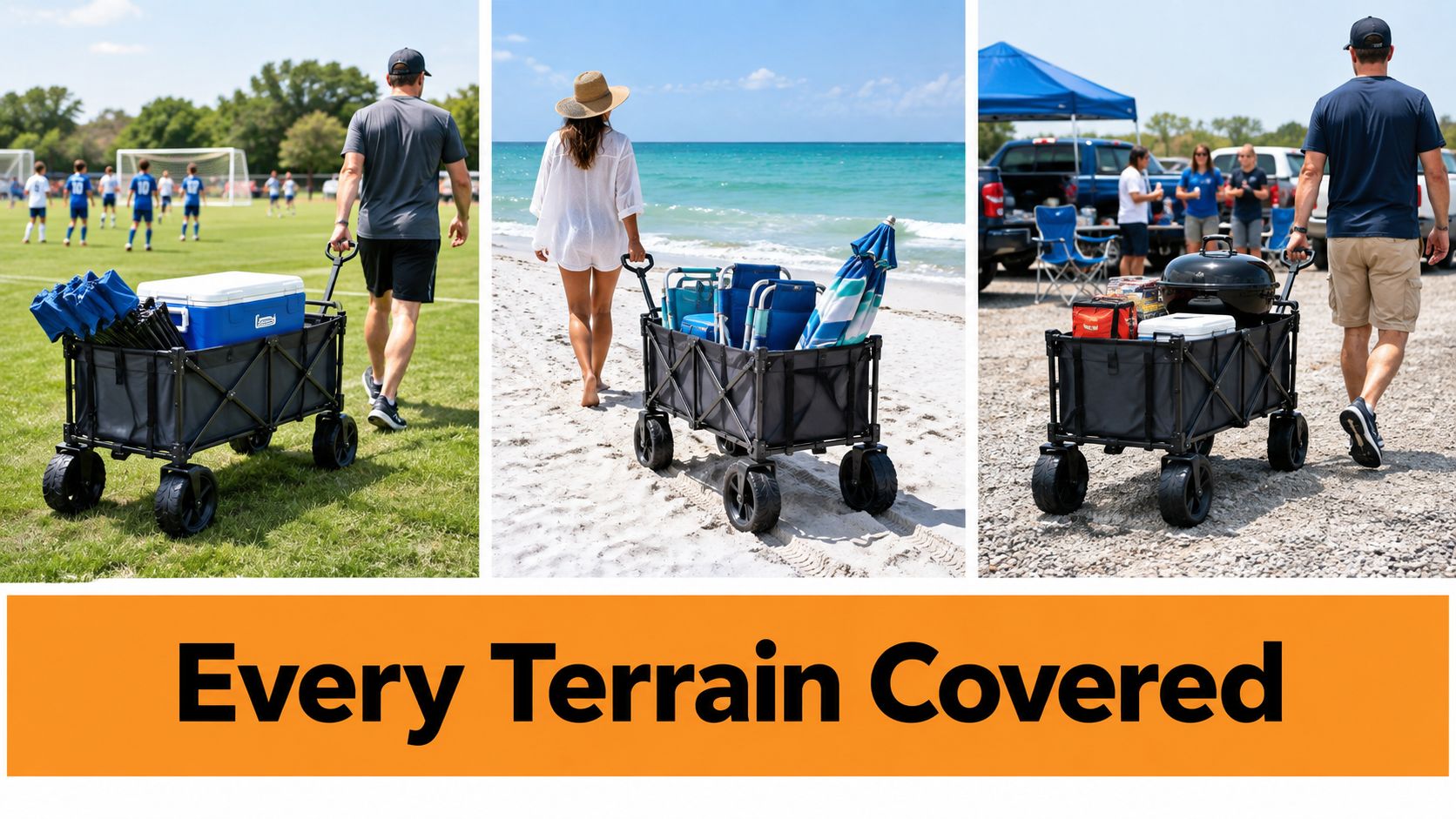
A youth soccer complex is a good test of a utility wagon. The car park may be firm, but the route to a field can cross grass, uneven edges, and crowded walkways while you're carrying a cooler, chairs, or a tent. A larger wheel helps with ordinary ground irregularities, and a single wagon can keep the gear together instead of spreading it across several trips.
The same thinking applies at a large event, though consumer wagons aren't a substitute for commercial logistics. Sports Business Journal reported that Rock-it expected to use about 5,000 vehicles and 1 million square feet of warehouse space to move more than 1 million pounds of equipment for the 2026 FIFA World Cup. Its report on World Cup equipment logistics is a professional-scale example of how much material event teams move across venues. For families and volunteers, the smaller version is familiar: water, signs, snacks, chairs, and supplies all need to get from the vehicle to the field.
From tournament grass to shoreline paths
On a Florida Gulf Coast beach day, umbrellas, sand toys, and refreshments can be awkward to carry. A wagon with big wheels may help on the access path and packed shoreline, but dry, soft sand is where wheel width and load weight become decisive. Read Lounge Wagon's guide to beach carts that won't sink in soft sand before assuming a big diameter alone solves the problem.
A pier fishing trip is a different job. Tackle boxes, bait buckets, and rods need to travel over a long path, sometimes with rough or uneven sections. Puncture-resistant wheels can be useful when the route includes debris, but load placement still matters, and an awkwardly stacked wagon can be harder to steer than a well-balanced one.
Watch the wagon in motion across changing surfaces to see what the specification sheet can't show: how the load sits, how the handle moves, and whether the wheel setup matches the route.
From Hauler to Bench Without Skipping a Beat
A gear wagon that becomes a seat has to work as more than a cart. Once you've rolled the cooler and event supplies to the sideline, the useful question is whether the wagon can become a comfortable place to rest without making you unload or rearrange everything first.
The Lounge Wagon is described as a 2-in-1 gear hauler and double-seater bench, with a padded seat, integrated cup holders, and storage pockets. Its 500 lb capacity applies to hauling, so don't assume it also describes the seated load limit; check the product's specifications for the rating that applies to seating. For an overview of the conversion concept, see Lounge Wagon's guide to its 2-in-1 wagon design.
Check the sitting position, not just the conversion
Seat height affects how easily someone can sit down and stand up. Back support can make a longer break more comfortable, while stable arms and an unobstructed transfer path matter for grandparents and anyone who needs more support getting on or off the bench.
Accessibility is part of whether people can stay at an outdoor event, not an extra flourish. A 2025 study of 446 adults aged 65 and older identified shaded seating and accessible facilities as highly valued features. Earlier observational research found that older adults may encounter too few seats, poor placement, or uncomfortable seats without backs or arms. The 2025 study on valued outdoor features supports treating seating as a real participation consideration.
Check these details before relying on a wagon bench for a long day:
Transfer effort: Can the person sit and stand without an awkward step?
Support: Does the seat provide a stable back and arm position?
Conversion: Must you remove cargo before using the bench?
Comfort: Is the seating suitable for the length of the event and the conditions?
Stability: Keep the wagon parked on a firm, level surface before anyone sits down.
Big wheels help get people and gear to the event. A thoughtful seat can make it easier to stay there.
Buying Checklist for Wagon Big Wheels in 2026
A wagon's wheel setup works as a system. Diameter helps it clear ruts and bumps; width spreads the load on soft sand; tire compliance and tread affect grip and comfort. The trade-off matters: wide wheels can float better on sand, while a suitable tread and compliant tire can help on grass and mixed paths. A high frame rating also does not mean every load will be easy to pull.
Match each specification to your route:
Diameter: Will the wheels clear the ruts and bumps you regularly cross?
Width: Is the footprint broad enough for the softest sand on your route, without compromising use on firmer ground?
Tread and compliance: Do the tread pattern and tire material suit your mix of grass, gravel, and packed paths?
Puncture resistance: Will the wheel hold up where sharp debris may be underfoot?
Capacity: Does the rating cover your intended cargo, and can you pull that load on your route?
Seating: Does the conversion suit the people who will use it?
Then compare your answers with the actual trip, whether it means packed beach, a grass field, a gravel path, or deep sand. Choose the setup that fits your terrain and cargo, rather than buying on wheel size or capacity alone.
Choosing a selection results in a full page refresh.
This pad is perfect for kids or dogs to be comfortable inside the moving wagon, and very nice after you set everything up and want to sit for extra padding.
Having the umbrella this summer has been easy to use and a must to make sitting and watching the parade so nice when there isn't any shade. My dogs laid on the wagon padding and enjoyed the day without getting too hot. I enjoyed the shade too.