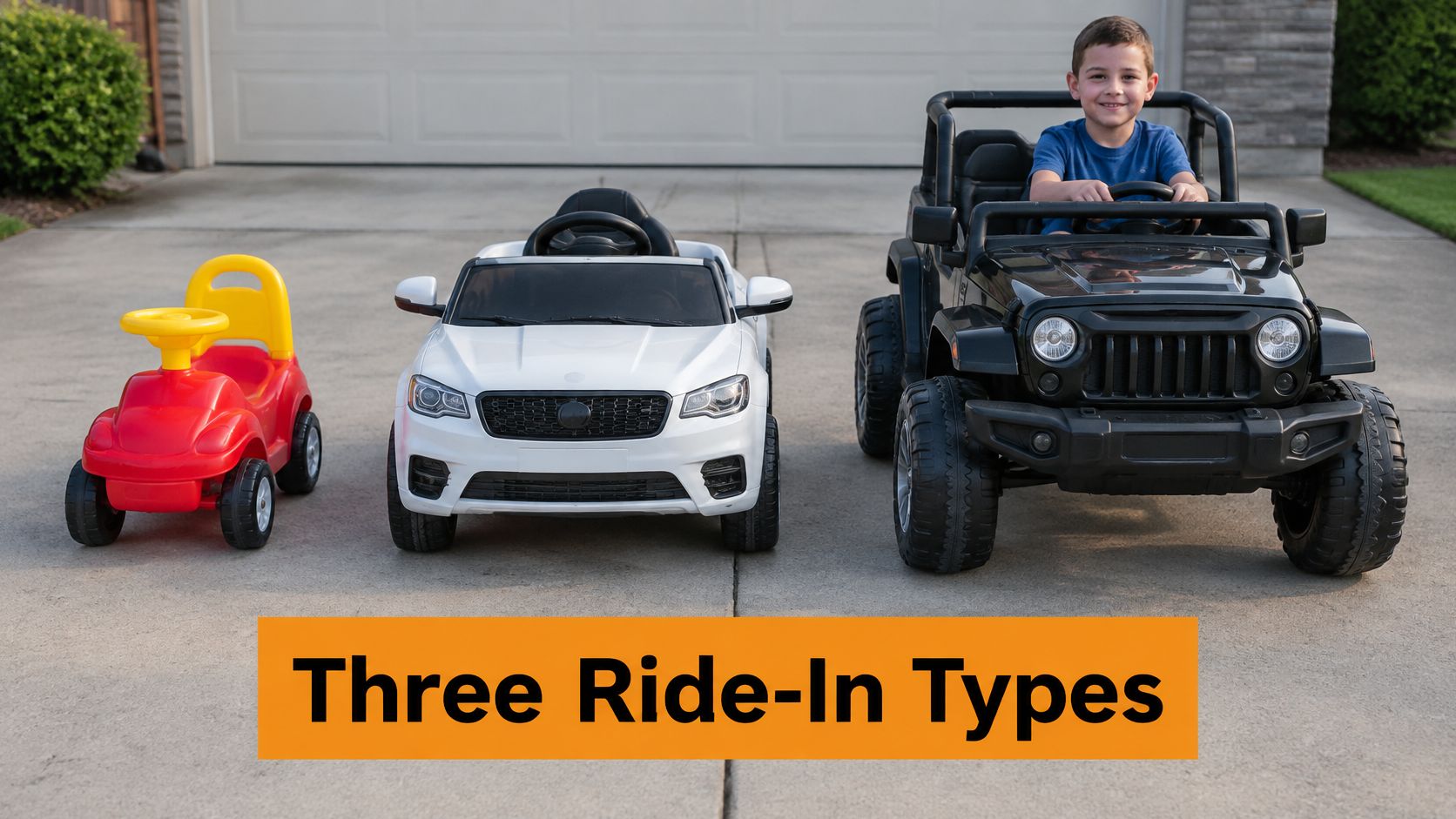
Foot-to-floor ride-in toys typically target ages 1-3 and 40-50 lb, 12V electric cars ages 3-6 and about 65 lb, and 24V cars ages 6-10 and 100-130 lb. Treat those as shopping categories, not permission to ride: each model's age, weight, terrain, and operating label is the final check.
A crowded trunk, a heavy battery-powered toy, and a toddler who wants to ride immediately can turn a park arrival into hard work. The wrong car takes up the luggage space, needs an awkward lift, and still won't move across the grass. Choose the child's toy for the child and the ground, then use a separate gear hauler, such as Lounge Wagon, for the adult side of the outing.
Three Types of Ride In Car and Who Each Fits
Ride in car usually means a child-sized vehicle, but listings mix foot-powered toys, electric cars, and accessories for the family vehicle. Start by separating those categories. A window sunshade won't solve a toy's poor fit, and a more powerful battery won't make an oversized seat appropriate for a toddler.
Choose the movement before the features
A foot-to-floor ride-on lets the child push against the ground and stop with their feet. It suits early rides when comfortable reach and simple movement matter more than lights, sounds, or a dashboard.
An electric kids' car adds a motor, controls, charging, and more adult responsibility. The child needs to understand stopping and steering, not just enjoy pressing the accelerator.
For the supplies that accompany either toy, View the Sideline Wagon alongside the outdoor toys and active-play planning guide. Lounge Wagon is an adult gear hauler with 500 lb hauling capacity that converts into a 2-in-1 bench for two adults, not a ride-on toy or a child passenger wagon.
Ride in car types by age, weight and power
Type
Typical age
Typical weight limit
Power and speed
Best use
Foot-to-floor ride-on
1-3 years
40-50 lb
None, child pushes with feet
Indoors, enclosed driveway, first rides
12V electric kids' car
3-6 years
About 65 lb
12V battery; model-listed speed
Flat, enclosed riding areas
24V electric kids' car
6-10 years
100-130 lb
24V battery; model-listed speed
Larger enclosed yards or permitted, traffic-free areas
Ride-in accessory, such as a seat protector, trunk ramp, or sunshade
Any age
N/A
None
Protects the vehicle interior or simplifies loading
These are broad shopping ranges, not universal specifications. Check the individual product's manual before buying, especially when a listing combines several versions under one product name.
Buying rule: A toy that fits the child but doesn't fit the trunk or riding area isn't a practical fit.
The pictured ride-on vehicles illustrate why storage and loading deserve attention before checkout.
Last Updated: July 2026
How to Match a Ride In Car to Your Child
Start with the child's current size and skills, not the age printed across a retailer's search results. A suitable ride-on lets the child sit securely, operate the intended controls, and get off without the toy rolling away.
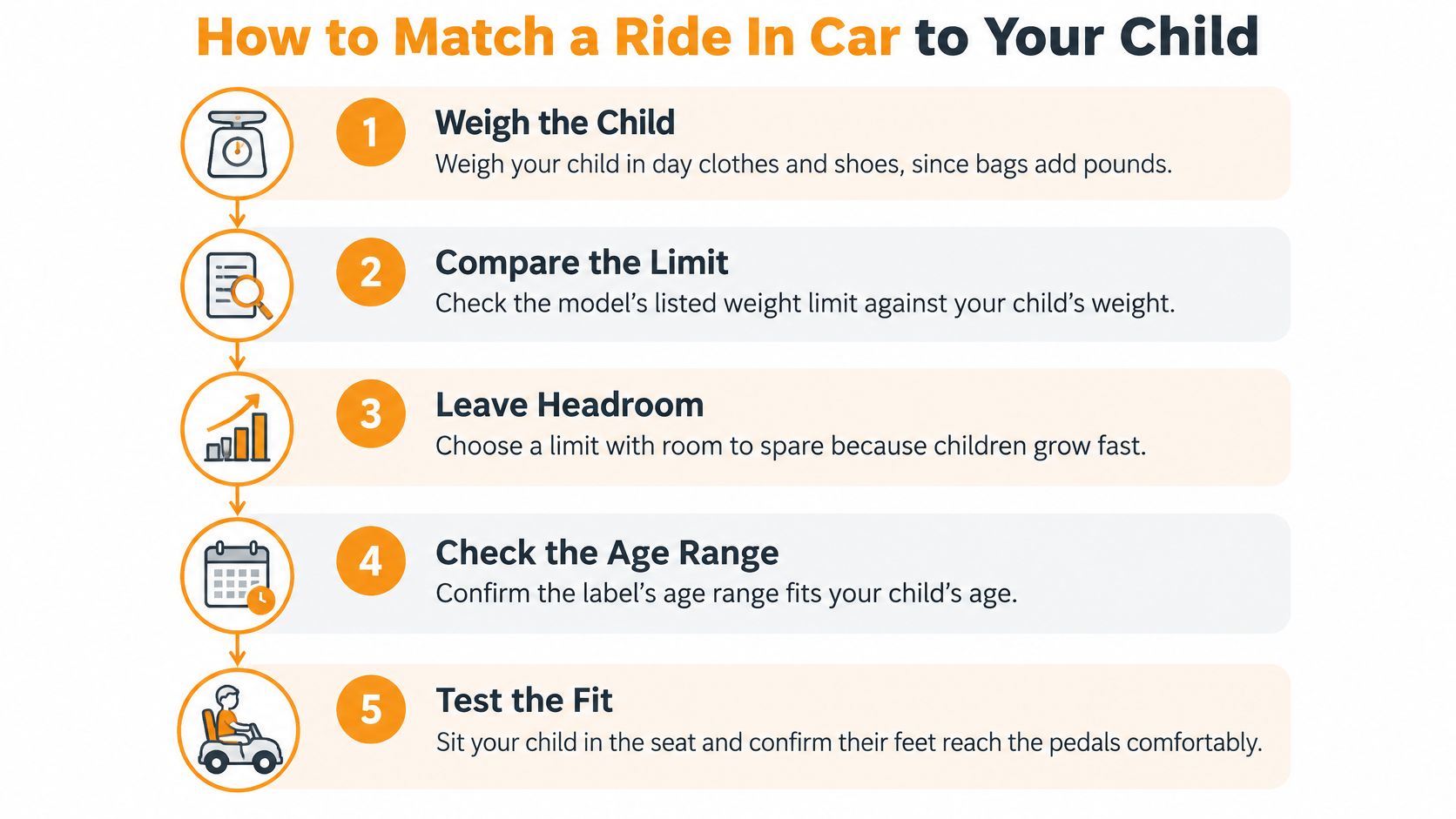
Use this visual checklist while comparing the label with the child's actual fit.
Make the fit check practical
Weigh the child in day clothes and shoes. Compare that weight with the model's listed rider limit. Leave room for growth, but don't count unused weight capacity as evidence that the seat fits.
Check the seated position. On a foot-powered toy, the feet must reach the floor comfortably; on an electric car, the child must reach the controls without sliding forward. Look for upright sitting, easy steering reach, and knees that aren't jammed against the dashboard.
Match the wheels to the surface. Hard plastic wheels can be adequate on smooth paving, while grass and loose gravel demand traction and suitable clearance. Wider or rubber tires may help, but they don't automatically make a toy suitable for deep sand.
Plan active supervision. Use an enclosed, flat riding area and stay engaged, including with foot-to-floor toys. A parent remote is a backup control, not permission for unsupervised riding or access to traffic.
Measure storage and charging space. Measure the assembled toy, trunk opening, and usable cargo area, including the space needed to lift it out. Charge only with the specified charger, on the manufacturer's schedule, in a dry location away from heat and escape routes.
Buying the next size up: Extra growing room doesn't help when the child can't reach the controls.
Ignoring terrain: A driveway demonstration doesn't prove that the same toy will cross a lawn or beach.
Use the video as an additional visual reference, then make the purchase decision from the specific model's instructions.
A good fit is visible during a controlled trial: the child steers and stops without strain and gets on and off confidently with appropriate adult help.
Toddler Stability and Age-Band Safety Rules
Toddlers need a low seat, broad wheelbase, and predictable movement more than motor power. A lower seat keeps the child closer to the ground, while a broad base can improve stability. Neither feature makes slopes, curbs, or uneven edges acceptable riding areas.
Consider an 18-month-old trying a foot-powered car on a lawn. Narrow wheels may sink or catch, leaving the child pushing without moving. On a smooth, enclosed paved area, the same child may manage the toy comfortably, provided the seat and handle positions fit.
Keep movement simple
Foot-powered movement gives the child direct control through contact with the ground. It also gives the parent an easy way to notice a poor fit: tiptoeing, leaning far forward, or struggling to turn are reasons to stop and reassess.
A ride-on should supplement walking and active play, not replace them. For separate movement activities away from the toy, JC Sports Houston's balance practice for youth sports offers ideas parents can adapt to a child's abilities.
Check these details before each outing:
Low seat: The child can sit securely and get off without a large drop.
Wide base: The wheels sit firmly on level ground without rocking.
Reachable handles: Steering doesn't require leaning out of the seat.
Usable stopping method: The child can operate the intended brake or foot stop.
Suitable load rating: The rider remains within the model's stated limit.
Safety gear and supervision by age band
Age band
Gear
Supervision
Parent action
Under 3
Correctly fitted helmet where appropriate to the activity; closed shoes
Constant, within arm's reach
Keep to flat, enclosed ground and follow helmet and toy instructions
3-6
Suitable helmet and closed shoes
Constant during riding
Use an enclosed driveway or fenced yard
6-10
Suitable helmet, closed shoes, and the supplied restraint as instructed
Active adult supervision; remote control where provided
Set an appropriate speed and exclude traffic, slopes, and drop-offs
A remote-equipped toy still belongs away from moving vehicles. Don't use a public street just because the adult can operate a remote.
Plan the hot-weather arrival
Parking doesn't finish the safety job. You still need to move the child and supplies to a suitable place without leaving anyone waiting inside the vehicle.
A UNECE vehicular heatstroke document identifies ambient temperature, exposure time, solar radiation, humidity, and rising cabin temperature as relevant risks, and reports 39 U.S. child hot-car deaths in 2024, compared with 29 in 2023. It also identifies children aged six and under as the majority of cases in the international evidence it discusses.
Unload the child first into a responsible adult's care. Never leave a child alone in a parked car, even briefly, and never use the cabin as temporary shade for people.
Have another adult establish shade and water before the child arrives where possible. If you're alone, keep the child with you throughout unloading and choose an arrival plan you can manage without returning to the vehicle unattended.
A wagon can simplify logistics. It doesn't prevent heat illness or make a parked vehicle safe.
Read the Ultimate Youth Sports Tournament Checklist as an arrival-planning exercise: identify the route, shade location, water access, and adult responsible for the child. Before choosing any child-carrying arrangement, review wagon and car-seat attachment considerations; an attachment discussion isn't approval for every wagon.
Our seating and hauling limits are separate. Follow your Lounge Wagon model's instructions before loading, rather than applying a cargo rating to seated occupants.
Electric Kids' Cars for Older Kids and Parents
A seven-year-old who feels cramped in a smaller electric car may need a different vehicle, but battery voltage alone doesn't settle the decision. Check seat dimensions, legroom, rider capacity, and control skills before moving to a more powerful model.
A larger electric car also takes more space to transport and turn. If the available riding area is narrow or crowded, keeping the smaller toy isn't necessarily the answer either. A different kind of active-play equipment may fit the setting better.
Compare the controls and the setting
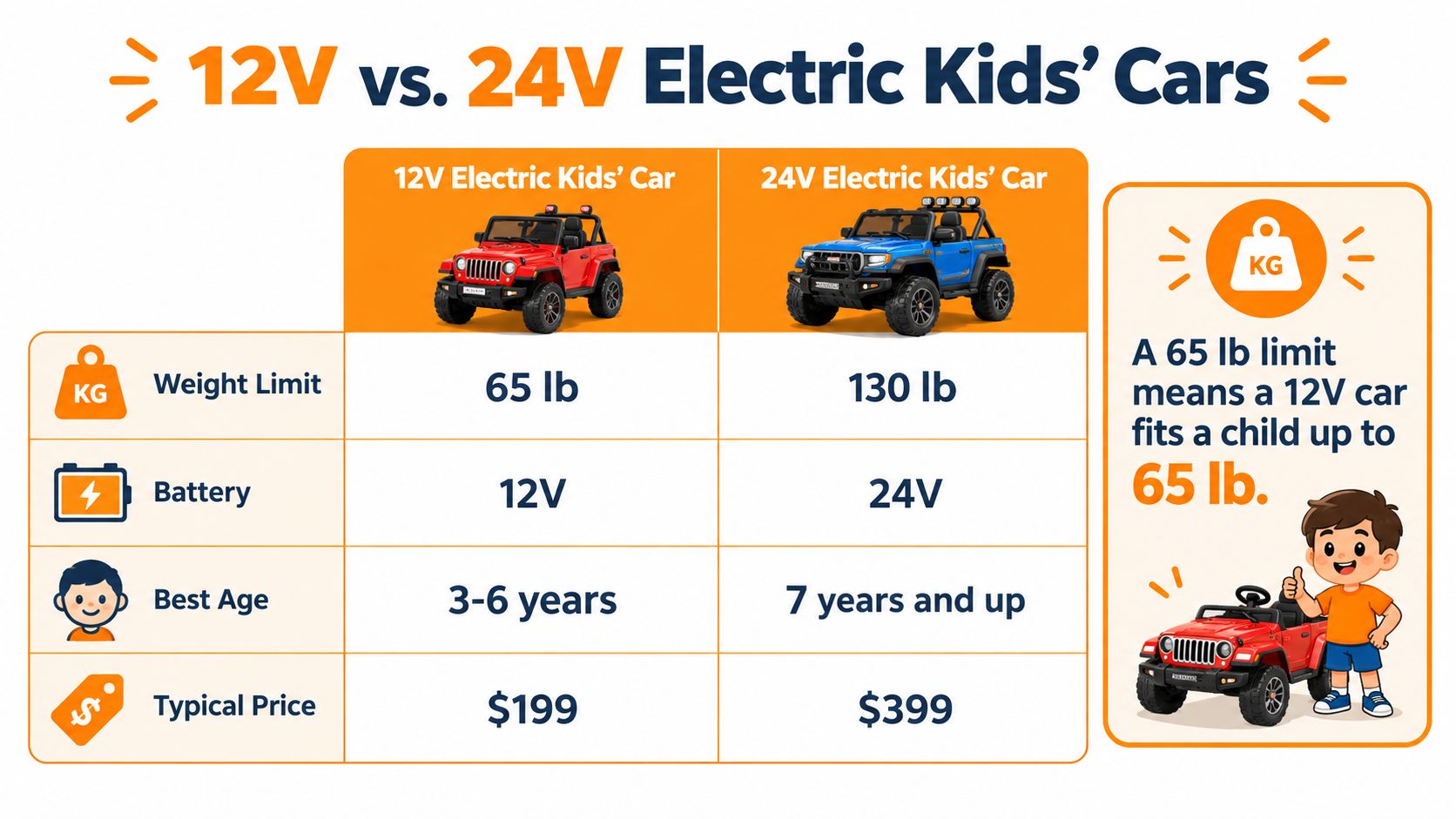
12V and 24V electric kids' cars compared
Feature
12V electric kids' car
24V electric kids' car
Rider age
Common shopping category for ages 3-6; check label
Common shopping category for ages 6-10; check label
Weight limit
Around 65 lb on some models; verify the exact rating
Around 100-130 lb on some models; verify the exact rating
Typical top speed
Use the model's stated maximum and available settings
Use the model's stated maximum and available settings
Parent remote
Available on some models; check included functions
Available on some models; check included functions
Seating
Usually a single-rider layout; confirm approval
Single- or multiple-rider layouts; confirm individual and combined limits
Best terrain
Smooth, flat surfaces approved by the manufacturer
Grass or light gravel only where the model permits
The comparison graphic is a shopping illustration, not a substitute for a model's current specifications or price.
A weight limit is a ceiling, not an age guarantee. A lighter child may still be too tall for the cockpit, and a roomy seat doesn't authorize carrying another child.
A speed-limit setting lets an adult start a new rider at the lowest available speed, giving the child more time to practise steering and stopping. That's more useful than buying for maximum speed and hoping the child grows into it.
Treat the remote as backup equipment
Check whether the parent remote can stop the car, steer it, or only change selected functions. Learn the pairing process before the child sits down, and test the stop function in a clear area.
Charging needs the same attention. Use the supplied or explicitly approved charger, keep it dry and away from hot surfaces, and disconnect it when the manufacturer's charging cycle is complete.
If the child would benefit more from self-propelled play, compare toddler balance bike features through Rider 18 before committing trunk space to an electric car. Choose the activity that suits the child's development and your actual riding area, not the largest battery you can buy.
Ride-In Accessories That Cut Trips to the Car
A muddy toy, a loose remote, and a trunk opening that sits too high are three different problems. Buy for the bottleneck you have: lifting, dirt, heat, or the walk from car to field.
Make loading easier without creating new hazards
Protective mat: A washable cargo liner catches dirt beneath a muddy toy and gives you a cleaner place to stage straps, shoes, and cleanup supplies. If using a seat protector beneath a child restraint, confirm that the restraint and vehicle manufacturers permit it.
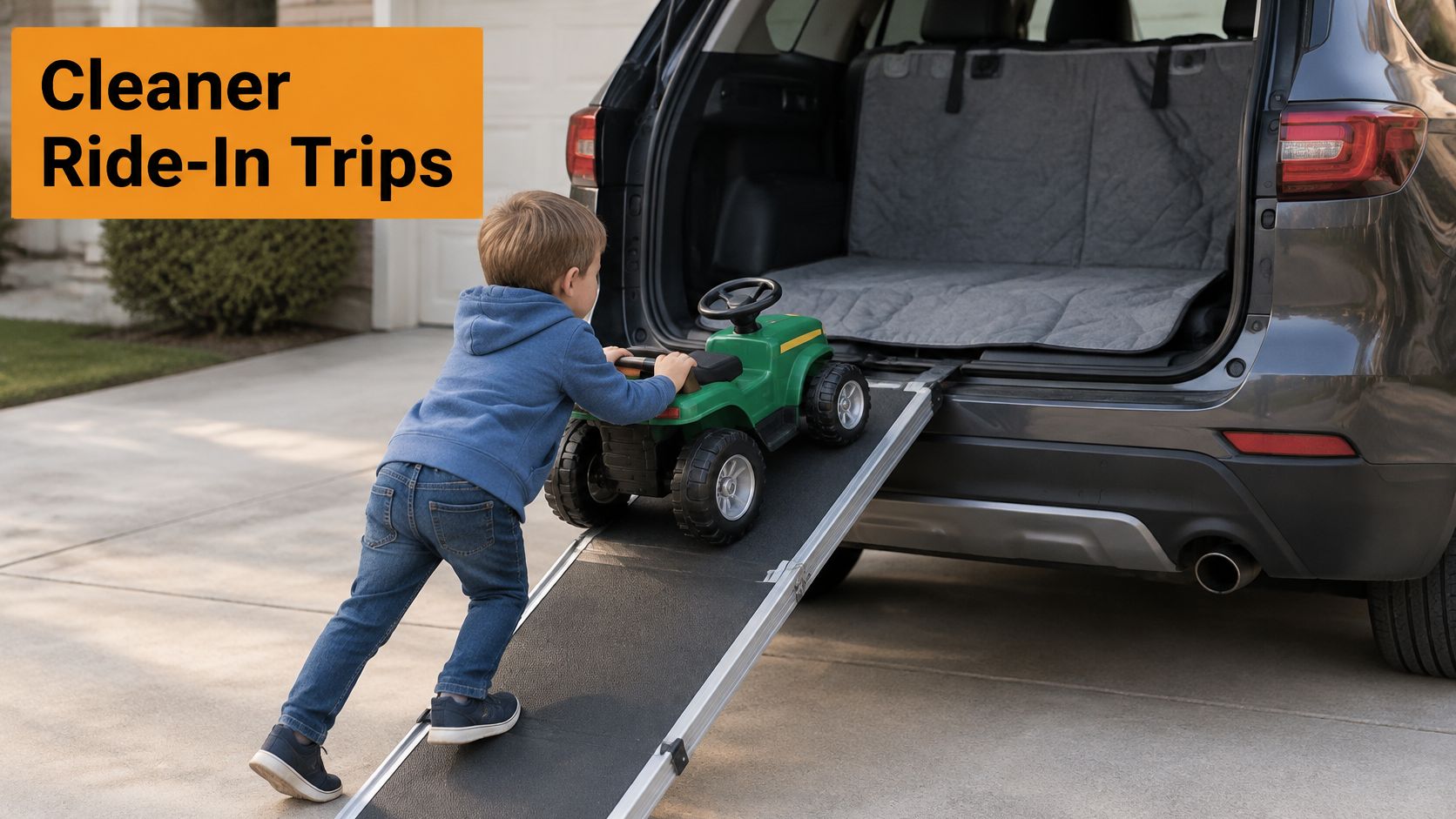
Secured loading ramp: A suitably rated ramp can let an adult roll a heavy toy into the cargo area instead of lifting it. Keep children clear, secure the ramp against slipping, and control the toy throughout loading.
Window sunshade: A correctly fitted shade reduces direct sunlight through the covered window and helps when the vehicle has been sitting in the sun. It doesn't make an occupied parked vehicle safe or replace ventilation and air conditioning while travelling.
The loading image shows the task a ramp addresses, but an adult should manage the loading operation rather than asking a child to push heavy equipment.
The NIOSH-based lifting analysis considers load mass, horizontal reach, lifting height, twisting, repetition, and grip quality, not weight alone. Bring the hauler close to the trunk, place dense supplies low and near its centre, and turn with your feet rather than twisting while holding a cooler.
For small loose items, find storage ideas for your car through Urban Totes. Keep the remote, cleanup supplies, and charging accessories together so they don't disappear beneath the larger equipment.
Separate hauling from riding
An adult hauler earns trunk space when it removes repeat trips, not when it becomes another thing to supervise. The Family Wagon hauls gear and converts into seating when parked, while the Wagon and 6 ft XL Sports Umbrella Setup suits a shaded base. Its 10-inch all-terrain wheels are built for grass, dirt, and sand, and the padded bench seats two adults once you are parked.
Use the walk from car to field as the test. If a bag, toy, cooler, or folding item still has to be carried by hand, the setup has not solved the trip problem. For deciding what stays within reach during that walk, use how to keep toddlers and gear organized at the park.
“Love that my family and friends can sit on it as well while we watch the kids play. Great for year round.” Melissa Dominguez, Lounge Wagon review
The adult-side benefit is a 2-in-1 bench at the destination and 500 lb hauling capacity for the equipment journey, subject to the separate seating and hauling limits in the model instructions. It is gear transport and adult seating, not a child ride.
Match the ride-on to the child's current age, weight, reach, and control skills. Then confirm that the toy and the rest of the outing equipment fit through the trunk opening and into the available storage space.
Before checkout, make a final practical check:
Child fit: Read the exact model's label and manual, not a category description.
Venue fit: Confirm permission to use motorized toys and keep riding away from traffic.
Transport fit: Plan who loads the toy and where loose equipment will be secured.
Family fit: Keep child transport separate from adult cargo and seating arrangements.
Choose The Sideline Wagon for ballgame logistics, The Beach Wagon for shore-day planning, or The Family Wagon for mixed outings. Lounge Wagon is made for beach days, ballgames, and everything between, with seating for two adults once you're parked.
Lounge Wagon offers a gear hauler that converts into an adult bench, keeping the supplies separate from your child's ride-on. Visit Lounge Wagon to compare the Sideline, Beach, and Family setups against your trunk space and destination. Choose the setup that fits your outing, stop making avoidable return trips, and make it a one-trip walk to the field or shore whenever the load and route allow.
Choosing a selection results in a full page refresh.
This pad is perfect for kids or dogs to be comfortable inside the moving wagon, and very nice after you set everything up and want to sit for extra padding.
B
Wagon & 6' Xl Sports Umbrella Setup Beth Ritchey
Umbrella is a must
Having the umbrella this summer has been easy to use and a must to make sitting and watching the parade so nice when there isn't any shade. My dogs laid on the wagon padding and enjoyed the day without getting too hot. I enjoyed the shade too.