Non toxic isn't a single regulated stroller label: verify OEKO-TEX STANDARD 100 Product Class I for fabrics, CPSC limits of 100 ppm lead and 0.1% regulated phthalates, and ASTM F833-21 for mechanical safety. Choose documented materials and tested construction, not an eco tag that covers only part of the stroller.
Last Updated: September 2026
The popular advice to “just buy organic fabric” misses the harder question: what's underneath it? A reassuring canopy label doesn't tell you what's in the seat foam, frame coating, or buckle your child can reach.
What Non Toxic Really Means for Strollers
Soft padding can look reassuring and still conceal chemical treatments. A stroller's appearance, feel, or general eco label cannot show what is in its foam. Ask for product-specific documents before treating a marketing claim as evidence.
A 2011 study examined 101 polyurethane-foam children's products and detected flame-retardant chemicals in 80, including products such as carriers, changing pads, and strollers, according to the Green Science Policy Institute's children's-products overview. Researchers identified TDCPP among the chemicals and estimated that infant exposure could exceed acceptable daily-intake levels. They did not directly measure exposure in infants, so the estimate is not proof of actual exposure.
California later changed its furniture-flammability requirements so products including strollers, infant carriers, and nursing pillows no longer had to use chemical flame retardants in their foam. That history makes foam treatment worth asking about, but it does not establish what is in any particular stroller today.
For hauling gear and seating at a destination, the Lounge Wagon is a separate kind of product, not an infant stroller. It has 10-inch all-terrain wheels and converts into seating when parked. Those features address transport and comfort, not chemical content. Do not infer chemical safety from a wagon's padding or product description.
Use separate checks for separate claims
Request evidence that matches the part and claim:
Textiles: Check which fabrics and components a certificate covers.
Foam and other materials: Ask for foam treatment declarations and chemical reports identifying the tested components.
Construction: Check stroller safety compliance separately from chemical testing.
A certificate only supports claims within its stated scope. The practical goal is documented control of identified hazards, with clear limits on what was tested.
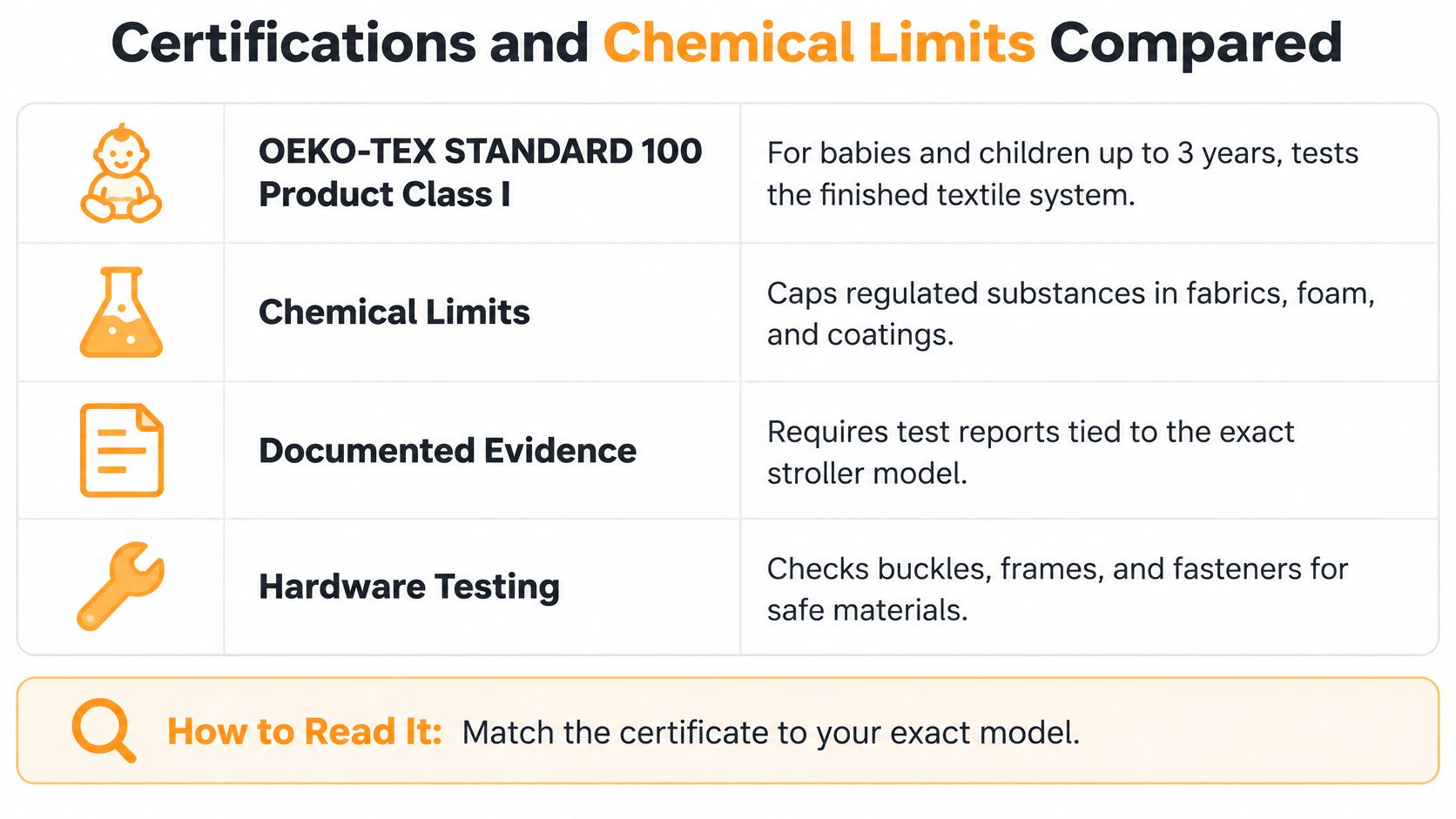
Certifications and Chemical Limits Compared
A stroller's soft, padded seat can still contain chemicals that its fabric certificate does not cover. Separate chemical evidence from mechanical testing, and ask for documents that identify exactly which materials were assessed.
Standard or limit
Key number or scope
What it verifies
What it leaves out
OEKO-TEX STANDARD 100 Product Class I
Babies and children up to 3 years; more than 1,000 substances screened
Finished textile system, including fibers, dyes, thread, buttons, and coatings
Separately undocumented frame, foam, buckles, wheels, and adhesives
GREENGUARD Gold
Low chemical emissions for indoor air
Emissions within the certified product's scope
Every additive's presence; mechanical safety
GOTS, Global Organic Textile Standard
Organic fiber content and processing-chemical requirements
Certified organic textiles and covered processing
Foam, frame, and metal hardware
CPSC lead limit, accessible components
100 ppm, or 0.01%, total lead
Child-accessible components
Non-accessible internal parts
CPSC surface-coating limit
90 ppm, or 0.009%, lead
Paint and similar surface coatings
Chemicals other than lead
CPSC phthalate limit, accessible plasticized parts
0.1%, or 1,000 ppm, of each regulated phthalate
Covered accessible plasticized components
Unregulated plasticizers and PFAS
The textile scope and figures are described in the OEKO-TEX STANDARD 100 requirements. Lead, coating, and phthalate thresholds are listed in the CPSC carriage and stroller FAQ. These standards answer different questions, so one badge cannot stand in for another.
The comparison below helps match a certificate to the evidence it should contain. Use it as a document-checking aid, not as a substitute for the standard's stated scope.
Read the label's boundaries
OEKO-TEX STANDARD 100 Product Class I applies to textiles intended for babies and young children. It assesses the finished textile system, rather than only its base fiber, and includes simulated saliva and perspiration/color-fastness testing. That makes it relevant to fabric a baby may mouth or touch. It does not establish that unlisted foam, buckles, or other stroller parts were tested.
GREENGUARD Gold addresses chemical emissions into indoor air. It provides emissions evidence for the product and components within its certification scope, not a full ingredient inventory or approval of stroller construction.
GOTS covers organic fiber content and requirements for textile processing. An organic textile claim does not establish what is in the foam beneath it or the coating on the frame.
CPSC chemical limits are legal benchmarks for specified substances and components. Meeting them does not mean a stroller is free of all chemicals of concern. Check what accessible parts and materials are covered, including padded areas and plastic components.
Ask for documents you can match
For practical guidance on evaluating testing claims, consult a conscious buyer's guide to product testing. Then ask the manufacturer for the certificate number and current validity, the tested model and components, and reports that identify the materials assessed. Request separate evidence for foam, buckles, frame coatings, wheels, and adhesives where applicable. A supplier's certified raw fabric does not automatically prove that the assembled seat or whole stroller is covered.
Check the certification issuer's current listing and compare it with the documents provided. Confirm that the certificate applies to the actual seat pad, canopy, harness padding, or coating in question, not merely to a similar material.
Families considering specialized equipment can also review the special-needs stroller guide. Chemical documentation describes material testing; it does not establish clinical suitability.
Mechanical Safety Checks and Recent Recalls
A stroller can meet chemical limits and still fail mechanically. A fabric certificate cannot confirm that a brake holds, just as a stability test cannot identify additives in a padded seat. Ask for evidence on both fronts.
The federal stroller rule, 16 CFR Part 1227, incorporates ASTM F833-21 for applicable products, according to the CPSC's business guidance for carriages and strollers. The requirements cover sharp points and edges, small parts, surface coatings, latches, openings, pinching and scissoring hazards, exposed springs, parking brakes, static load, stability, restraints, occupant retention, impact, wheel detachment, and head entrapment with an attached car seat.
Each requirement addresses a specific injury risk. A folding latch helps prevent collapse; secure wheel attachments support control; restraints help keep the child in place.
Recall history changes the buying decision
The CPSC Guava Roam recall notice covers approximately 8,500 strollers. The notice reports 67 reports of brake-lock disengagement and 152 reports of the brake pedal failing to engage. The Bugaboo Dragonfly seat-stroller recall notice covers about 1,000 U.S. units and approximately 200 sold in Canada.
Before buying secondhand, compare the exact model and affected identifiers with recall notices. A brand name alone cannot confirm whether a specific stroller is affected.
Safety boundary: A home check cannot rule out a recall. Follow the stated recall remedy, even if the stroller appears to work normally.
Check operation without a child aboard
Follow the manual and leave the stroller empty during these checks:
Brake hold: On a gentle slope, keep a firm grip while checking whether the engaged parking brake holds. Never let go of the stroller.
Fold-latch engagement: Open the stroller fully, confirm the latch engages, and apply only the verification movement described in the manual.
Wheel attachment: Check that each wheel is securely engaged and shows no unexpected movement. Do not dismantle it.
A home inspection can catch an obvious problem, but it cannot reproduce laboratory testing or rule out intermittent failure. Stop using the stroller if its latch is uncertain, its brake slips, or a wheel is loose. For terrain decisions, compare stroller wheel considerations, then check wheel compatibility and installation in the stroller's manual.
Frame, Fabric and Foam Materials Compared
A polished fabric can conceal a chemical treatment, and a soft, padded seat can conceal flame retardants. Ask for component-specific documents before relying on a broad “non-toxic” label.
Start with foam and coatings. Polyurethane foam alone does not show whether flame retardants were added, and thick padding alone does not prove contamination. Request a declaration on intentionally added flame retardants, plus relevant screening results. A certificate for the textile does not automatically cover the foam, frame, buckles, or finished stroller.
Match the material to its evidence
Component
Common material
What to request
Tradeoff
Seat pad and canopy
Organic cotton
Class I certificate covering the finished pad
Check softness, dirt visibility, and drying requirements
Canopy shell
Recycled polyester
Finished-textile certificate; PFAS screening if water-repellent
Easy-care construction does not identify finish chemistry
Stronger construction can take more effort to lift
Buckles and trays
Nylon or polypropylene
Applicable lead and phthalate reports
Easy cleaning does not establish additive content
Wheels
Rubber or foam
Relevant lead and phthalate reports
Consider puncture maintenance and rough-ground handling
Use the performance column as a shopping checklist, not a universal ranking. Fabric construction, frame geometry, wheel design, and care instructions affect day-to-day use alongside the material itself. For example, a coating that repels water may simplify cleanup, but you should ask what treatment provides that resistance.
Don't confuse recycled, organic, and tested
“Recycled” describes material origin. “Organic” addresses different production questions. Neither label identifies every dye, finish, adhesive, or treatment in the finished stroller. Ask which product parts a certificate covers, and whether the model and color you are buying are included.
The EPA's phthalate overview explains that some phthalates are suspected endocrine disruptors and notes concerns about possible developmental and behavioral effects in children. This supports asking about specific plastic components. It does not establish that every plastic buckle contains hazardous phthalates.
For water- or stain-resistant textiles, request targeted PFAS information. For foam, ask about organophosphate flame retardants. The CPSC stroller compliance presentation provides regulatory context for screening accessible components.
The earlier certification comparison explains why the certificate's scope matters. Apply the same check to replacement parts: a matching color is not proof that the material specification matches. For a broader comparison of plastic wagon materials, see considerations for plastic children's wagons. A wagon's material description does not establish stroller compliance.
Compare actual reports and the parts you will handle and clean. Weight and price cannot verify chemical safety, and neither can a product label that leaves components unspecified.
Price Tiers and Performance Tradeoffs
A higher price does not establish chemical safety. A budget stroller may use suitable materials but provide little documentation. A premium model can still leave questions about foam or coatings unanswered. A padded seat may conceal flame retardants, so request component-specific documents rather than relying on an eco-themed label.
Retail prices vary by model and configuration, so compare tiers by relative cost and what the paperwork covers.
Tier
Relative cost
Documentation to require
Performance tradeoff to examine
Budget
Lowest upfront cost
Applicable safety compliance and material reports
Whether the lower cost comes with gaps in product documentation
Mid-range
Moderate cost
Certificate scope and a component-level material list
Whether added features make lifting or storage harder
Premium
Highest upfront cost
Model-specific reports and documented replacement parts
Whether accessories and bulk suit your routine
Pay for evidence before extras
Start with documents you can match to the exact model. A higher price for an eco-themed collection is useful only if its paperwork identifies a meaningful difference. Ask whether replacement covers retain the original material specification, and whether the certificate covers the specific colorway. Do not assume a report applies to every version.
Then test day-to-day handling. Lift the stroller as you would at home, including up stairs or into a high trunk. Check the folded shape against your storage space, and assess wheel performance on your usual route, especially uneven ground or sand. Test the brake for reliable engagement and clear operation before treating accessory convenience as a priority.
Separate stroller spending from hauling spending
A stroller for an infant and equipment for a family outing serve different purposes. Keep the stroller budget focused on the child's transport and positioning. For beach or sideline trips, compare a separate wagon's hauling and seating functions with the gear you would otherwise carry. That comparison does not establish that the wagon provides the same protection or positioning as a stroller.
A premium stroller may offer useful engineering, serviceability, or comfort. It cannot make up for missing test reports. Set your budget around the documentation you can verify, then decide whether the features justify the added cost.
How to Clean a Stroller Without Undoing Its Safety
Follow the manufacturer's care instructions before any general cleaning routine. Removable fabric, harness webbing, foam inserts, and coated frames may require different methods.
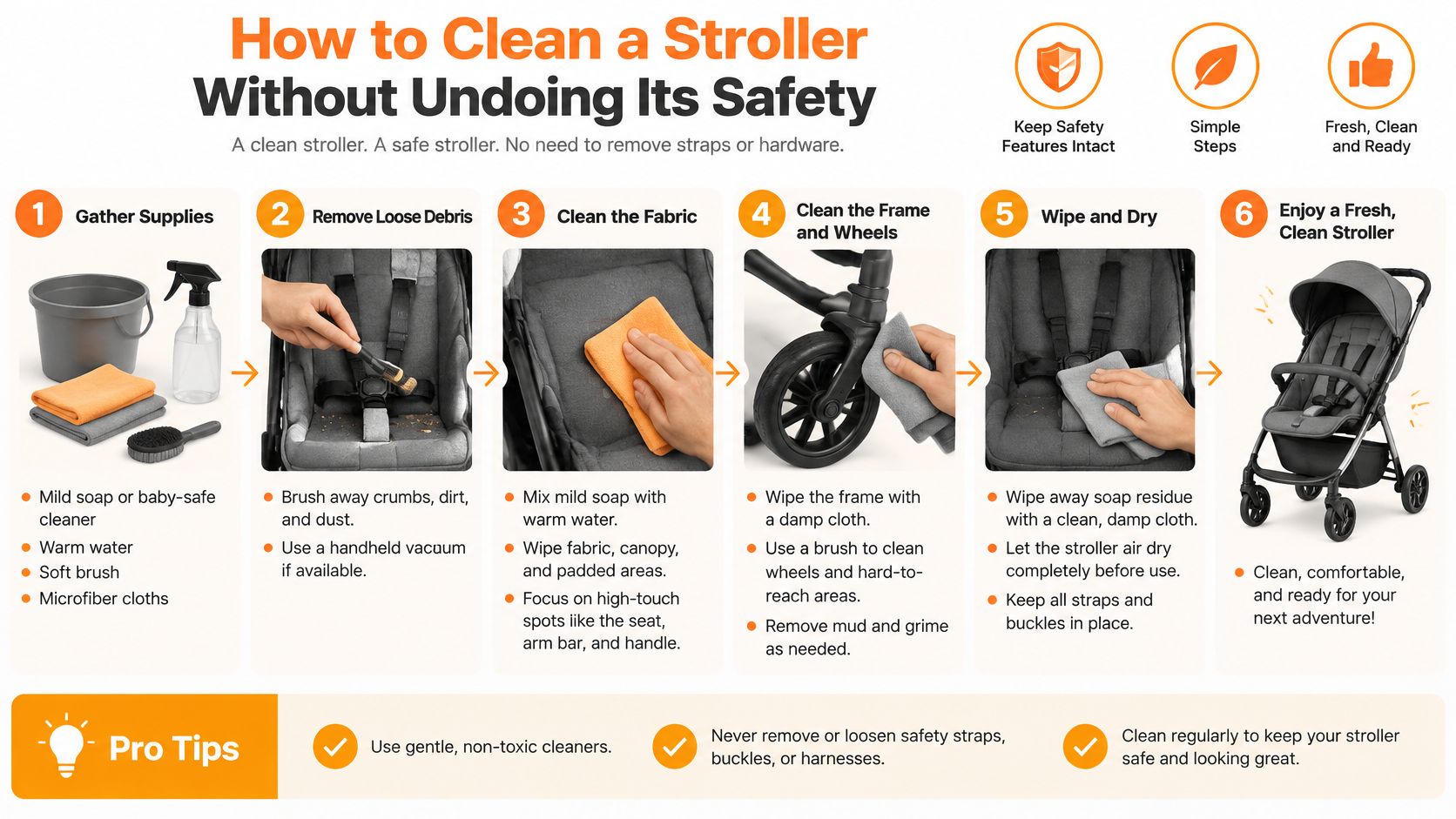
Use this visual as a reminder, then follow the more detailed routine below.
Clean without changing the assembly
Read and spot-test. Check the care label and test an approved mild soap on a hidden seam. This helps you identify discoloration or finish damage before cleaning a visible area.
Remove only approved parts. Take off the canopy and seat pad if the manual permits, then shake or brush out crumbs. Photograph the attachment arrangement if reassembly isn't obvious.
Wash gently. Where hand washing is allowed, use lukewarm water and fragrance-free, dye-free soap. Avoid bleach, harsh disinfectants, and fabric softener unless the manufacturer specifically permits them.
Rinse thoroughly. Keep rinsing until soap residue is gone, without soaking components the manual says to keep dry. For outdoor cleaning, our shower bag can hang from a tree, fence, canopy, or vehicle to create a portable rinse station.
Air-dry as directed. Choose shade where the instructions allow, and don't tumble-dry foam unless expressly permitted. Surface dryness doesn't establish that thick padding is dry inside.
Wipe hard components. Use a damp cloth on approved frame and plastic surfaces, then remove grit around buckles and wheels. Don't introduce cleaners or lubricants into mechanisms without manufacturer guidance.
Check before reassembly. Allow foam and fabric to dry completely, and inspect for tears, deterioration, or missing attachment points. Refit only compatible parts in the original arrangement.
Repeat the operational checks. With the stroller empty, verify brake engagement, fold-latch security, harness routing, and wheel attachment. Cleaning is a useful inspection opportunity, not merely a cosmetic task.
Keep the rinse setup separate from the stroller
Position any portable rinse station so water won't flood wheel bearings, brake mechanisms, or enclosed frame sections. Control runoff and keep the child away from the cleaning area.
This video provides additional outdoor setup context.
Cleaning isn't a reliable way to remove flame-retardant additives from foam. Replace torn or deteriorating padding with an approved replacement, and request documentation matching the original specification rather than scrubbing damaged foam harder.
Use Cases from Sideline to Shoreline
At a youth tournament, the gear may include a cooler, tent, and bags, while adults need somewhere to sit between games. Separate the job of carrying equipment from the job of transporting an infant: a wagon that converts into seating when parked is not an infant stroller.
Feature
Lounge Wagon
Generic sports or beach wagon
Seating
Converts into seating when parked for family or friends watching children play
Check whether seating is intended and how it is configured
Wheels and terrain
10-inch all-terrain wheels roll over sand, grass, and dirt
Check wheel design and intended terrain
Chemical documentation
Request reports for the actual components before making a non-toxic claim
Request model-specific evidence
Tournament equipment and parked seating
The Lounge Wagon is designed to haul gear and provide seating when parked. Family members or friends can sit while they watch children play. Check the product's instructions and intended use when loading it, and avoid treating its seating function as infant-stroller approval.
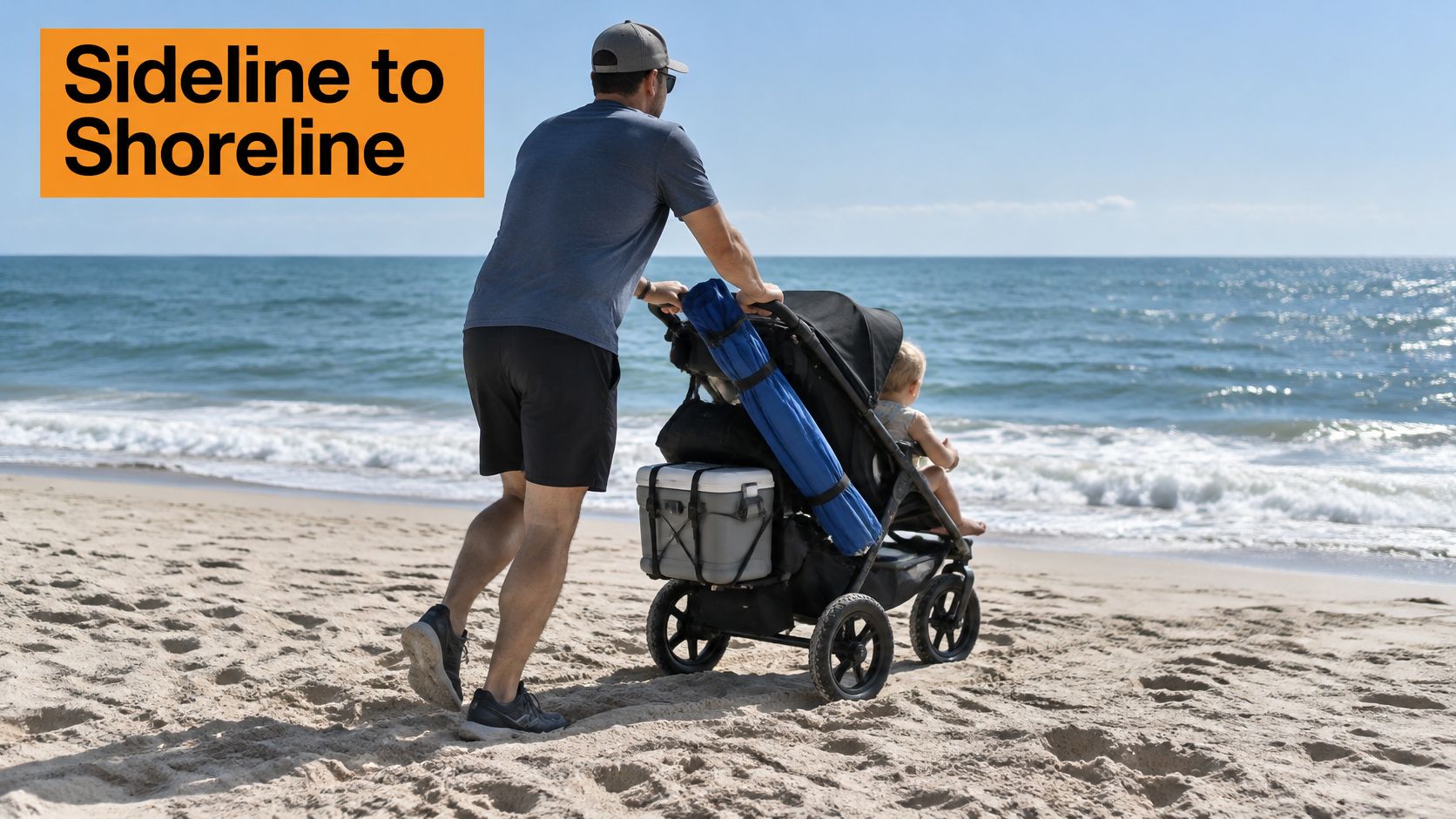
A beach outing may involve umbrellas, refreshments, and sand toys. Soft sand can take more pulling effort, and load placement affects how a wagon handles. All-terrain wheels help across sand, grass, and dirt, but do not guarantee the same effort on every route or under every load.
Renee B's website review describes her family's beach outing: “We love our wagon! Big kids tend to haul big things and this wagon fit everything we needed for a day at the beach. It was so easy pull on the beach.” That is an account of hauling convenience, not evidence about chemical content.
The scene also shows why families should choose infant transport and gear transport for their distinct uses.
Venue routes and rest stops
For a zoo visit or a parade, check the venue's wagon rules before setting out. Then consider the route's surface, walking distance, and where the group can stop; these details affect whether hauling gear and having a place to sit when parked will suit the outing. Adults should also consider whether they can maneuver and load the wagon comfortably.
For an infant, select a stroller with an age-appropriate, manufacturer-approved configuration. Compare all-terrain stroller considerations for uneven routes, and assess chemical documentation separately from terrain performance.
Confirm These Points Before You Buy
A certificate cannot establish that a stroller's brakes or frame work safely, and mechanical compliance says nothing about chemical content. Check both. A soft, padded seat deserves particular scrutiny because its foam or finish may contain flame retardants that a general marketing label does not disclose.
Before buying, request documents for the actual components:
Finished textiles: Ask for a current Product Class I certificate covering the seat pad and canopy, including relevant harness padding and finishes.
Accessible components: Match lead and regulated-phthalate reports to the applicable CPSC limits. An undated compliance badge is not enough.
Padding: Request a flame-retardant disclosure and relevant foam screening.
Mechanical compliance: Ask for the applicable stroller-standard statement, check recall information, and follow the manual's brake and fold-latch checks before use.
Long-term care: Confirm cleaning instructions and whether approved replacement covers are available with matching documentation.
For an infant who rides daily, prioritize an age-appropriate, properly configured stroller with material and mechanical evidence. For family gear transport, assess a wagon separately. Review the stroller-wagon buying guide to compare the category, but do not treat a padded bench as infant seating approval or a positive customer experience as laboratory evidence.
Match each claim to a document and each product to its intended job. Lounge Wagon offers a beach trolley and youth sports wagon for hauling equipment and seating after arrival, not as a substitute for a documented infant stroller. Choose transport suited to your child, then assess whether the gear-hauling setup fits your outing.
Choosing a selection results in a full page refresh.
This pad is perfect for kids or dogs to be comfortable inside the moving wagon, and very nice after you set everything up and want to sit for extra padding.
B
Wagon & 6' Xl Sports Umbrella Setup Beth Ritchey
Umbrella is a must
Having the umbrella this summer has been easy to use and a must to make sitting and watching the parade so nice when there isn't any shade. My dogs laid on the wagon padding and enjoyed the day without getting too hot. I enjoyed the shade too.