TL;DR: An outdoor bench with wheels should do two jobs safely: roll a loaded haul across sand, grass, or gravel, then become a stable seat when parked. Look for large, wide wheels, a positive brake or wheel lock, a rigid frame, and verified seating capacity. The Lounge Wagon combines a gear hauler with a padded two-person bench, making one trip practical for beaches, tournaments, festivals, and piers.
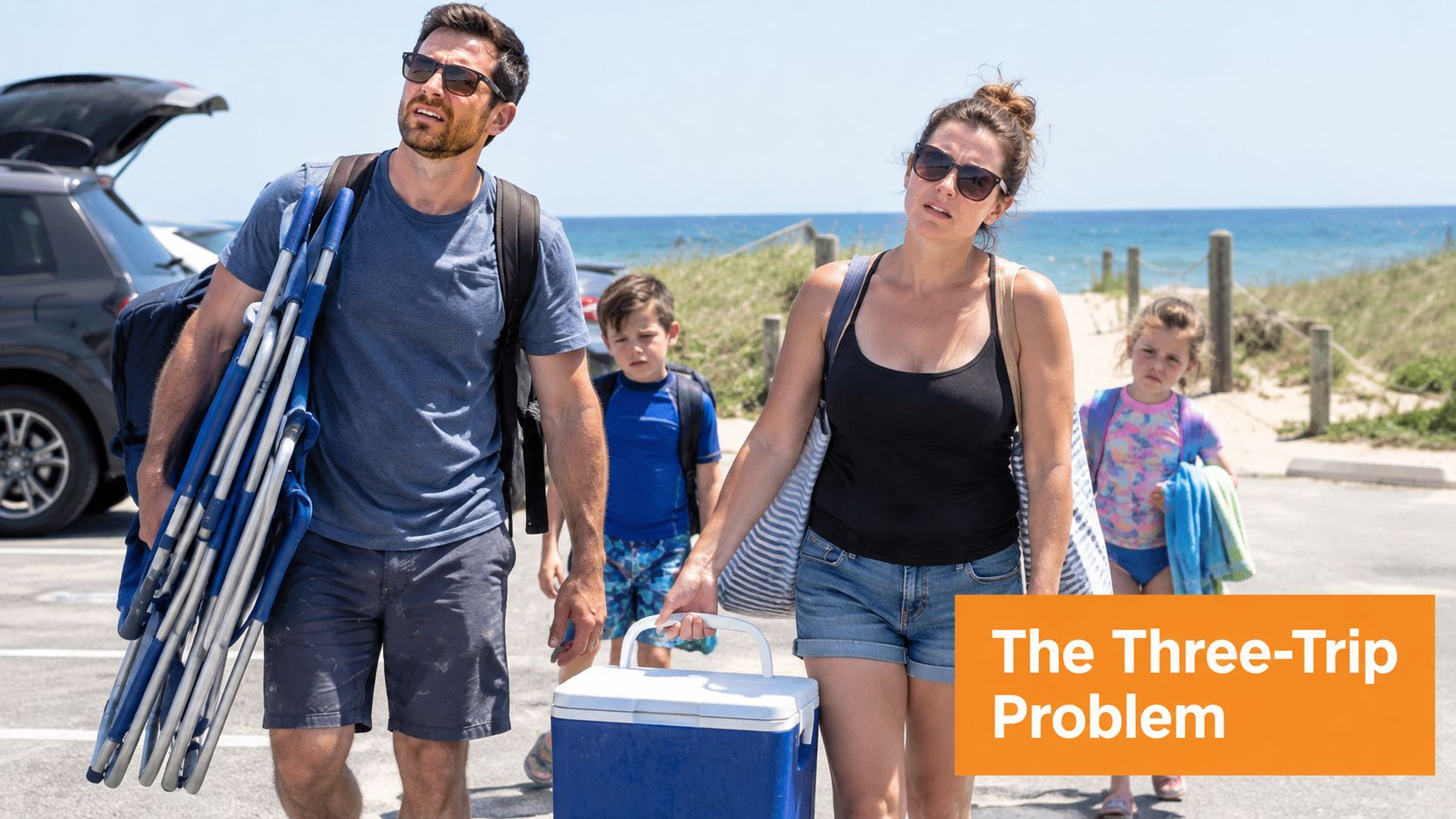
The parking lot is 400 yards from the beach access, the cooler is already sweating, and someone has handed you two folding chairs while the kids argue over who gets the umbrella. One trip takes the shade gear. The next takes the cooler and tote. The third is for the speaker somebody forgot, by which point the sun is sharp, wet sand is stuck to everything, and the morning feels like logistics instead of a day outside.
A heavier cart only makes the load easier to move after you've made multiple trips. A second adult helps, but doesn't solve the problem when both adults are already carrying gear. Even a rented beach wheelchair addresses a specific access need rather than giving the whole family one rolling load and a place to sit.
A 2-in-1 outdoor bench with wheels changes that sequence. Load the gear once, pull it across the surface, lock the wheels, and convert the hauler into seating at the spot. The practical promise is simple: haul more, sit better, and start the outing before everyone is worn out.
The Three-Trip Problem Every Outdoor Family Knows
Beach days expose weak outdoor equipment quickly. A folding wagon that behaves well on pavement can bog down at the surf line, while a separate bench or chair adds another item to carry. On Florida Gulf Coast sand, the difference between “all-terrain” on a product page and usable equipment becomes obvious within a few yards.
The first pass usually carries the umbrella, base, and shade tent. The second carries the cooler, towels, sand toys, and beach bag. The third is where the forgotten Bluetooth speaker, extra water, or fishing gear gets added, and every return walk feels longer because the family is already waiting in the heat.
Why ordinary carts don't finish the job
A utility wagon solves the hauling contract, but many stop there. The sides may fold, the handle may telescope, and the wheels may look rugged, yet the top often remains a cargo floor that isn't designed for an adult to occupy. Perching on a tailgate or cooler lid can shift the center of gravity and create the very wobble you were trying to avoid.
A separate beach chair solves comfort but costs trunk space and adds another object to unload. At a youth soccer complex, the same issue appears in a different form: the cooler, pop-up shade, folding chairs, and sports bags all need to cross gravel, then somebody still has to find a clean seat between matches.
The one-trip alternative
A convertible hauler earns its place when it carries the full load and becomes usable seating without a separate setup. The Lounge Wagon Beach Day Bundle is designed around that sequence, with a heavy-duty wagon platform that converts into a padded bench after arrival.
The useful test isn't whether a product has a seat panel. It's whether the transition is quick, the wheels can be secured, and the occupied bench feels like a bench rather than a cart that happens to have cushions. When those details work together, the family can unload once, park the wagon, and sit before the first towel is even spread.
What an Outdoor Bench With Wheels Actually Is
An outdoor bench with wheels is a hybrid product with two separate design contracts. In rolling mode, it needs balanced load distribution, low rolling resistance, a usable handle, and wheel geometry suited to the ground. In seated mode, it needs a level seat plane, a stable footprint, rigid locks, and a capacity appropriate for the occupants.
The distinction matters because a cart can roll well and still fail as seating. A frame that flexes under a concentrated load, wheels that remain free to swivel, or a narrow stance can turn a quick rest into an unstable perch.
The rolling contract
Rolling performance depends on more than the number of wheels. Larger diameters reduce the tendency to dig into soft ground, while wider contact patches spread the load over a broader area. Experimental rover research on loose soil found that increasing wheel diameter from 9 inches to 16 inches produced a reported 33% increase in traction at equal width and payload, as described in the loose-soil wheel study.
That finding isn't a direct rating for a consumer wagon, but it gives buyers a sound engineering principle. Sand, grass, and gravel punish small hard casters because they sink, slip, or catch on irregularities. A wheel system built for outdoor movement should match the surface rather than relying on the label “all-terrain.”
The seated contract
Seating begins when the wheels stop being a mobility feature and become a stability risk. A positive brake, wheel chock, or mechanical lock should prevent movement, and the frame should keep the load on a broad, rigid base.
The convertible outdoor bench guide explains the central category distinction: a convertible bench is not just a wagon with a flat lid. It combines a hauling structure with a seat surface and support system intended for occupied use.
A useful buying question is: Does this product become a stable bench, or does it merely let someone sit on the cargo area? The answer tells you whether you're buying a true 2-in-1 or a repurposed cooler hauler.
Key Features That Separate a Real Bench-Wagon From a Pretty Cart
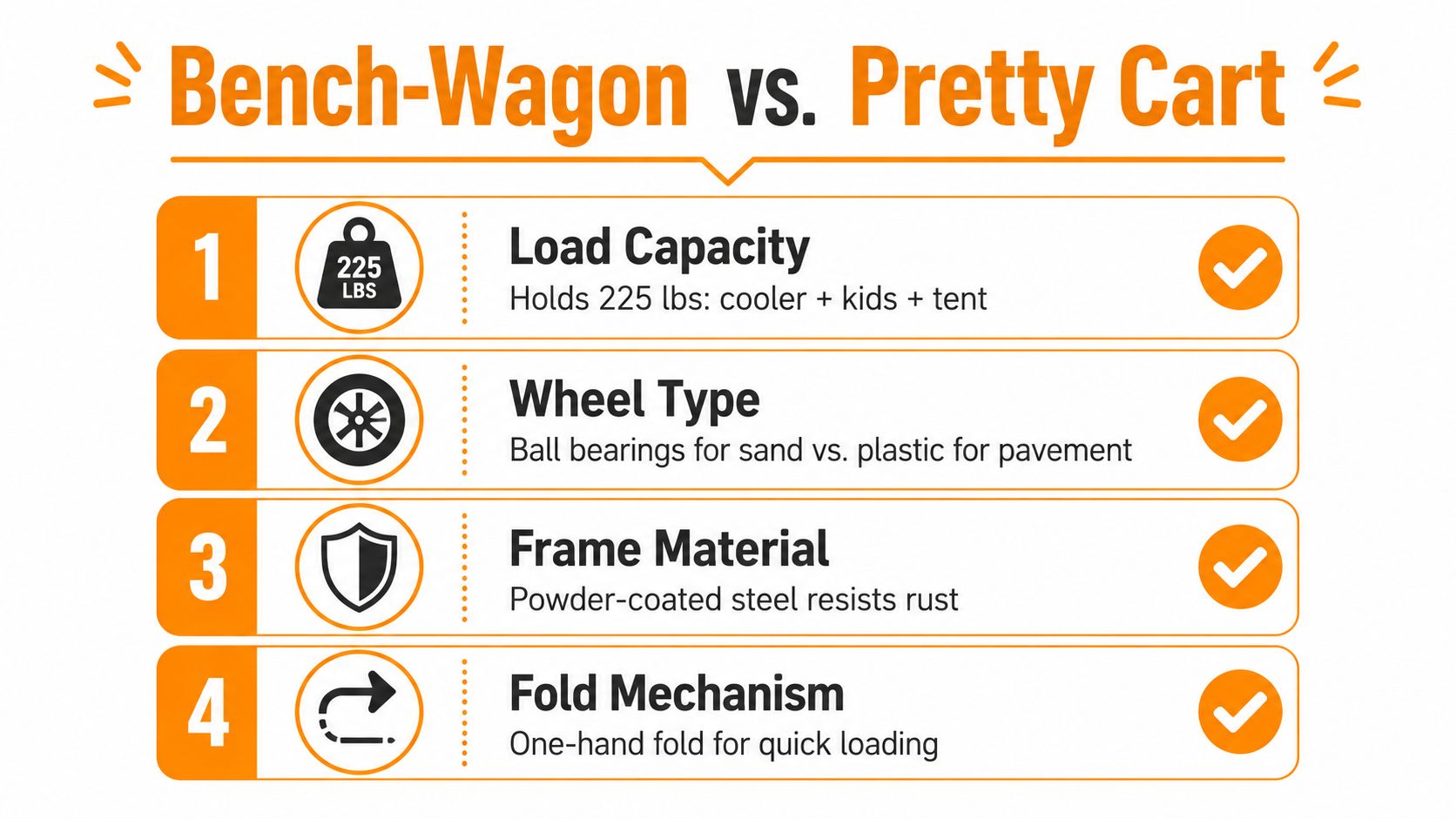
A good-looking cart can still be frustrating in the field. I judge an outdoor bench with wheels by what happens after it's loaded, when the path turns from pavement to gravel or the beach access drops into soft sand. Four features determine whether the product remains useful after the first impression fades.
Load capacity is about the real load
Capacity should cover more than the cooler. At a tournament, the wagon may carry water, chairs, a shade tent, balls, bags, and children who climb in during halftime. The load also shifts when someone sits off-center, so a headline maximum doesn't tell the whole story.
The Lounge Wagon lists a 500 lb capacity, which gives a family or team parent more room for bulky gear than a light folding cart. Capacity is valuable only when the frame, axle, seat panel, and braking system support the way people load and occupy the product.
Wheel size controls where you can go
Hard plastic casters are acceptable on a smooth patio. They're a poor match for deep sand, loose gravel, and rutted turf because they tend to catch or sink rather than roll.
The Lounge Wagon uses 10-inch puncture-proof wheels, so the practical benefit is less dragging when the route includes grass, beach approaches, and uneven sports-complex paths. Wheel width matters too, especially on soft ground, where a broader contact patch can reduce sinkage.
Frame material absorbs outdoor abuse
A powder-coated steel frame offers useful resistance to bending and abrasion during repeated hauling. Salt air, curbs, sloped turf, and a child climbing onto the seat all create different stresses, so a thin frame can feel fine in a showroom and less convincing after a season of use.
The cover matters as well. 1000D polyester provides a substantial fabric platform for gear and seating, but it still needs rinsing and drying after beach use.
Conversion should take seconds, not tools
The 2-in-1 feature has to work in the moment you need it. A quick-flip seat panel, supported backrest, secure wheel lock, and integrated storage are more useful than a complicated conversion that requires removing parts beside a crowded shoreline.
Practical rule: A real bench-wagon should roll loaded, lock firmly, and support seated use without asking you to improvise with a cooler lid.
The heavy-duty wagon wheels guide is useful background when comparing wheel construction and terrain performance. The buying question that matters most is straightforward: will it roll loaded, sit stable, and survive the salt?
Lounge Wagon vs Generic All-Terrain Wagons
Generic all-terrain wagons vary widely. Some focus on folding convenience and pavement movement, while others add seats without building a rigid seated platform. The Lounge Wagon takes a different approach by treating the hauler and bench as one product rather than separate accessories.
Feature
Lounge Wagon
Generic All-Terrain Wagon
Load capacity
500 lb stated capacity
Varies by model and must be verified
Seating
Padded 2-in-1 bench for two adults
Often cargo-only, or a basic seat attachment
Wheel system
10-inch puncture-proof wheels
Varies, with smaller wheels common on lighter models
Braking and parking
Wheel-locking function should be confirmed for the specific configuration
Often basic or absent
Frame and cover
Reinforced steel frame with 1000D polyester cover
Materials and durability vary considerably
The comparison isn't only about carrying weight. A wagon that rolls well but lacks a stable seat still requires separate chairs, while a seat attachment that doesn't lock the chassis can feel insecure on uneven grass. The Lounge Wagon's value comes from combining the two use cases, though buyers should still confirm the current product specifications and included accessories before ordering.
Some general market guidance can help frame the category. The global outdoor benches market was estimated at $4.8 billion in 2025 and projected to reach $7.2 billion by 2034, with a projected 5.3% CAGR, according to The Business Research Company's referenced market report. That estimate covers outdoor benches broadly, not convertible wagons, but it shows why seating products are increasingly relevant across homes, public spaces, recreation areas, and outdoor living.
For buyers comparing seating styles, Custom Mark's ultimate guide offers useful context on portable chair formats and the compromises involved in carrying dedicated seating. A convertible bench makes the most sense when trunk space and trip count matter as much as the seat itself.
Where an Outdoor Bench With Wheels Earns Its Keep
The best use case isn't a quiet patio. It's a crowded place where the route is uneven, the load is awkward, and sitting down matters as much as arriving. That's why the same wagon-to-bench design can serve a tournament parent, beach family, festival regular, or angler.
Youth soccer complexes
At a youth soccer complex, one pull can carry the cooler, chairs, pop-up shade, and team supplies across gravel parking areas and grass. Once the equipment is in place, the bench gives parents a clean, raised seat instead of forcing them to unfold multiple chairs between matches.
The 500 lb capacity also gives a tournament parent useful room for a heavy cooler and extra equipment, provided the actual load remains within the manufacturer's instructions. A stable parking position matters here because fields often have slopes, ruts, or uneven transitions.
Florida Gulf Coast beaches
Beach access paths punish small wheels. A broad, puncture-proof wheel system helps the wagon keep moving when the surface changes from pavement to boardwalk to soft sand, while the padded bench provides a place to sit without unpacking a separate chair.
The two-part benefit is practical: the wagon carries umbrellas, towels, toys, and refreshments, then becomes seating at the shoreline. Parents spend less time walking back to the car and more time watching the kids.
Festivals and markets
At a music festival or farmers market, the wagon creates a mobile base for blankets, purchases, water, and personal bags. A reliable brake or locking mechanism keeps it from drifting on a grassy slope, while the bench offers back-supported seating in a space where ground seating is uncomfortable and separate chairs are cumbersome.
The same arrangement works for tailgating, where one piece of gear can serve as both cargo support and a place to sit while the group waits.
Piers and fishing spots
A mobile angler may need to move a tackle bag, cooler, bait bucket, and rod equipment along a pier or packed shoreline. A bench surface means the angler doesn't need to bring a separate stool, which leaves more room for the gear that supports the day.
The Lounge Wagon product page lets buyers check the current configuration before matching it to their fishing load, beach kit, or tournament equipment.
A short product demonstration can be helpful when you want to judge the conversion rather than read about it.
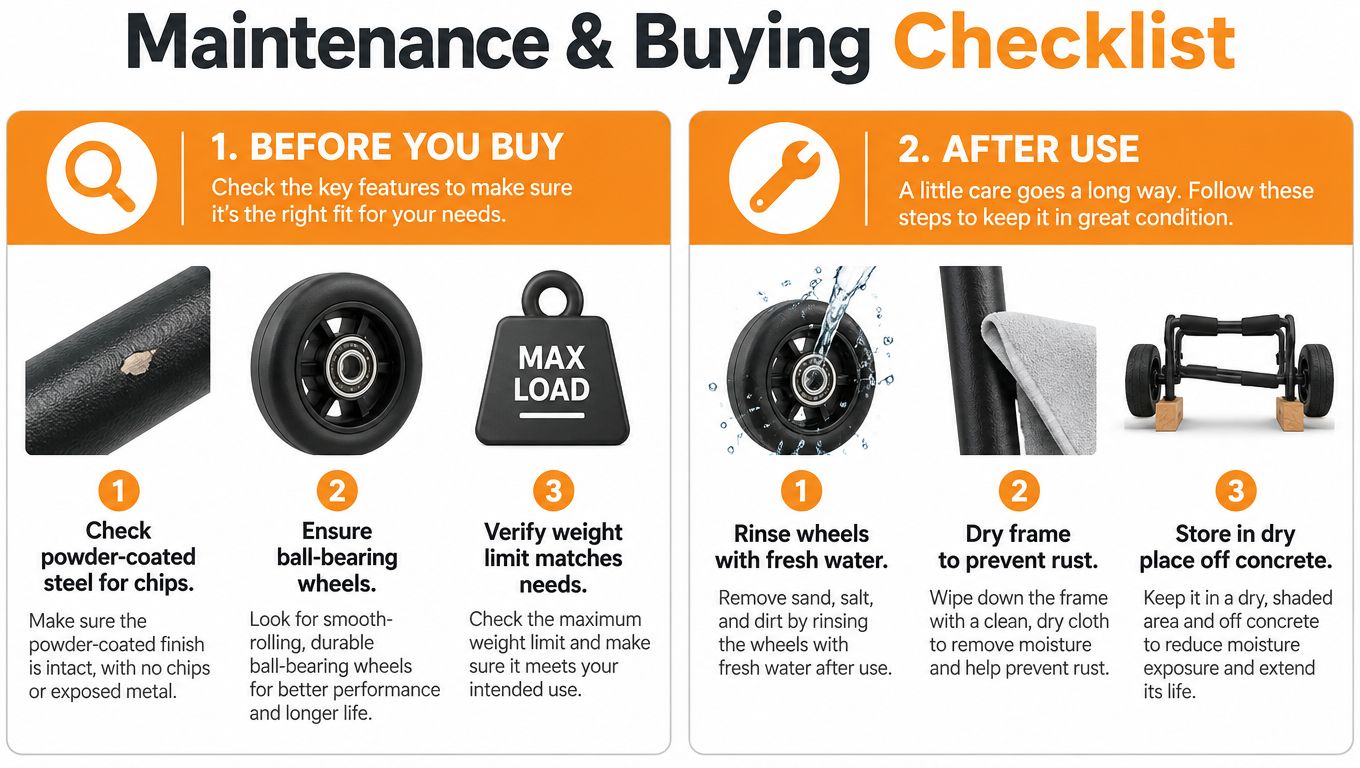
Maintenance and Buying Checklist Before You Load It Up
Outdoor equipment lasts longer when maintenance follows the surface it has seen. Beach sand and salt require more attention than a dry soccer field, while repeated folding puts extra stress around joints and latch points.
Before buying
Check the product in the order you'll use it, starting with the load and ending with the seat.
Verify capacity: Confirm the actual stated limit and compare it with your heaviest normal combination of cooler, children, shade gear, and bags.
Inspect the frame: Look for a rigid, powder-coated steel structure and examine fold joints for gaps, chips, or flex.
Match the wheels: Choose wheel diameter and tread for your regular terrain, not just the smooth surface outside a store.
Test the lock: Make sure the brake or wheel lock engages positively and keeps the wagon from creeping.
Confirm bench mode: Sit on the padded surface, check the backrest support, and verify that conversion doesn't require loose parts or tools.
After beach and field use
Rinse the wheels and bearings with fresh water after a beach trip. Salt and sand can work into moving parts, increase friction, and accelerate wear around the axle.
Clean the 1000D polyester cover with mild soap and water, then let it dry fully before storage. Avoid bleach, which can damage protective coatings and weaken fabric over time.
The wagon maintenance guide provides a useful routine for keeping the frame, wheels, and fabric ready for the next outing. Store the wagon dry and off bare concrete when possible, especially in humid coastal conditions.
Common Questions Real Buyers Ask First
Is it genuinely a bench?
A legitimate convertible bench needs more than a flat cargo top. It should provide a padded seat, back support, a reinforced frame, and a wheel-locking system that keeps the chassis settled while occupied.
The Lounge Wagon is described as a 2-in-1 gear hauler and luxury bench with seating for two adults. Its 500 lb capacity applies to the overall product specification, but buyers should still follow the current instructions for how much weight belongs in hauling mode versus seated use.
Can the wheels handle soft beach sand?
Wheel design makes soft sand easier, but no wagon eliminates the physics of deep, loose terrain. Wider tires distribute pressure more effectively than narrow hard casters, and pulling from the front handle generally gives better control than trying to push a heavy load through a soft patch.
Choose a route with firmer sand when available, keep the load balanced, and avoid expecting a compact cart to behave like a powered beach vehicle. The beach wagon FAQ offers a practical way to compare terrain, family size, and equipment needs before purchasing.
Is the premium price justified?
The answer depends on what the wagon replaces. If you already own a reliable cart and comfortable chairs, a conversion feature may not add enough value. If you regularly carry a cooler, shade equipment, children's gear, and seating, combining those functions can reduce trunk clutter and setup time.
Look at durability as part of the calculation. A powder-coated steel frame and 1000D polyester cover are intended for repeated outdoor use, but buyers should still rinse salt, dry the fabric, and respect the stated capacity.
How stable should it feel when occupied?
It should feel like a parked bench, not a rolling cart. The Lounge Wagon accessories page can help you identify the current add-ons and configuration, but the essential checks remain the same: wide stance, level seat, positive lock, and no unwanted wheel movement.
Make It a One-Trip Walk to the Shoreline
The payoff arrives at the parking lot. You load the cooler, chairs, umbrella, towels, toys, and speaker into one wagon, pull across grass and sand, lock it at your spot, and flip it into a padded bench while the kids climb aboard.
That one trip replaces the familiar shuffle of cooler, chairs, and shade gear. It also changes how long the family can stay, because everyone begins with a seat instead of an exhausted walk back to the car.
The decision should come down to your real route and real load. If you spend weekends at youth soccer complexes, Florida Gulf Coast beaches, festivals, piers, or campgrounds, check the current dimensions, wheel setup, capacity, colors, and bundles on the Lounge Wagon product details page before you buy. For more practical loading ideas, use this guide to hauling heavy gear to the beach alone.
Lounge Wagon combines a heavy-duty gear hauler with a padded 2-in-1 bench, so you can move more equipment and still have a comfortable place to sit when you arrive. Visit Lounge Wagon to check the current specifications, color options, and bundle availability, then make your next beach, tournament, festival, or pier trip a one-trip walk.
Choosing a selection results in a full page refresh.
This pad is perfect for kids or dogs to be comfortable inside the moving wagon, and very nice after you set everything up and want to sit for extra padding.
Having the umbrella this summer has been easy to use and a must to make sitting and watching the parade so nice when there isn't any shade. My dogs laid on the wagon padding and enjoyed the day without getting too hot. I enjoyed the shade too.