Last Updated: August 2026
TL;DR: The right all-terrain stroller depends on where you push, how much you carry, and whether your child needs a dedicated seat. Large wheels, useful suspension, reliable brakes, and a lockable front wheel matter on rough ground. For gear-heavy outdoor days, a 500 lb-capacity, 2-in-1 wagon-bench can replace separate seating and cargo hauling, while a stroller remains more practical for everyday walks, tight spaces, and travel.
The three-trip walk from the car is familiar. You unload the children, return for the folding chairs and cooler, then make one more trip for the forgotten water bottles, sunscreen, and stroller. By the time everyone reaches the soccer field or beach, the outing has already taken more energy than the activity itself.
A serious all-terrain stroller solves rough-surface mobility, but it doesn't always solve the larger logistics problem. It still gives you a child seat with limited room for chairs, coolers, sports bags, and the rest of the day's equipment. For many outdoor families, the more useful comparison is a stroller versus a 500 lb-capacity, 2-in-1 wagon-bench that carries the load and provides a place to sit.
The Three-Trip Problem and Why It Matters
At a youth soccer complex, the parking lot can feel farther away than it looked from the car. One parent carries the cooler, another takes the chairs, and a child who walked happily from the house suddenly refuses to cross the grass. The stroller may handle the field, but it rarely handles the entire load without forcing you to choose what stays behind.
That choice creates fatigue before the game begins. You're managing children, drinks, blankets, snacks, sports equipment, and personal bags while keeping one hand available for a tired toddler. The return trip is worse because the children are more tired, the cooler is heavier, and the gear still has to reach the car.
The real measure is total trip load
A stroller's advertised terrain ability tells only part of the story. The practical question is whether it moves people and equipment together, without making you carry a second seat or return to the vehicle.
A heavy-duty wagon-bench changes the calculation:
-
Cargo first: An open bed can take coolers, sports bags, towels, umbrellas, and folding equipment without forcing everything into a small basket.
-
Seating second: The same platform can give two tired children a place to rest instead of requiring a separate stroller and chairs.
-
One-trip value: Fewer walks between the car and the venue mean less lifting, less back strain, and fewer forgotten items.
Lounge Wagon describes its product as a gear hauler that converts into a padded bench for two, with 500 lb capacity and outdoor wheels. You can view the Lounge Wagon if your typical outing includes more than one child and a substantial equipment load.
Field rule: Choose the gear that solves the whole outing, not just the surface beneath the wheels.
That doesn't make a wagon the universal replacement for an all-terrain stroller. A stroller is usually easier for a daily neighborhood walk, a store aisle, or a child who needs a close-fitting harness and reclined ride. The point is to measure the complete trip, including cargo, seating, parking distance, and how often you return to the car.
What Actually Makes a Stroller All Terrain
“All-terrain” should describe a stroller's construction, not just its marketing position. A useful evaluation starts with five filters: wheel diameter, tire construction, suspension, frame design, and payload.
Start with the wheels
Independent testing guides commonly distinguish 12 to 16 inch wheels from the smaller wheels found on standard strollers. Larger wheels roll over roots, gravel, and curbs more effectively because they meet obstacles at a less aggressive angle and send less vibration into the frame and handlebar. Stroller360's all-terrain guide explains why wheel diameter and suspension work best as a pair.
An 8-inch wheel may be comfortable on sidewalks, while a larger wheel is more useful on grass, gravel, and uneven paths. For loose sand, wheel width and tire deformation matter as much as diameter.
Tire material changes the ride:
-
Hard plastic is durable but transmits more impact.
-
EVA foam avoids inflation but can feel firmer over roots.
-
Air-filled pneumatic tires cushion better and spread load on soft surfaces, though they need pressure checks and can puncture.
-
Foam-filled or solid rubber tires reduce maintenance but don't always match the compliance of a properly inflated air tire.
Suspension and frame decide what the wheels can deliver
Suspension can use springs, elastomer components, or an articulated frame. Push down on the seat and watch the rebound. A controlled return suggests useful movement, while a frame that barely moves or flops back gives you little reason to expect a smooth ride over repeated bumps.
A steel frame can bring strength with added weight. Aluminum can reduce lifting effort, while hybrid designs balance rigidity and mass. The right choice depends on whether you're loading a small child for a walk or carrying a larger child with equipment.
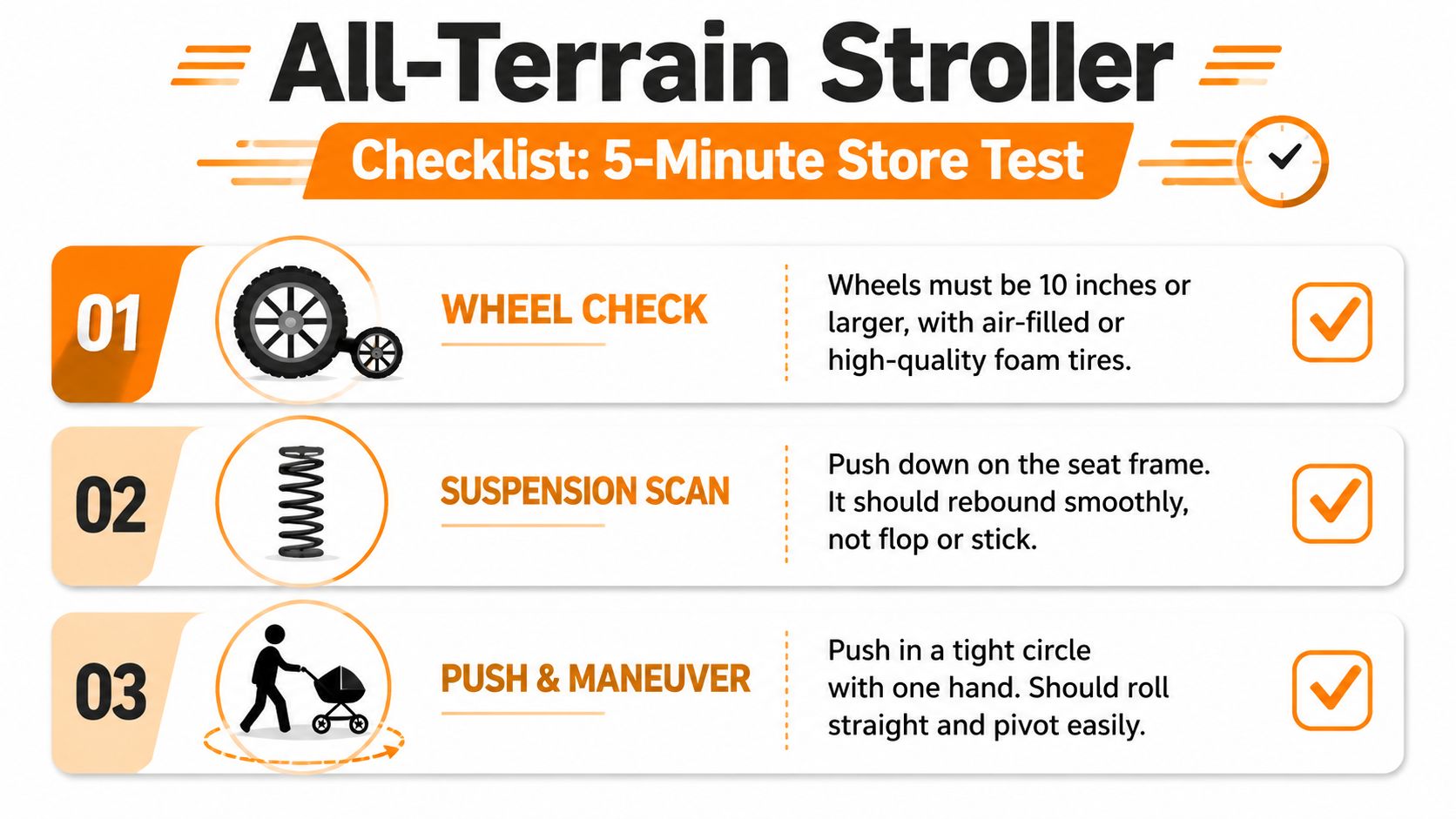
Use capacity as a hard filter
Many dedicated strollers have a child-and-cargo limit that makes sense for their intended use. A heavy-duty wagon is built around a much larger payload, so it can carry children and equipment without treating the storage basket as an afterthought.
Before buying, check:
-
The combined load: Count the child, bags, food, water, and accessories.
-
The front wheel: Confirm whether it locks for straight tracking or swivels for tight maneuvering.
-
The actual surface: Test grass, packed gravel, and sand separately.
-
The folded footprint: Measure your trunk, doorway, and storage space.
For a deeper look at wheel construction, read how stroller wheels affect all-terrain performance. A product that passes all five filters deserves the label. One with small wheels, little suspension, and a low payload may be fine on paved paths, but it isn't a convincing off-road tool.
All Terrain Stroller vs Heavy-Duty All Terrain Wagon
An all-terrain stroller and a heavy-duty wagon address different parts of an outdoor outing. The stroller focuses on a shaped child seat, harness, quick steering, and controlled rides. The wagon focuses on carrying children alongside coolers, chairs, bags, and other equipment.
| Criteria |
All Terrain Stroller |
Heavy-Duty All Terrain Wagon |
| Primary job |
Carry one or two children in dedicated seats |
Carry children, coolers, chairs, and equipment |
| Payload approach |
Limited child-and-basket capacity |
500 lb capacity for people and cargo |
| Terrain setup |
Large wheels and suspension, model dependent |
Wide outdoor wheels and open ground clearance |
| Seating |
Forward-facing stroller seats |
2-in-1 seating, with a bench configuration |
| Storage |
Under-seat basket and pockets |
Open bed for totes, chairs, coolers, and bags |
| Best environment |
Neighborhoods, parks, trails, and daily errands |
Sports complexes, beaches, festivals, tailgates, and campsites |
| Main compromise |
Limited cargo and larger folded frames |
Bulkier than a compact stroller in tight spaces |
The total-trip calculation often favors the wagon on gear-heavy days. A stroller can carry a child comfortably, while a cooler, folding chairs, and sports bags still require another carrier. A wagon combines those jobs and converts into seating at the destination. Lounge Wagon's guide to wagons with seats explains how this two-use format changes outing planning.
That difference also affects fatigue. Fewer separate loads mean fewer trips from the vehicle, less gear balanced in your hands, and a place to sit once you arrive. For families carrying equipment as well as children, a 500 lb capacity wagon with 2-in-1 seating can provide more practical value than a single-purpose stroller, even when the stroller is easier to steer.
Terrain depends on the surface
Both categories can perform well on grass, packed gravel, and ordinary park paths when their wheels and frames suit the ground. Loose sand is more demanding. Air-filled tires deform under load and spread weight, while small travel-stroller wheels tend to sink. Air tires can still sink more in loose sand than packed sand, as described by The Bump's guidance on strollers for sand.
A wagon with wide, surface-specific wheels may handle beach logistics better than a narrow stroller. Austlen's beach wheel design examples use unusually wide wheel dimensions for travel between sand and boardwalk. That design difference shows why an “all-terrain” label alone does not confirm beach performance.
For daily walks, a stroller remains easier to steer, contains the child more closely, and fits through tight doors. For outdoor days where seating, cargo, and fewer hauling trips matter as much as mobility, the wagon earns its space in the vehicle.
Matching the Right Setup to Your Outdoor Life
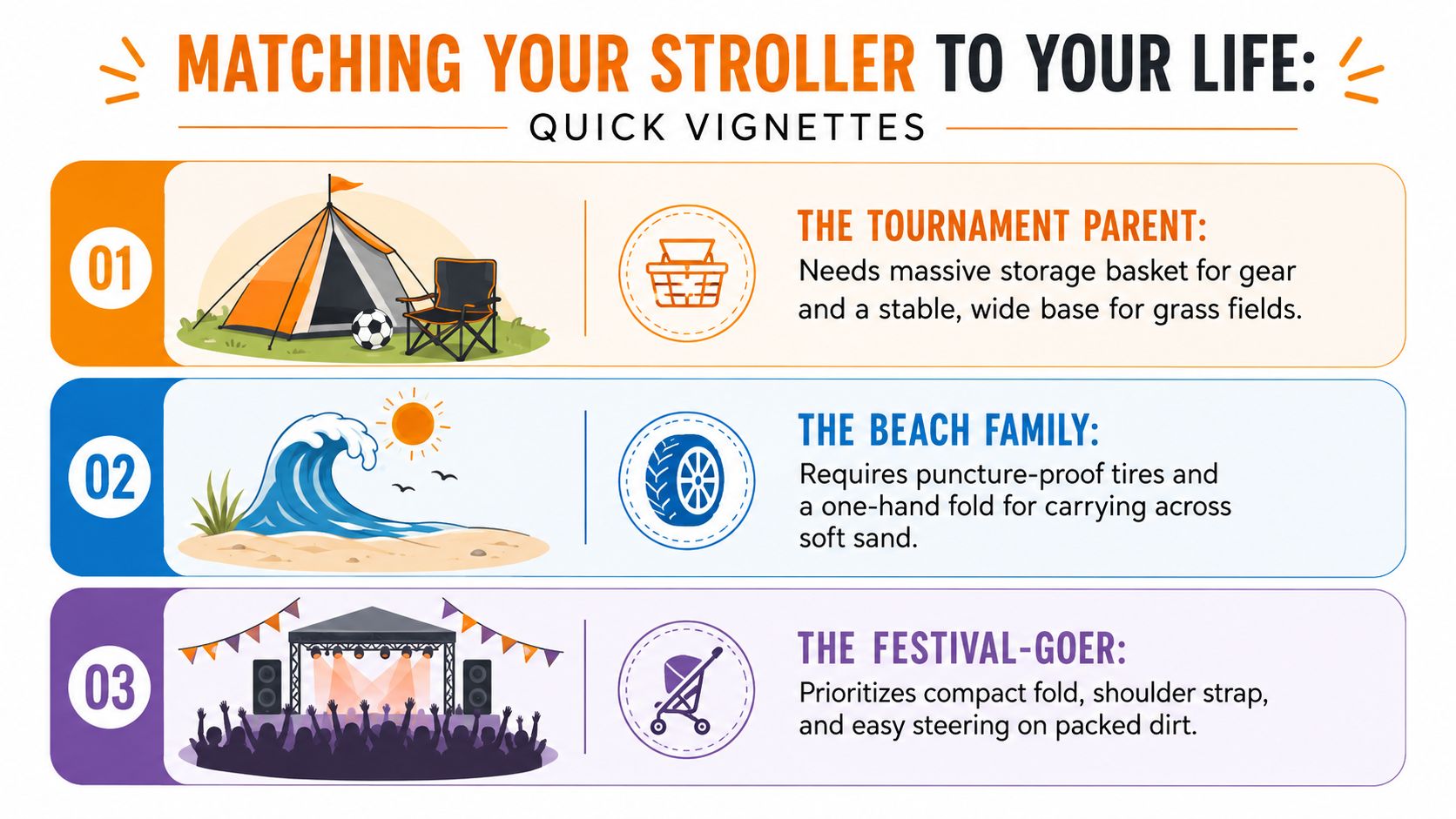
At a tournament, the parent with the sleeping child usually has the least free capacity. One arm supports the child, the other drags a cooler, and the folding chairs are balanced against a sports bag. A dedicated all-terrain stroller handles the rider, but the rest of the setup still needs a solution.
The tournament parent
Soccer and lacrosse complexes reward large cargo capacity and stable rolling on grass. A wagon-bench can carry the team cooler, tent, blankets, and bags, then provide a bench when the match ends. The 500 lb capacity and 2-in-1 seating matter because the same product handles transport and rest without adding separate chairs.
The beach family
Soft sand exposes weak wheel designs quickly. Small wheels drag, narrow tires cut into the surface, and a free-spinning swivel wheel can wander. Families heading to the Florida Gulf Coast should prioritize wide wheels, appropriate tire construction, and a realistic plan for loose sand rather than trusting an all-terrain label.
For active families bringing a dog, safe control of the animal matters too. A practical resource on how to find a harness for active dogs can help keep a dog secure while you push or pull loaded gear.
The festival and market regular
Crowded festivals create a different problem. You need a stable home base, but you also need to move through packed dirt, people, blankets, and vendor spaces. A wagon offers room for chairs and purchases, while its bench mode gives adults a supported place to sit instead of lowering themselves onto the ground.
Grandparents, anglers, and tailgaters
Grandparents often need frequent rest stops between the parking area and a zoo, parade, or venue. A bench eliminates the need to carry a separate chair and gives children a predictable place to settle.
Anglers have a similar calculation. Tackle boxes, bait, rods, and food occupy the cargo space, while an integrated seat avoids adding a stool. Tailgaters and campers can also use one platform for transport and seating, which helps when an SUV is already full.
Event volunteers and youth coaches benefit from the same layout. Signs, water containers, and supplies go in the bed, then the bench becomes a practical registration or rest seat. The family wagon cart guide is useful for comparing those multi-purpose jobs against a single-purpose stroller.
Testing, Tuning, and Maintaining Your Gear
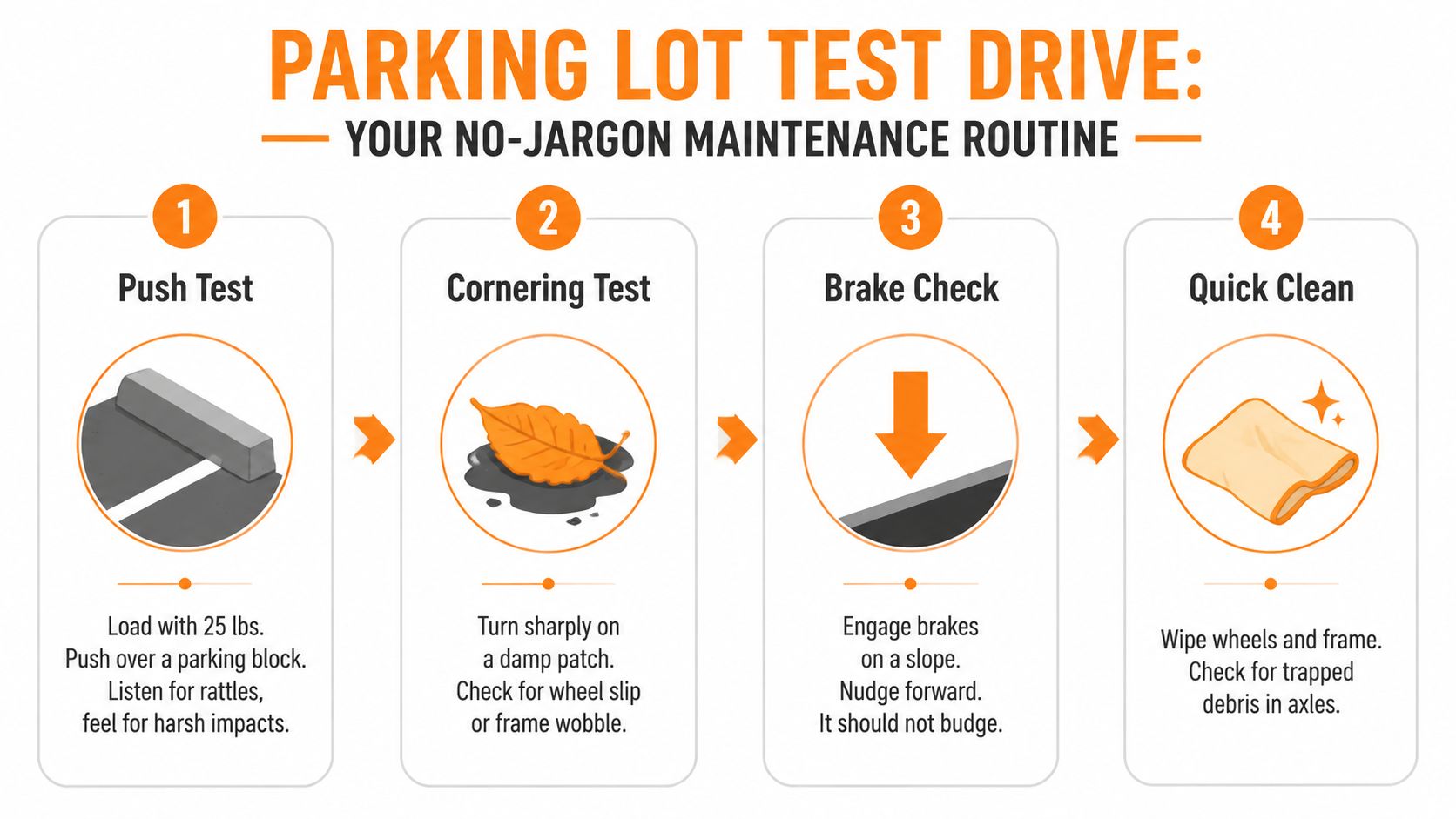
A showroom floor can make almost any stroller look capable. The useful test happens when you load it, turn it, stop it, and fold it while managing the distractions that define a real outing.
Run four simple tests
Start with a curb or low parking block. Add a realistic load, push slowly, and listen for rattles. The handle should stay controlled rather than twisting sharply when the front wheel meets the obstacle.
Next, turn on damp grass. A stroller that slips, skates, or develops frame wobble may feel much less predictable on wet turf. Then engage the brake on a gentle slope and nudge the handle forward. The product shouldn't roll away.
Finish with the fold. Time yourself through the complete process, including removing accessories and fitting the folded unit into your vehicle. A fold that looks simple with an empty stroller may be frustrating when you're holding a child and carrying bags.
Read the tire before reading the label
Look for diameter, tread pattern, width, and construction. Air-filled tires can improve comfort and soft-surface flotation, but they require pressure checks. Foam-filled and solid tires reduce the chance of a flat, although they may feel firmer over rough ground.
Maintenance should follow the surface you use:
-
After sand exposure: Brush and wipe wheel areas so grit doesn't work into bearings or axles.
-
After wet grass or mud: Clean the frame and inspect moving joints before storage.
-
Before long outings: Check tire pressure, wheel bolts, brake engagement, and harness hardware.
-
Throughout the season: Lubricate approved hinges and replace damaged parts instead of forcing them.
Avoid pressure-washing bearings, and don't apply silicone products to rubber grips unless the manufacturer specifically permits it. Keep likely replacements, such as tubes or fasteners where applicable, available before a major trip. Lounge Wagon's maintenance guide offers a useful reference for keeping wagon hardware and wheels ready for outdoor use.
Safety Standards Every Parent Should Know
In the United States, ASTM F833 is the core consumer safety specification for carriages and strollers. It was first approved in 1983 and has been revised more than 20 times, with ASTM F833-21 applying to products manufactured after February 15, 2022, according to the U.S. regulatory text referencing the stroller standard.
The standard matters because uneven-ground products face specific risks. Testing addresses tipping, braking, entrapment, and stability, so “rugged” construction still needs to work within a formal safety framework.
The parking-brake requirement is especially practical. Under the referenced test, the brake must remain engaged and prevent the braked wheels from rotating more than 90 degrees during the specified five-cycle test, as shown in the ASTM F833-21 sample.
| Standard requirement |
What it actually tests |
What you should do in-store |
| Parking brake |
Whether the parked product stays controlled |
Engage the brake once, then apply a gentle forward and backward nudge |
| Stability |
Resistance to tipping on uneven conditions |
Push over a small threshold slowly and watch the frame and front wheel |
| Restraint system |
Whether the child remains positioned during movement |
Inspect the harness adjustment, buckle, and attachment points |
| Entrapment protection |
Whether openings or folding joints create hazards |
Run a visual check around hinges, gaps, and accessible moving parts |
| Structural integrity |
Whether the frame and attachments remain secure |
Check for looseness, unusual flex, rattles, or damaged hardware |
A wagon-style product may sit outside the exact stroller category, depending on its design and intended use. That doesn't remove the need for equivalent caution. Any child-carrying gear used around crowds, slopes, or uneven ground should have dependable braking, secure seating, and a load rating that matches the actual outing.
Parents researching broader baby-gear safety can also consult guidance on which baby bottle is safer. The same habit applies here: inspect the specific product, follow its instructions, and don't treat a category label as a substitute for safe use.
Before leaving home, check:
-
Wheels: No loose axle, damaged tire, or trapped debris.
-
Brake: Fully engaged and visibly holding.
-
Seat or bench: Secure fabric, frame, and support points.
-
Restraint: Buckle closes and adjusts correctly.
-
Load: Children and cargo remain within the stated limit.
When a Standard Stroller Still Makes More Sense
Bigger isn't automatically better. A compact stroller wins in narrow store aisles, subway turnstiles, small elevators, and apartment hallways where a wide wheelbase turns every corner into a negotiation.
Air travel is another clear exception. Large all-terrain units may need gate checking, and oversized wagons rarely suit overhead storage or tight aircraft handling. A lighter stroller or baby carrier can keep the airport transfer manageable, especially when the trip includes multiple security and boarding transitions.
Newborn needs can outweigh terrain features
For a newborn, recline angle, bassinet support, and car-seat compatibility may matter more than wheel diameter. Parents should follow the product's age and positioning instructions rather than assuming that a rugged frame is ready for every stage.
A standard stroller also makes sense when your routine is mostly pavement and you don't carry coolers, chairs, sports bags, or beach equipment. The smaller frame usually stores more easily, turns faster, and demands less lifting.
Apartment families should measure stairs, closets, doorways, and vehicle space before buying. A stroller that fits the terrain but stays folded in a storage room because it's difficult to move isn't a practical solution.
Jogging strollers deserve their own distinction. A lockable front wheel and hand brake are valuable for running and descents, while an all-terrain stroller emphasizes shock absorption and rough-surface control. If your main activity is a neighborhood run, choose running control. If your main activity is a wide trail, beach approach, or sports field, choose the construction that matches that surface.
These aren't contradictions to the one-trip argument. They're conditions. Use the lighter tool when mobility through tight urban spaces is the dominant problem, and choose the larger cargo-and-seating platform when outdoor logistics are what repeatedly wear you down.
Making the One-Trip Decision
Use three questions before you compare models.
-
How many bodies and bags move with you? If one child and a small diaper bag are the full load, a stroller may be enough. If you regularly move multiple children, coolers, chairs, sports bags, or beach equipment, you need more than a stroller basket.
-
What surface dominates your weekends? Packed gravel and grass are easier than loose sand. Match wheel width, tire construction, suspension, and braking to the hardest surface you use.
-
Are you making multiple trips from the car? Repeated returns for seating, drinks, or equipment are a sign that your transport system is undersized.
Cargo plus seating plus uneven ground points toward a 500 lb-capacity, 2-in-1 wagon-bench. A single child, pavement-heavy routine, newborn setup, or frequent air travel points toward a standard or jogging stroller.
Keep the final checks practical. Test the brake, inspect the frame, confirm the load rating, and make sure the folded product fits your vehicle and home. If a larger platform will replace separate chairs and a gear cart, the calculation is about fewer lifts and simpler outings, not just wheel size.
For families focused on beach access and heavy loads, this large beach cart guide is a useful final comparison.
Lounge Wagon combines heavy-duty outdoor hauling with 2-in-1 seating, giving families a way to move children, coolers, chairs, and supplies before creating a comfortable place to rest. Visit Lounge Wagon to turn the exhausting three-trip walk into a simpler one-trip outing.


