Last Updated: September 2026
If you want one piece of outdoor gear that earns trunk space, buy a heavy duty pull wagon that hauls real weight, rolls on wide wheels, and gives adults a place to sit when you arrive. Capacity matters, but terrain and seating matter more. One-trip hauling beats three sweaty laps every time.
Meta description: Heavy duty pull wagon guide for 2026. Find the right hauler-plus-bench setup for sand, grass, and tournaments. Shop smarter now.
The exhausting walk usually starts in the parking lot. First trip is chairs. Second trip is the cooler, toys, and half the food. Third trip is the umbrella, the dog gear, the extra bag you forgot, and a kid who suddenly refuses to walk. By the time you reach the sand or the sideline, everyone's already irritated.
That's why I'm opinionated about this category. Many shoppers don't need a wagon that merely carries stuff. They need a two-product mobility platform that handles the load on the way out, then gives adults a decent place to sit once the hauling is done. If you're planning weekends around beaches, youth soccer, festivals, fishing, or campground walks, that difference matters a lot more than a flashy “all-terrain” sticker.
For families planning coastal outings, family beach trip packing and hauling ideas make the problem obvious fast. The less you carry by hand, the better the day goes.
The Three-Trip Problem Every Outdoor Family Knows
The parking lot tax
Outdoor families pay the same tax every weekend. You unload at the curb, stack too much in your arms, drop something before you make it halfway, then go back for another round. At the beach, the walk feels longer because soft ground steals energy with every step. At a sports complex, you're racing the clock before warmups start.
It gets worse when the group spans ages. One grandparent can't do the second lap. One toddler wants to be carried. One parent is balancing folding chairs against a shoulder while trying not to spill drinks out of a tote. None of that is hard once. It's hard when you do it over and over.
What ruins most outdoor days isn't the destination. It's the setup.
Why the first half hour sets the tone
I've watched this happen at crowded soccer fields, beach access paths, and festival lots. Parents burn energy before the day begins. Kids get impatient because setup drags. Adults start making dumb decisions, like leaving useful gear in the car because they can't face another walk.
A good heavy duty pull wagon fixes a practical problem first. It turns scattered loose items into one controlled load. Better still, the right one keeps helping after arrival by doubling as a place to sit, especially when benches are full, wet, or too far from your setup.
The shift that actually matters
This is the mindset shift: stop shopping for a cargo box on wheels. Start shopping for something that replaces both hauling and seating. That's the standard I use now, because a wagon that only works on the walk out solves half the day.
What a Heavy Duty Pull Wagon Actually Is
Start with the plain-English definition
A heavy duty pull wagon is a hand-drawn, four-wheeled carrier built to move real loads across uneven ground. It isn't a toy cart, and it isn't a grocery buggy with delusions of grandeur. It should handle bulky gear, stay composed on rough surfaces, and keep the load stable when the ground gets weird.
The basic hauling idea is old. The earliest credible evidence for the wheelbarrow comes from China around 100 to 118 CE during the Han dynasty, with similar designs not showing up in Europe until roughly 1170 to 1250 CE. That puts East Asia about 1,000 to 1,150 years ahead on the core load-over-wheel concept that modern carts still use today, as outlined in this history of the wheelbarrow's early development.
Why history still matters in a parking lot
That old engineering principle still holds. Put the load where the wheels can carry it efficiently, and one person can move what would otherwise take multiple people. That's the same reason utility wagons became popular far beyond farms and worksites.
Today's market treats wagons and carts as a mature category with segments like utility wagons, dump carts, flatbed carts, and folding wagons, according to garden wagon and cart market segmentation. That tells you this isn't novelty gear anymore. Buyers want something purpose-built for grass, gravel, sand, and mixed-use weekends.
The smarter way to think about the category
Most shoppers still evaluate these wagons like static cargo carriers. That's too narrow. The better frame is this: a serious wagon should work as a hauler on the move and a bench at destination.
If you're comparing use cases, this guide on choosing a sports wagon caddie is useful for seeing how families and sports parents prioritize transport differently from casual users. For the same push-versus-pull decision, pull wagon versus push wagon tradeoffs are worth understanding before you buy.
Key Specs That Separate Real Wagons From Pretenders
Capacity is only one part of the story
People get hypnotized by weight ratings. That's a mistake. Capacity matters, but it only matters if the frame, wheels, fabric, and geometry support that load in the world.
A solid benchmark is 500 lb capacity when you want a real heavy duty pull wagon. That gives room for coolers, chairs, umbrellas, sports gear, and the random extra junk every family somehow accumulates by noon.
The five specs I care about
-
Frame material: A reinforced steel frame matters because loaded wagons twist at stress points first. A stouter frame means less flex when the wagon hits ruts, curbs, or uneven grass.
-
Wheel diameter: Bigger wheels roll over obstacles more cleanly. A 7 to 10 inch wheel range is common in all-terrain wagon reviews, which is exactly what you want when the path includes gravel, dirt, or broken ground, as noted in this 2026 all-terrain wagon category review.
-
Wheel width: Width decides whether the wagon floats or digs. On sand and other loose ground, wide tread wins.
-
Fabric durability: Heavy gear and wet gear punish cheap liners. Durable polyester with reinforced stitching lasts longer and resists the daily abuse of sunscreen, sand, and cooler condensation.
-
Handle design: A padded handle with enough length and good pivoting keeps your shoulders from doing all the work when the load shifts.
The spec-sheet traps that fool people
-
Narrow wheels with big promises: A wagon can have a respectable weight rating and still be miserable to pull.
-
Tall sidewalls without stability: High cargo walls tempt people to stack upward, which raises the center of gravity and makes tip-over more likely.
-
Folding gimmicks over structure: Easy fold is nice. Easy fold plus weak joints is junk.
Practical rule: Don't buy a wagon by capacity alone. Buy the wheel and frame package that lets you actually use that capacity.
For a deeper look at what weight ratings mean in practice, wagon towing capacity explained is the right place to separate label claims from usable hauling.
How a Heavy Duty Wagon Handles Real Terrain
All-terrain is the most abused label in this category
Almost every collapsible cart gets called all-terrain now. That word means very little unless you know the wheel diameter, the wheel width, and the tire material. In real use, those three details decide whether the wagon rolls, bogs down, or tips sideways when one wheel finds a rut.
Independent buying guidance gets this right. For sand and loose ground, look for tread widths of 3 inches or more, and for dedicated sand use, 3.5 inches or wider with at least 7-inch diameter wheels. It also warns that narrow plastic wheels sink and drag, which matches what anyone who's pulled a cheap wagon through soft beach access already knows from this utility wagon wheel guide.
What actually happens on different surfaces
On packed sand, a lot of wagons feel decent. On loose dry sand, pretenders get exposed fast. On damp grass, most decent wagons can manage, but a wider stance still helps. Crushed gravel punishes tiny hard wheels because they chatter, stall, and throw the load around. Festival parking lots add ruts, potholes, and weird transitions that punish unstable frames.
A useful reality check comes from independent review coverage and product guidance that highlight a mismatch between broad “all-terrain” marketing and actual performance on deep sand, gravel, and uneven ground. That gap is laid out clearly in this review of folding utility wagon terrain performance.
Wheel Spec vs. Pull Effort Across Four Surfaces
| Surface |
Narrow 4" Wheels (Pull Effort / Sink) |
Wide 8" Beach Wheels (Pull Effort / Sink) |
Verdict |
| Packed sand |
Moderate pull, minor sink |
Easy pull, minimal sink |
Both work, wider wheels feel smoother |
| Loose beach sand |
High pull, deep sink |
Lower pull, better float |
Wide wheels are the difference-maker |
| Damp grass |
Moderate pull, occasional drag |
Easy pull, stable roll |
Bigger footprint helps with wet patches |
| Crushed gravel |
Jarring pull, catches easily |
Smoother pull, better rollover |
Large wide wheels track better |
Pneumatic versus solid wheels
A 500-lb beach utility cart with 9-inch all-terrain pneumatic wheels and 4-inch-wide balloon wheels is described as rolling smoothly on sand and rough surfaces, which is exactly why wider wheels improve maneuverability on loose terrain in this beach utility cart product listing. Pneumatic wheels usually ride softer and grip well, but you need to keep an eye on pressure. Solid PU or puncture-proof wheels trade some cushion for zero flats.
For more category-specific beach and mixed-ground guidance, all-terrain cart advice for real surfaces is worth reading before you trust any all-terrain claim on the box.
Who the Heavy Duty Pull Wagon Is Built For
The beach family
This is the obvious one. Towels, cooler, umbrella, toys, snack bag, and the extra clothes that always seem unnecessary until they aren't. The key feature here is wide wheels that don't cut into loose sand, plus 2-in-1 seating so adults have a place to sit when every beach bench is already taken.
The tournament parent and the angler
At soccer and lacrosse complexes, one wagon often carries the team cooler, folding chairs, shade gear, and a ball bucket. The useful spec is 500 lb capacity, because tournament days reward overbuilt gear. Fishers have a similar problem on piers and shore paths. Rods, tackle, bait, and a jacket aren't complicated items, but they're awkward to carry by hand.
The camper and the festival regular
Campers need one load from parking area to site, not a parade of smaller trips. Festival-goers need transport and a home base. If your wagon can't become a bench, you'll still end up packing chairs, and there goes your trunk space.
-
For campers: Stable wheels and a sturdy frame matter more than ultra-compact folding.
-
For festival users: Adult seating matters more than oversized cargo walls.
-
For tailgaters: Easy conversion from hauler to hangout setup saves space.
The senior, gardener, and event helper
Older users often care less about max cargo and more about whether the wagon gives them a stable place to rest. That's a real gap in most wagon reviews. Folding wagon coverage often emphasizes storage and multifunctionality, but it rarely answers whether sitting is comfortable or safe for repeated use over a long event day, a gap reflected in this folding wagon market discussion of modular and convertible designs.
Ergonomics matter here. Research on adult car-seat comfort identifies adjustable seat back incline and adjustable seat bottom incline as important design factors, which supports a simple point: a flat sling isn't real adult seating if you're staying put for hours, as discussed in this adult seating ergonomics reference.
How to Choose the Right Heavy Duty Pull Wagon
You feel the difference at the parking lot, not on the product page. One wagon rolls out with the cooler, canopy, bags, and chairs in one pull, then turns into a place to sit once you claim your spot. The other looks fine online, then bogs down in soft sand, twists under load, and still leaves you carrying extra chairs by hand.
That is the buying test that matters. Choose the wagon as a mobility platform, not just a box on wheels.
My no-regret buying checklist
Start with the job you need it to do for a full day. If it has to haul gear across uneven ground, park at the sideline or shoreline, and give tired adults a decent place to sit, the weak designs drop out fast.
-
Buy for wheel performance first
Ignore flashy capacity claims if the wheels are undersized. Wide, all-terrain wheels matter more than almost anything else because bad wheels turn every load into dead weight, especially on sand and chewed-up grass.
-
Check the frame under a real load
A heavy duty wagon should track straight and stay composed when packed with bulky gear. If the side rails flex, the handle feels sloppy, or the whole thing looks twitchy once loaded, pass.
-
Treat seating as a real feature, not a bonus
This is the point a lot of guides miss. If you spend long days at tournaments, beaches, or festivals, a wagon that also works as a bench can replace separate chairs and cut down what you pack.
-
Make folded size your fourth check, not your first
Easy storage matters. It just matters less than how the wagon pulls and sits. Plenty of compact-fold models earn their small footprint by giving up wheel quality or frame strength.
-
Inspect fabric, joints, and contact points
Failures usually show up where the fabric rubs, where hardware pivots, and where loaded weight settles for hours. Thin fabric and light stitching do not hold up to wet towels, coolers, and repeated weekend use.
Here's the short version in visual form.
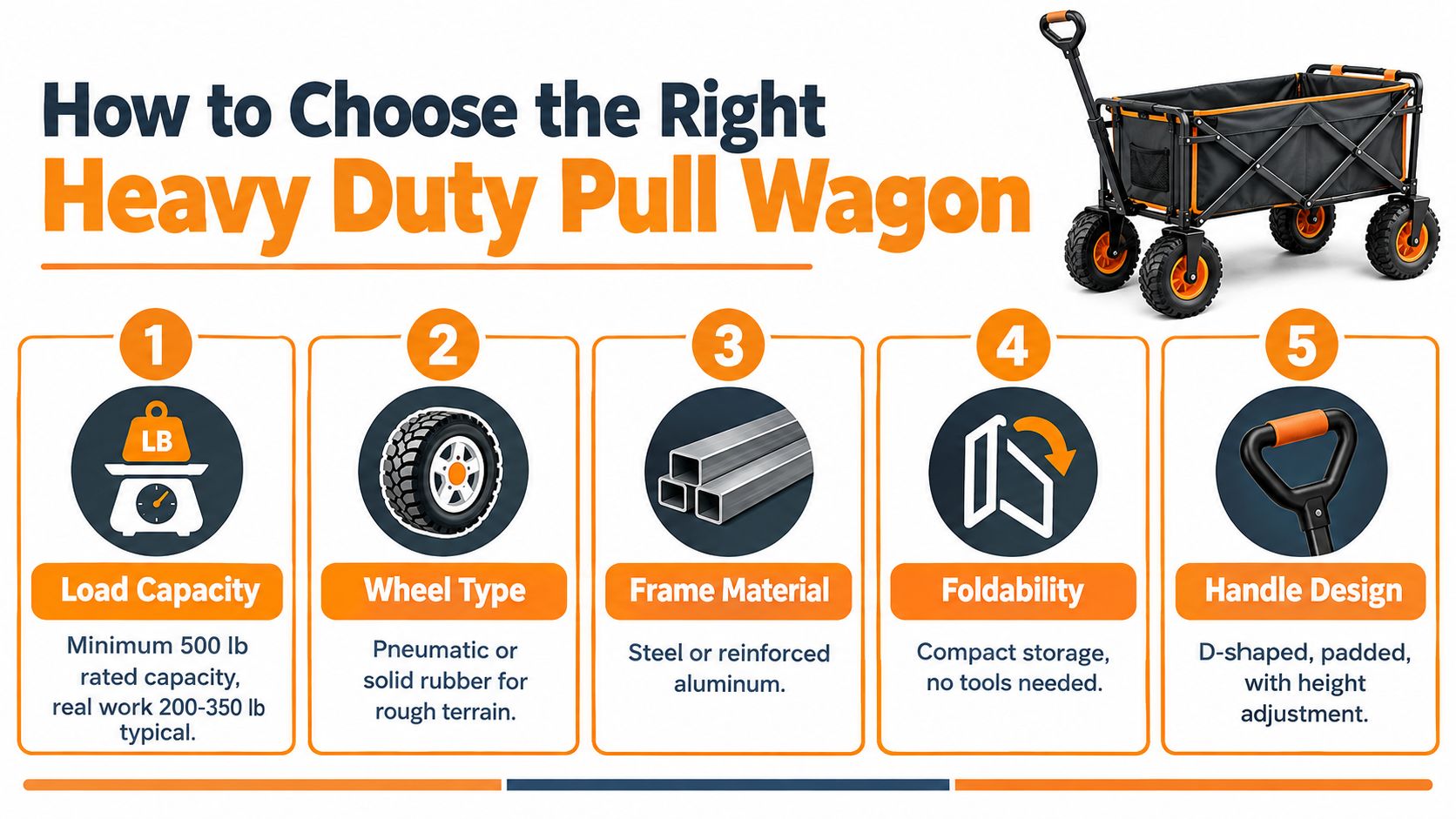
A quick comparison that keeps you honest
Use this table to filter out wagons that look versatile but only solve half the problem.
| Wagon Type |
Weight Capacity |
Seating |
Wheel Size |
| Lounge Wagon |
500 lb capacity |
2-in-1 seating for two adults |
10-inch all-terrain wheels |
| Generic folding wagon |
Varies |
Usually cargo only |
Often smaller mixed-use wheels |
| Generic beach cart |
Varies |
Rarely built as adult bench |
Often wide rear-focused wheels |
The question is simple. Do you want a wagon that only moves gear, or one that also gives you a usable base once you get there?
If you want a factual product example of the hauler-plus-bench setup, View the Lounge Wagon collection. If you want more context before buying, browse Lounge Wagon articles on hauling and seating.
Maintenance and Safety for Long-Term Heavy Duty
The two real risks are uneven loading and wheel trouble. Check both before every haul.
A wagon usually fails in the field because the owner gets casual. Load goes too high, weight shifts to one side, one wheel hits soft ground, and the whole thing gets sketchy. The fix isn't complicated. Keep the heavy gear low, centered, and balanced.
The habits that keep a wagon service-ready
-
Center the heavy stuff: Put the densest items low and near the axle line so the wagon tracks straighter.
-
Don't stack above the rails: Tall loads look efficient until the first rut or curb.
-
Check tires and tread regularly: Low pressure or packed debris increases resistance and can make a loaded wagon miserable to pull.
-
Rinse off sand and salt: Beach grit chews up moving parts over time.
-
Store it dry and folded: Sun and moisture punish fabric faster than you realize.
The quick visual checklist helps if you want a pre-trip routine you can run in under a minute.
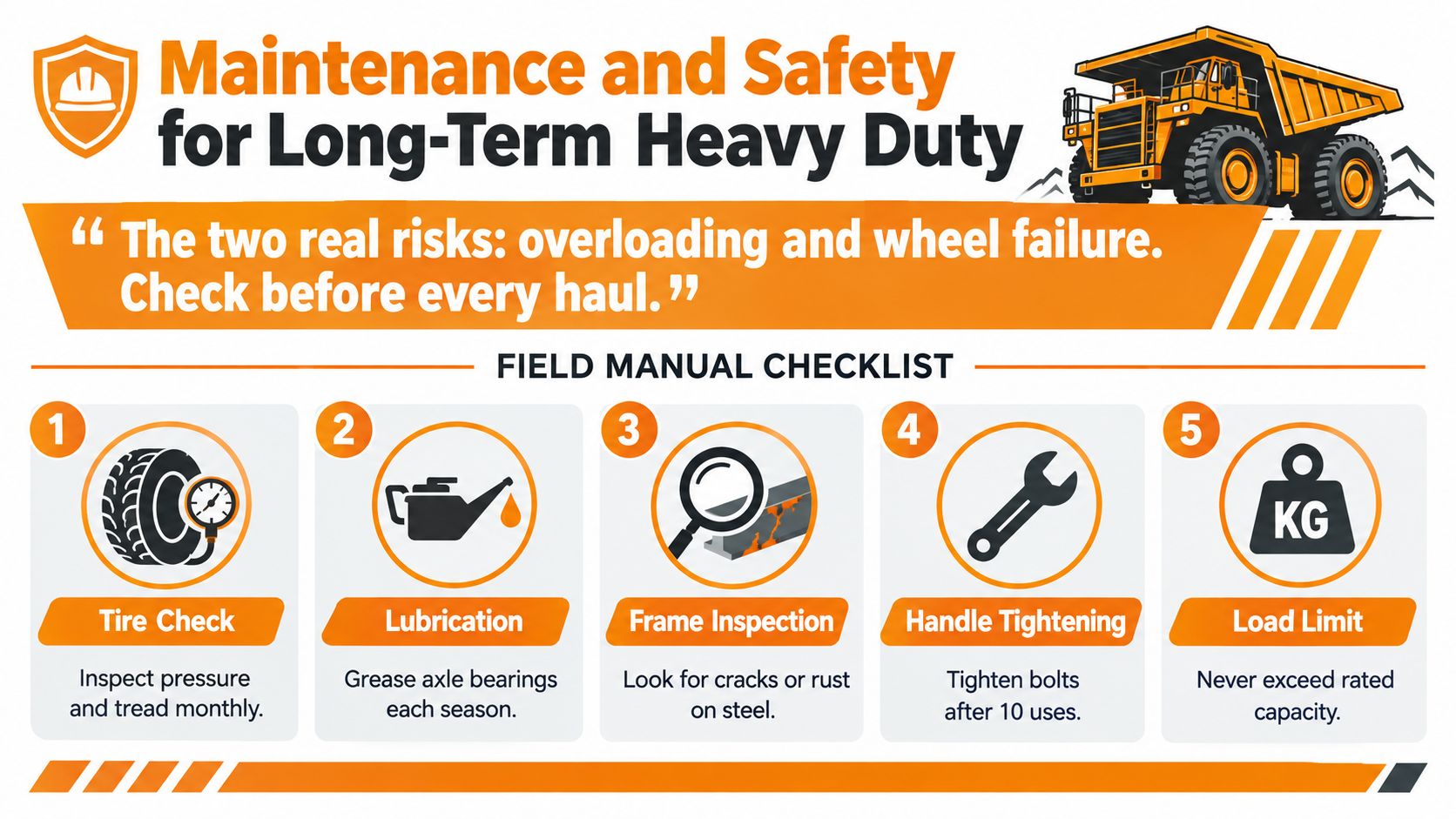
My pre-trip scan
-
Handle lock: Make sure it's secure and moving cleanly.
-
Wheel pins: Confirm nothing's backing out or loose.
-
Fabric check: Look for tears where the load presses hardest.
-
Load balance: Heaviest item first, then distribute the rest.
-
Terrain match: If you're heading to soft sand, don't pretend narrow wheels will suddenly become beach wheels.
Make It a One-Trip Walk to the Shore
The whole point of a heavy duty pull wagon is simple. You stop burning energy on setup and start using that energy where it counts. One well-loaded wagon beats three sloppy trips every time, especially when the ground is soft and the day is long.
I'd also be careful about replacing one bad setup with another. Plenty of buyers compare wagons against beach carts and assume the answer is obvious, but this look at beach cart tradeoffs and hauling realities shows why wheel setup and use case matter more than category labels.
If you spend all day at fields, beaches, festivals, or campgrounds, the upgrade is combining 500 lb capacity with 2-in-1 seating. That's what changes the day. You get the haul in one pull, then the wagon keeps working after you stop moving.
Ready to stop hauling and start lounging? Get a setup that handles the load, survives real terrain, and gives you a real seat when you arrive.
Lounge Wagon offers a practical answer for people who need both hauling and seating in one piece of gear. If you want a heavy duty pull wagon with 500 lb capacity, 10-inch all-terrain wheels, and 2-in-1 bench seating, visit Lounge Wagon and see whether it fits the way your weekends work.


