A folding wagon's advertised weight limit is a maximum structural ceiling, but practical rolling capacity on uneven terrain such as sand or grass is typically 10–15% lower, making load distribution and wheel size just as important as the headline number. A 500-pound capacity doesn't guarantee easy pulling, steering, or stopping when the wagon is fully loaded.
The exhausting three-trip walk from the car to the shoreline or a youth soccer complex starts with an innocent plan: cooler, chairs, shade tent, bags, and everyone's essentials. Then the wagon drags through soft sand, tips when a load shifts, or becomes so difficult to steer that carrying everything by hand feels easier. It ruins the morning before you've even found a place to sit.
The Lounge Wagon addresses that logistics problem as a folding gear hauler that converts into a 2-in-1 bench. You can view the Lounge Wagon, then judge its 500 lb capacity, wheel design, frame construction, and seating function against the conditions where you'll use it.
Last Updated: October 2026
The Reality Behind Advertised Capacity Claims
A printed capacity answers a narrow question: how much supported weight the structure may withstand under defined conditions. It doesn't answer the question tournament parents, beachgoers, and tailgaters care about: how much can I pull and steer comfortably across the ground in front of me?
That distinction explains why a wagon rated for a heavy load can feel fine on smooth pavement but exhausting on grass, gravel, or soft sand. Rolling resistance rises, wheels encounter holes and edges, and a shifting cooler changes the force reaching the handle. The frame may remain intact while the operator loses control or has to stop repeatedly.
Available safety guidance treats a wagon's maximum weight as a structural ceiling rather than a promise of equally easy handling. In demanding use, practical responsiveness may be closer to 70–75% of the rated maximum, according to this wagon safety guidance. For a 500 lb capacity, that corresponds to approximately 350–375 pounds when easier control matters more than avoiding structural failure.
That isn't a universal operating rule. It's a useful way to understand why a headline rating can overstate the comfortable working load on difficult terrain. A fully loaded wagon also behaves differently when it's stationary, moving forward, turning, crossing a curb, or traveling down a slope.
The same issue appears in product specifications that separate total capacity from basket capacity. A wagon-style child-transport product may publish a total rating while limiting the basket to approximately 10–15 pounds, showing why buyers must identify what the advertised number includes.
Practical rule: Treat the capacity label as the upper boundary of support, then choose a lower working load based on terrain, motion, balance, and your ability to stop the wagon safely.
What a useful specification should tell you
A responsible listing should distinguish between:
-
Gross capacity: The combined supported weight, which may include cargo, occupants, and accessories.
-
Usable payload: The cargo remaining after subtracting the wagon's own weight.
-
Rolling capacity: The load the complete wagon can move with reasonable control.
-
Seating capacity: The supported occupant load when the wagon is configured as a bench.
That's why the practical guidance in Lounge Wagon's heavy-duty wagon guide matters more than a large number printed beside a product photo. A capacity claim has value only when the frame, wheels, joints, and intended terrain support the way customers will use it.
Engineering Factors That Determine True Limits
Modern folding wagons weren't created by adding a fabric basket to wheels. Their design history reflects a difficult compromise: retain the load-bearing function of a conventional utility wagon while making the product collapse into a smaller storage footprint. The patent record for U.S. Patent No. 8,011,686 shows a folding wagon application filed on October 10, 2008 and granted on September 6, 2011, with an earlier 2003 filing referenced for wheels that folded into a compact, briefcase-like form. See the folding wagon patent record.
That history explains why a folding wagon weight limit reflects more than the material used for its basket. The structure must transfer force through folding joints, chassis members, axles, wheel attachments, and fabric-panel connection points without losing its ability to collapse.
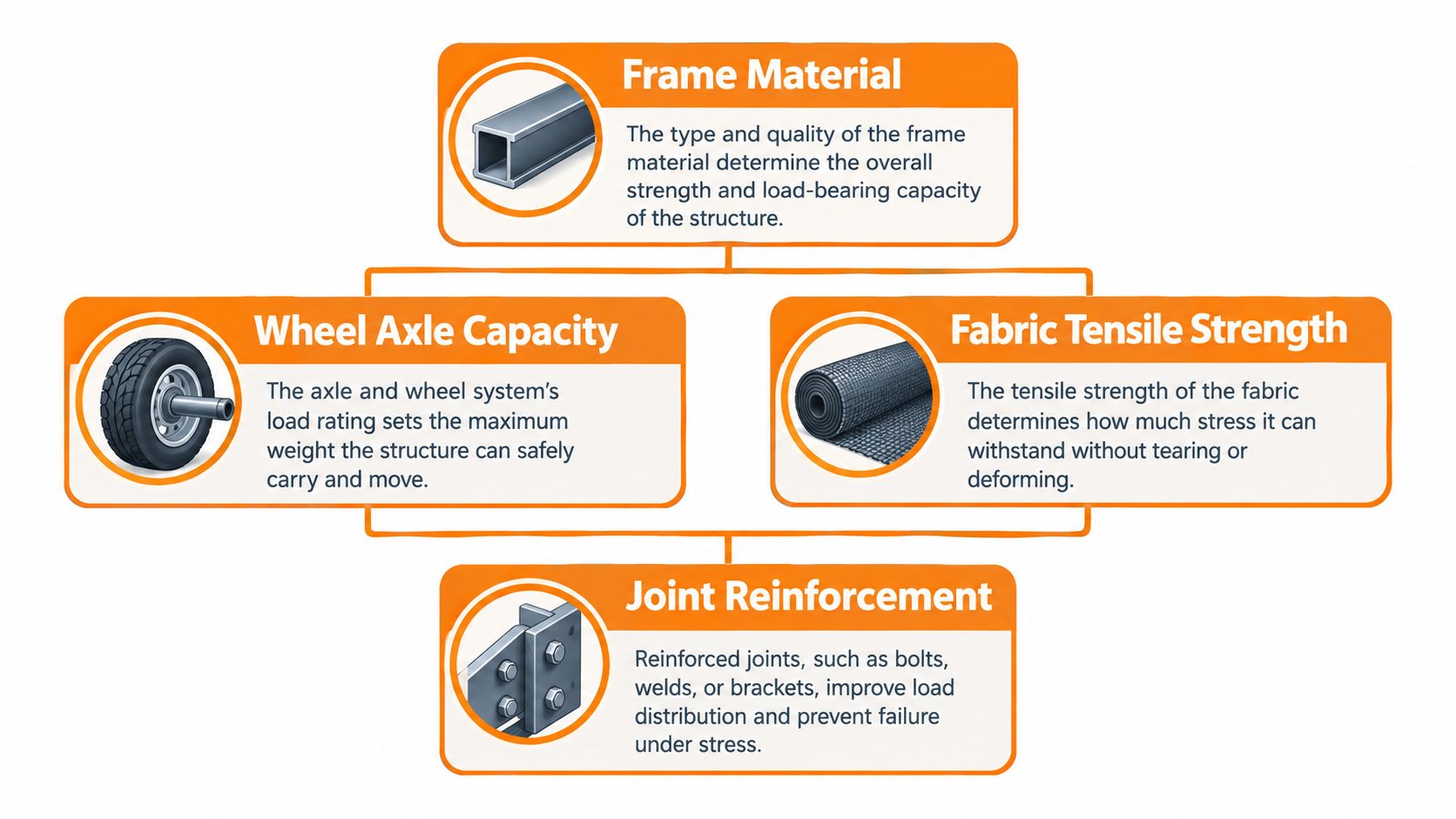
The components that carry the load
A reinforced frame provides the skeleton, but each supporting area creates a different failure risk:
-
Frame material: A reinforced steel frame can resist bending and twisting under concentrated loads, although it also contributes to the wagon's tare weight.
-
Axle and wheel attachments: These transfer load into the ground. A strong basket cannot compensate for wheels that wobble, deform, or bind.
-
Fabric tensile strength: The fabric must hold dense items without tearing at seams or pulling away from its attachment points.
-
Folding joints: Hinges and locking areas preserve compact storage, but they also carry forces that a fixed utility cart would send through uninterrupted rails.
A high rating becomes less persuasive when a product describes only one component. Frame strength doesn't establish wheel strength, and a large wheel doesn't prove that the folding joints can tolerate repeated impacts.
Why collapsibility changes the evaluation
The engineering goal is not maximum strength at any cost. It's a usable balance between structural support, portability, storage, and handling. A wagon that's overbuilt may carry more on paper but become harder to lift into a vehicle, while a lighter wagon may store easily but flex under dense equipment.
When comparing models, inspect how the complete assembly works. Look for secure locks, firm wheel mounting, a chassis that doesn't twist excessively, and attachment points that don't concentrate stress in one area. Large wagon wheels can improve movement, but they're only one part of the load path.
Calculating Your Safe Payload for Any Terrain
Start with the number most listings leave unclear: is the advertised limit a gross load or a true cargo allowance? If it's a gross rating, the wagon itself consumes part of that capacity before you add a cooler, tent, chairs, or passengers.
The basic calculation is:
Maximum cargo = rated gross load − wagon tare weight
For example, a wagon rated at 500 lb that weighs 50 lb empty leaves approximately 450 lb for cargo before accounting for occupants, accessories, or uneven loading. That example is a calculation, not a claim about any particular product's weight.
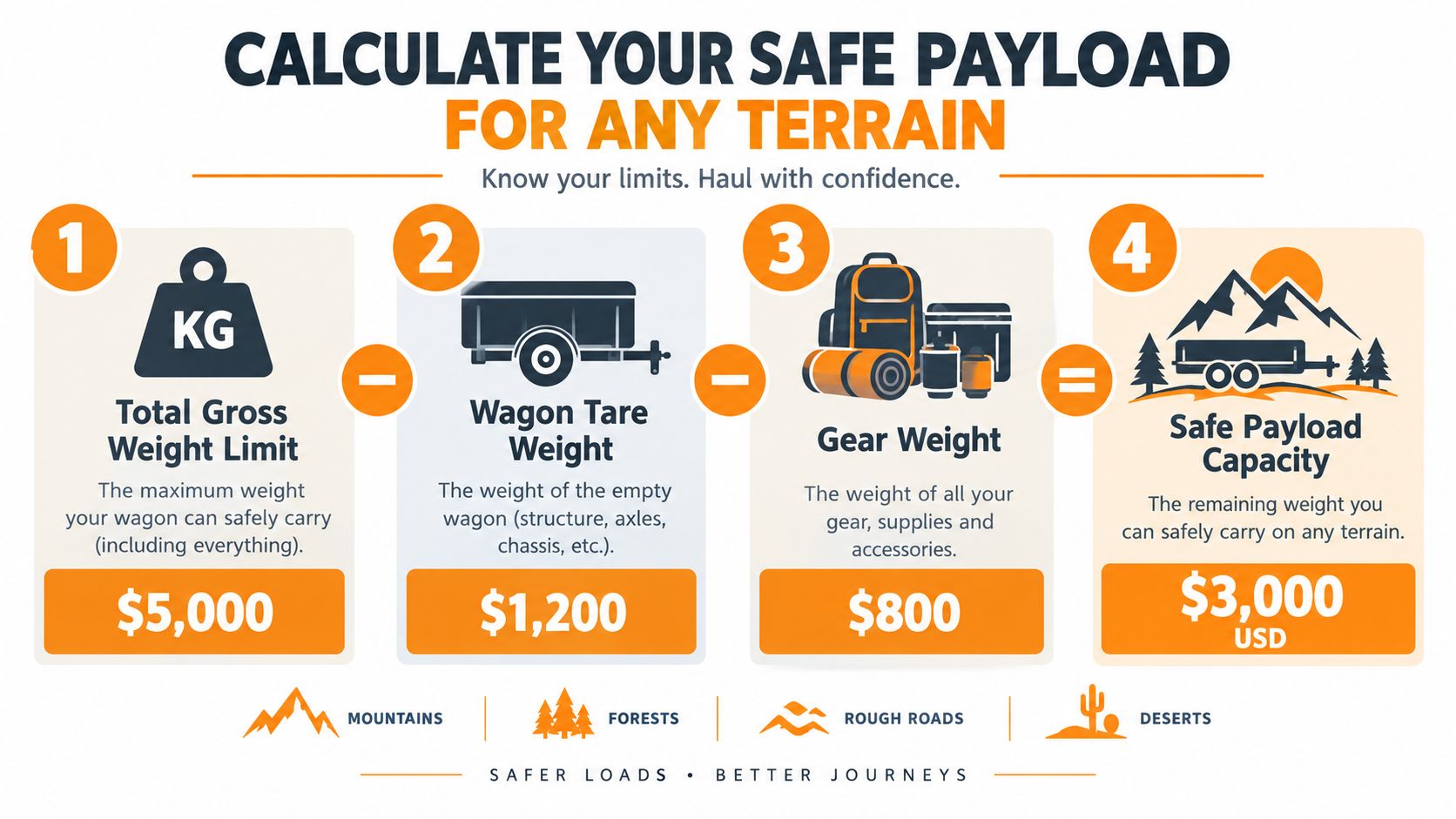
Use a terrain reserve
Uneven ground changes the working margin. Recent testing guidance recommends reducing a stated capacity by roughly 10–15% on grass, gravel, or mud because rocking and bouncing increase stress and reduce control, as discussed in this camping wagon comparison.
A practical loading sequence looks like this:
-
Confirm the rating type. Check whether the manufacturer means gross supported load, cargo-only payload, stationary load, or rolling load.
-
Subtract the wagon's tare weight. The empty wagon remains part of the supported system.
-
Subtract occupants and accessories. Seats, coolers, bags, and attached equipment all consume capacity when included by the manufacturer.
-
Reduce the working load for terrain. Grass, gravel, soft sand, slopes, and curb transitions deserve a more conservative approach than level pavement.
-
Test the first movement slowly. Watch for wheel wobble, frame twist, handle flex, or a load that shifts under braking.
Load low, centered, and secured
Dense items should sit low and near the axle line. A cooler, water container, tackle box, or equipment case placed high or against one side raises the center of gravity and makes turning less predictable.
Keep the forward view clear, especially at crowded sports complexes and beach access points. OSHA guidance recommends balanced loads, appropriate wheels, and total weight below the manufacturer's limit, principles covered in this wagon towing capacity guide.
The load that stays centered is often easier to control than a lighter load stacked high and allowed to slide.
How Wheel Size and Surface Change the Rules
A wagon doesn't experience the same load on every surface. Smooth pavement offers consistent wheel contact, while grass introduces drag and uneven resistance. Gravel adds rolling obstacles, and soft sand allows wheels to sink instead of transferring force efficiently into a firm surface.
That's why a 500 lb capacity wagon can feel completely different at a Florida Gulf Coast beach than it does in a parking lot. The frame may support the same mass, but the person at the handle must overcome a different combination of rolling resistance, wheel sink, bumps, and steering drag.
Why larger wheels help
Increasing wheel diameter generally decreases the force required to move a cart, according to OSHA material-handling guidance. Larger wheels also improve obstacle clearance, which helps reduce the abrupt jolts caused by ruts, thresholds, and uneven ground.
A 10-inch puncture-proof wheel can therefore provide a real human benefit: less dragging over grass and better clearance across small depressions. It doesn't turn deep sand into pavement, and it doesn't eliminate the need to reduce the load when steering becomes difficult.
See how wheel geometry affects outdoor hauling in Lounge Wagon's 10-inch wheel guide.
Match the wagon to the surface
| Surface |
What changes |
What works better |
| Pavement |
Low rolling resistance and predictable contact |
Balanced loading and controlled turns |
| Grass |
More drag, especially when damp or uneven |
Larger wheels and a lighter working load |
| Gravel |
Bouncing and intermittent wheel impacts |
Low centered cargo, slower movement |
| Soft sand |
Wheel sink and high pulling resistance |
Broad, capable wheels and substantially reduced load |
| Slopes |
Gravity increases pulling and stopping effort |
Secure cargo, slow speed, and conservative loading |
Rough terrain can create abrupt impacts that raise stress on wheels, axles, joints, and the frame. OSHA also recommends suitable pneumatic wheels for uneven surfaces and replacing wheels that become wobbly or uneven. For a parent crossing a youth soccer complex, wheel quality may affect the day more than an impressive capacity printed on the side panel.
Transitioning Safely From Cargo Hauler to Seating
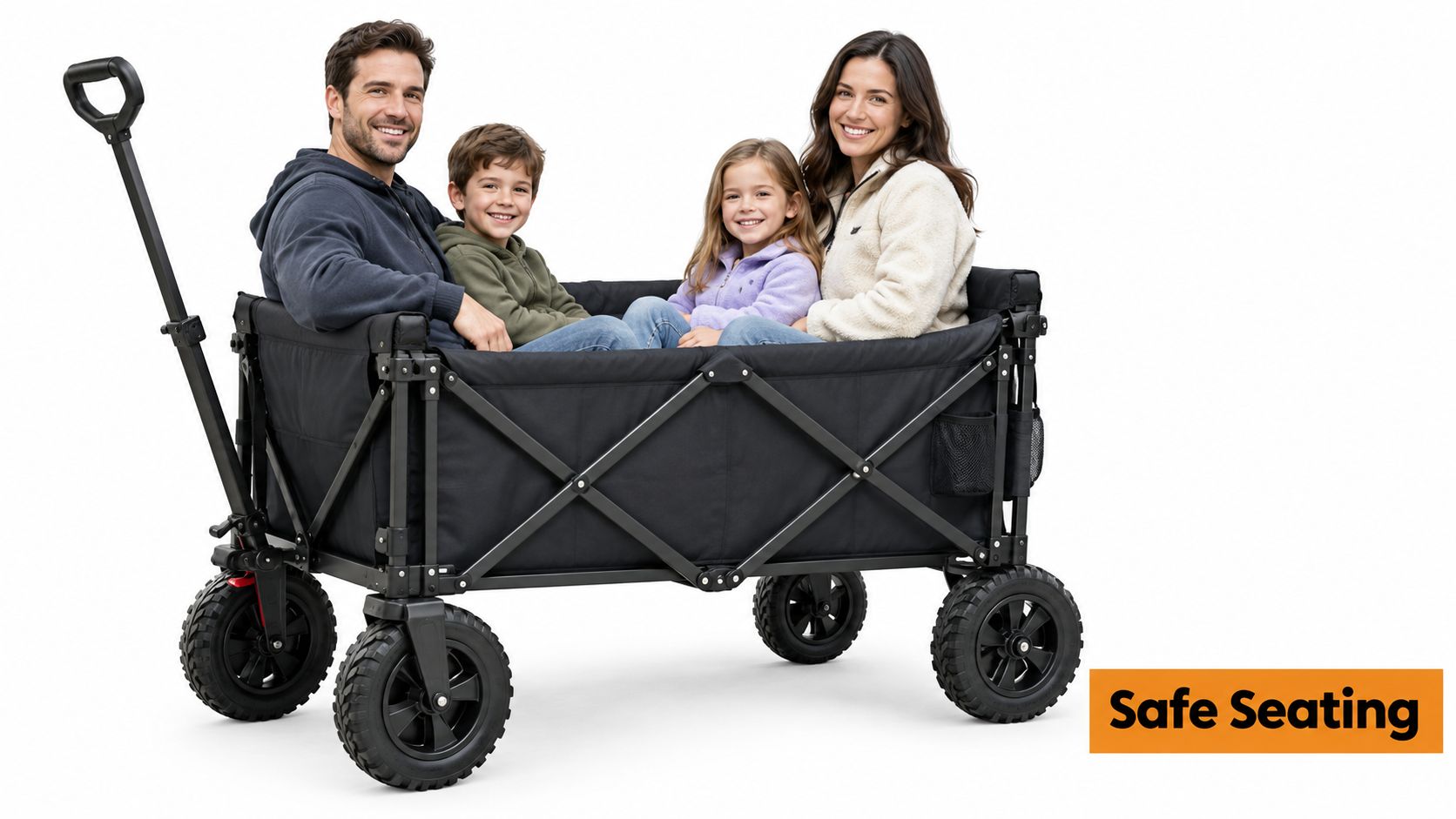
A wagon that becomes a bench has two different jobs, and the weight limit for one job doesn't automatically validate the other. Cargo usually sits low and spreads across the basket, while occupants shift their weight, sit higher, and may move suddenly as they enter, exit, or lean toward the field.
A seating configuration therefore needs separate answers. Does the manufacturer publish an occupant limit? Is the bench designed for one person or two? Does the seat remain stable when the cargo area contains dense equipment?
Static support and tip resistance are different
ASTM stroller safety material illustrates the distinction. Its carriage-and-stroller specification calls for a product to support a 100-pound static load, or 2.5 times the manufacturer's recommended maximum weight, whichever is greater, for each individual seating area. It separately requires stability testing to determine whether the product tips on the prescribed test plane. Those figures and requirements appear in the ASTM seating and stability material.
The principle applies beyond strollers. A cargo rating proves neither that two adults can sit safely nor that the wagon will resist tipping when one person shifts toward an edge. Static structural support and dynamic stability require different evaluations.
What to check in a 2-in-1 design
For a convertible bench, look for:
-
Published seating guidance: Cargo and occupant limits should be separated rather than hidden behind one headline number.
-
A stable seat structure: The bench should connect to the frame without excessive flex or side-to-side movement.
-
A low center of gravity: Heavy gear belongs low and centered, not stacked beside or behind seated occupants.
-
A clear entry and exit path: People shouldn't have to climb over coolers or tall equipment to use the seat.
-
A firm footprint: Wheel placement and chassis geometry affect tip resistance when someone sits down.
The Lounge Wagon's 2-in-1 seating concept is useful because one product can haul equipment and provide a sideline seat, but the mode change doesn't erase basic physics. Use the manufacturer's separate cargo and seating instructions, keep the load balanced, and don't treat a 500 lb capacity as an automatic permission for any seating arrangement.
The useful question isn't whether a product can display a large number. It's whether the complete system supports the work you'll ask it to do at a beach, tournament, tailgate, market, or festival.
The Lounge Wagon combines a reinforced steel frame, 10-inch puncture-proof wheels, and a 2-in-1 bench conversion. Those features address different problems: the frame supports the load path, the wheels reduce resistance and improve obstacle clearance, and the bench removes the need to carry a separate seat.
A practical comparison
| Feature |
Lounge Wagon |
Generic Folding Wagon |
| Weight Capacity |
Stated 500 lb capacity
|
Rating varies by model and configuration |
| Seating |
2-in-1 seating for a double-seater bench |
Often cargo-only, or seating limits may be separate |
| Wheel Size |
10-inch puncture-proof wheels |
Wheel diameter and construction vary |
| Frame |
Reinforced steel frame |
Material and reinforcement vary |
| Outdoor use |
Designed for sand, grass, and gravel |
Performance depends on wheel and chassis design |
OSHA guidance recommends balancing loads and choosing wheels suited to the surface, while noting that larger-diameter wheels improve maneuvering and obstacle clearance for heavy outdoor carts. That makes the Lounge Wagon's specifications relevant to outdoor logistics, but it doesn't make the printed rating universal across every slope, sand condition, or moving configuration.
Where the design earns its keep
For a tournament parent, the wagon can carry a cooler, shade equipment, chairs, bags, and field supplies, then become a sideline seat between matches. At the beach, broad wheel capability matters because soft sand punishes small wheels and poorly balanced loads. At a tailgate or festival, the 2-in-1 seating reduces the need to pack a separate bench while providing a defined place to rest.
The real-load examples from Lounge Wagon are most useful when read alongside the capacity rules above. Load the densest items low, secure anything that can slide, keep the path visible, and slow down before curbs, ruts, turns, and slopes.
Don't judge a wagon only by its maximum rating. Judge whether its wheels, frame, joints, seat structure, and loading guidance match your real route from the car to the field or shoreline.
Ready to stop making multiple trips and start lounging? The Lounge Wagon combines a heavy-duty hauler, 500 lb capacity, 10-inch wheels, and 2-in-1 seating for outdoor days where gear and comfort both matter. Visit Lounge Wagon and make your next walk from the car to the beach, field, or tailgate a one-trip haul.


