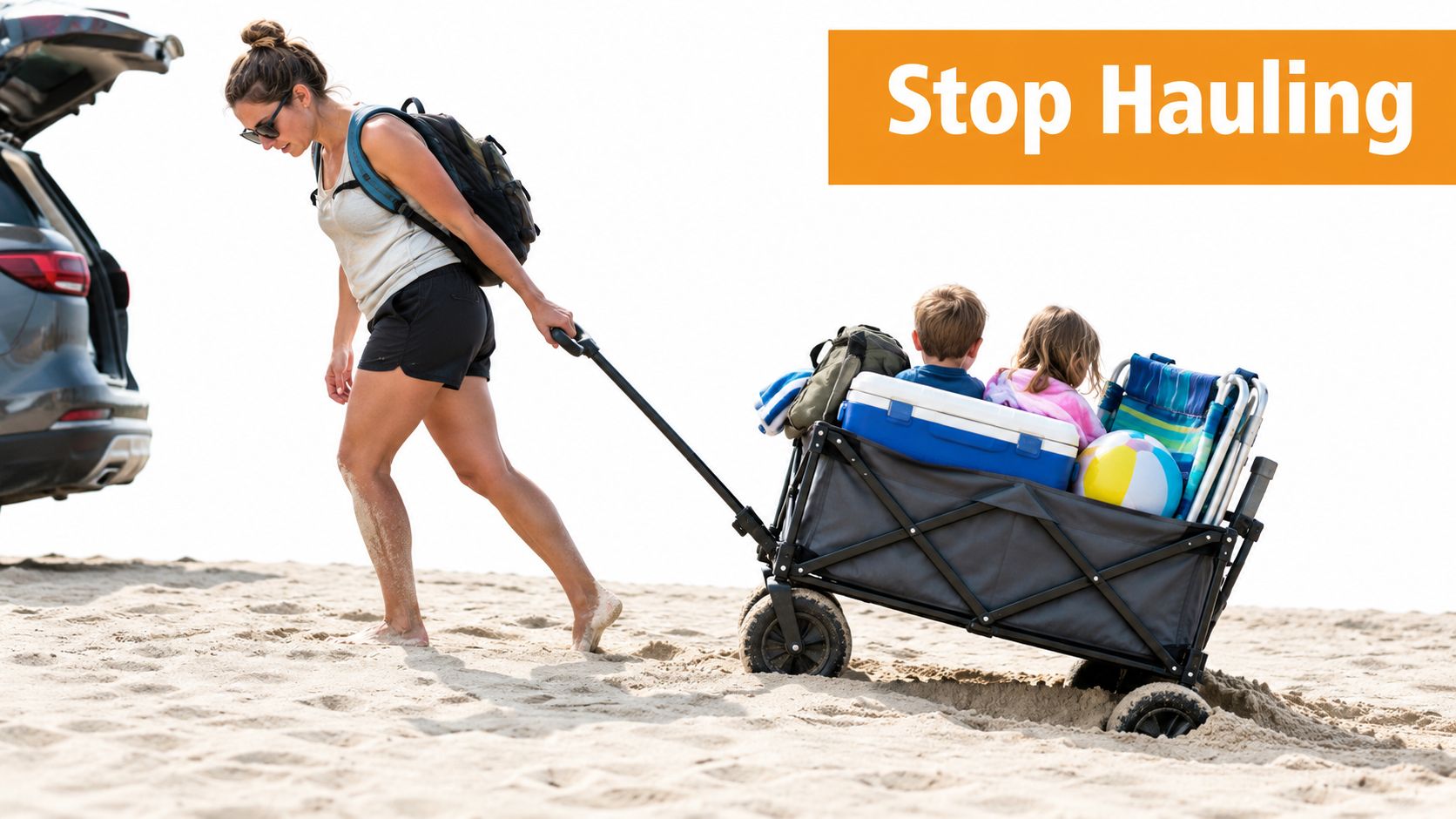
The three-trip walk from the car to the beach or sideline gets old fast. A folding wagon with large wheels reduces drag across sand, grass, gravel, and uneven pavement, but wheel diameter alone isn't enough. Width, tread, chassis geometry, load balance, and foldability determine whether the wagon glides or bogs down. Last Updated: May 2026
Stop Hauling and Start Lounging on Every Trip
You've packed the cooler, towels, umbrella, chairs, sports bags, and snacks. The car is parked farther away than expected, so one trip becomes three, and by the time everything reaches the shoreline or soccer field, the morning has already cost you energy. The same problem shows up at crowded festivals, youth soccer complexes, tailgates, and park events.
A folding wagon large wheels setup can change that routine because the wheels carry more of the load over obstacles instead of forcing you to drag a compact cart through every rut. The practical answer is simple: choose a wagon with wheels matched to your terrain, then verify that the frame, load rating, handle, and folding system can support the way you use it. Larger diameter helps, but width and chassis stability decide whether it performs on soft ground.
For a beach day, that means looking beyond the words “all terrain.” A wagon may roll confidently on pavement and packed sand but struggle once its wheels meet loose, dry sand. If your route runs from a Florida Gulf Coast parking area to the water, the softest part of the route should guide your choice.
The Lounge Wagon is designed as a gear hauler that converts into a double-seater bench, with a reinforced steel frame, 500 lb capacity, and large all-terrain wheels. You can view the Beach Day Bundle when your typical load includes beach equipment and a place to sit, rather than cargo alone.
The comfort problem matters too
A wagon that carries everything but leaves you sitting on a damp towel hasn't solved the whole outing. Adult seating guidance commonly places comfortable seat height around 17 to 19 inches, a range also reflected in accessibility-oriented seating guidance from Wheels for Wellbeing. That height can make getting up easier than using a low ground chair, although comfort still depends on padding, back support, and the wagon's frame.
A separate guide to luxury outdoor furniture is useful if you're comparing portable seating with more permanent outdoor comfort. The key distinction is mobility. A folding wagon earns its space when it hauls the equipment first and becomes useful seating after arrival.
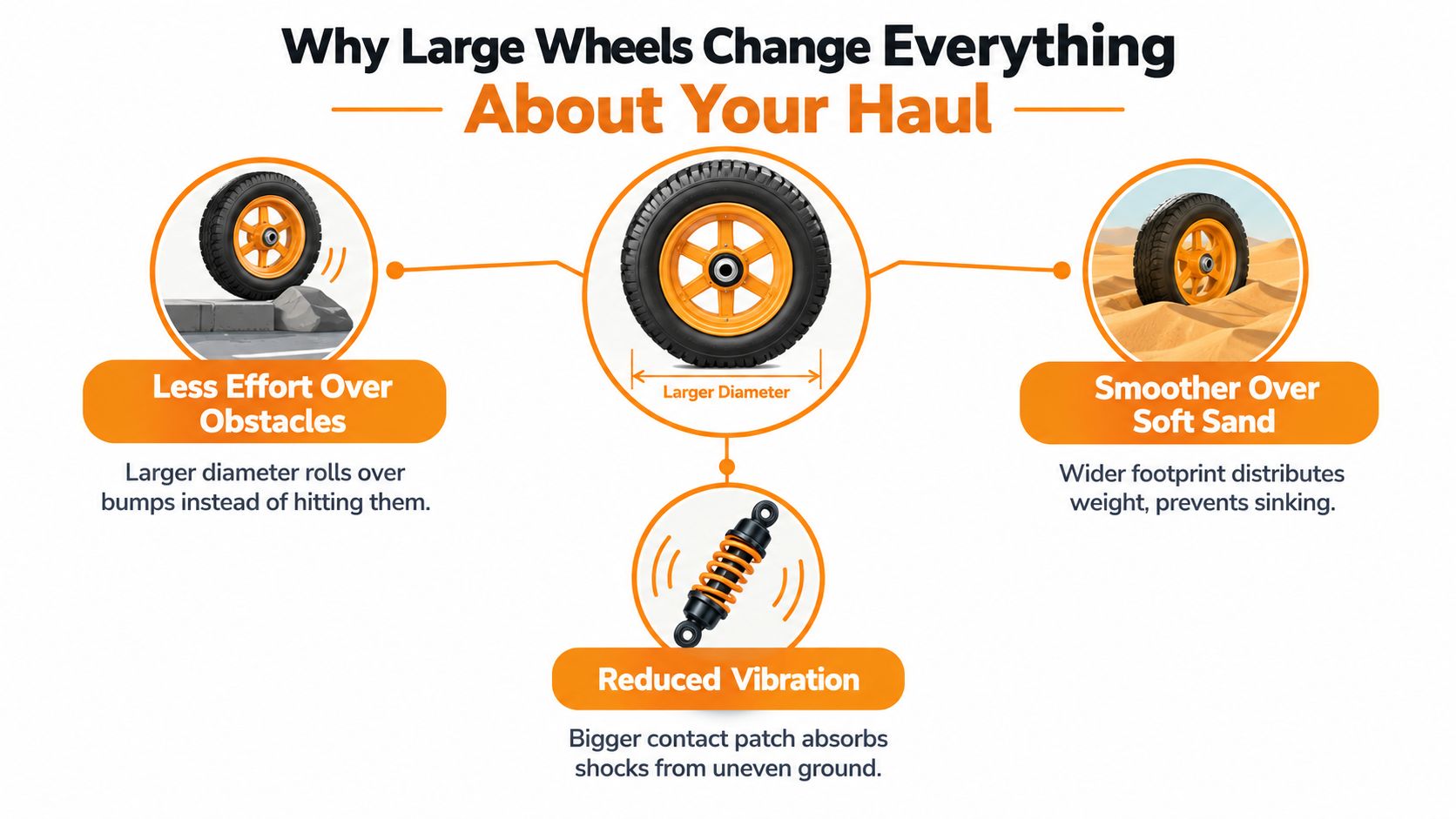
Why Large Wheels Change Everything About Your Haul
Wheel diameter changes how a wagon meets an obstacle. A small wheel drops into a crack or presses directly into a ridge, while a larger wheel approaches the same obstacle at a gentler angle. The effect is similar to riding a bicycle over a curb. A larger wheel still needs effort, but it doesn't hit the edge as abruptly.
The same principle applies to rough paths. A 2026 wheel-selection guide explains that larger diameters roll more smoothly over rough terrain, while traditional wagon wheel applications commonly range from 30 inches to 54 inches, with 36-inch to 48-inch wheels often sufficient for many uses. Modern collapsible wagons use much smaller wheels, commonly 7 inches, 7.5 inches, or 8 inches, as described in this wagon wheel types buying guide. The measurements aren't interchangeable, but the engineering principle is.
Diameter helps, but it isn't the whole wheel
A wide contact patch spreads weight across more ground. That can reduce sinking on soft sand and make a loaded wagon feel less like it's cutting into the surface. Tread adds grip, especially where grass is damp or gravel shifts under the wheels, but tread can't fully compensate for a wheel that's too narrow for the load and terrain.
Practical rule: Choose the wheel for the worst surface on your route, not the easiest surface near your car.
The modern market commonly groups all-terrain replacement wheels around 7-inch, 7.5-inch, and 8-inch diameters, while some utility wagons advertise 7.5-inch by 3.4-inch or 8-inch by 3.4-inch wheels for softer surfaces and easier maneuvering, according to the same buying guide. A larger wheel can improve obstacle clearance, but a wider wheel can improve floatation. You need both characteristics when soft sand and heavy cargo appear together.
For a deeper look at how wheel dimensions affect hauling, see Lounge Wagon's guide to 10-inch wagon wheels. The useful takeaway isn't that the largest wheel always wins. It's that wheel diameter, width, tread, and frame geometry need to work as a system.
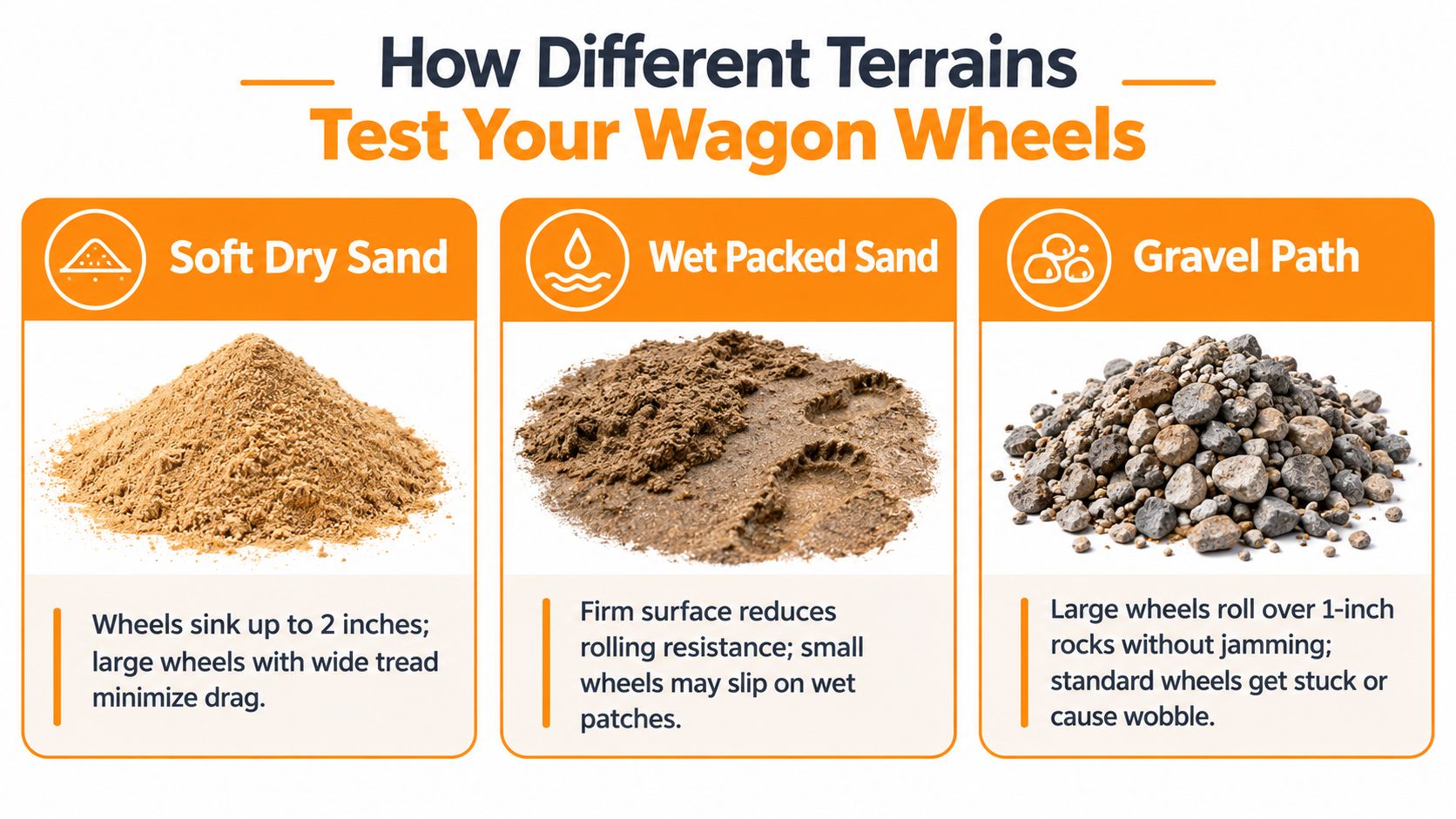
How Different Terrains Test Your Wagon Wheels
“Sand” covers several very different hauling conditions. Wet packed sand near a firm shoreline can feel almost like a hard path, while dry loose sand near dunes can swallow narrow wheels. Grass, gravel, and pavement introduce their own demands, so a wagon that's excellent on one surface may feel mediocre on another.
Hard-packed sand is the forgiving case. Many wagon designs can cross it because the surface offers more support under the wheel. Soft dry sand is less tolerant, especially with a heavy cooler, umbrella, chairs, and children's gear inside.
Match wheel design to the surface
Recent beach-wagon guidance recommends at least 9-inch wheels for soft dry sand, with 10-inch to 12-inch balloon tires performing better because their larger contact patches reduce sinking and rolling resistance. That guidance appears in this beach sand wagon review. Wider wheels and balloon-style tires spread the load, which means less digging and less stop-start pulling.
A separate review of folding utility wagons notes that 9-inch, 4-inch-wide wheels can perform well on sand, while stability still depends on wheel placement, frame geometry, and loading. It also identifies 9-inch to 10-inch wheels as the practical upper end for mainstream folding wagons. Read the full folding utility wagon coverage for the important caveat: bigger wheels don't automatically prevent tipping.
Wet packed sand favors versatility. A moderately wide all-terrain wheel can provide a better compromise between beach movement, sidewalks, and storage than a bulky balloon tire. Gravel rewards diameter because the wheel can roll over loose stones instead of wedging between them.
Watch for these terrain-specific signals:
Soft dry sand: Prioritize wide or balloon-style wheels, a broad footprint, and a stable loaded chassis.
Wet packed sand: Favor a balanced all-terrain setup that won't feel cumbersome on pavement.
Grass and sports fields: Look for tread that maintains grip without collecting excessive mud.
Gravel paths: Use larger diameter wheels and a frame that resists side-to-side wobble.
Mixed routes: Match the wagon to the softest surface, then confirm that its folded size suits your vehicle.
The Lounge Wagon's all-terrain cart wheel guide is relevant for shoppers comparing beach access with everyday park and sports use. In practical terms, the correct wheel is the one that keeps the wagon moving when the load is real, the path is crowded, and the surface changes halfway through the trip.
What Really Determines Capacity Stability and Fold
Large wheels only help if the wagon's frame can keep the load controlled. A reinforced, powder-coated steel frame supports heavier cargo and resists the twisting that can make a tall loaded wagon feel unstable. The fabric body also matters. 1000D polyester provides a heavy-duty enclosure for equipment, towels, coolers, and field supplies, while pockets and cup holders keep smaller items accessible.
Capacity needs honest context. Neutral folding-wagon reviews cite models ranging from about 150 pounds to 560 pounds, while a mainstream all-terrain example lists 225 pounds, according to this folding-wagon review coverage. A 500 lb capacity therefore sits near the upper end of the category, but the rating doesn't mean every load should be stacked high or unevenly.
Stability comes from the whole chassis
A review covering larger beach wheels notes that wheel placement, frame geometry, and loading behavior can matter as much as diameter. Put dense items low and centered. Keep long umbrellas, rods, and tent poles from creating a top-heavy stack, and don't treat the maximum capacity as a reason to ignore the handle's feel or the route's slope.
The practical stability checklist is short:
Low center of gravity: Put coolers, tackle boxes, and water containers on the floor.
Even distribution: Balance left and right sides before pulling across a slope.
Controlled height: Keep soft, light items on top rather than building a tall tower.
Wheel placement: Favor designs where the wheels support the body rather than sitting too far outside the load.
Seating transition: Test the bench conversion with the wagon empty and loaded, because the balance changes.
Feature
Lounge Wagon
Generic Folding Wagons
Weight capacity
500 lb capacity
Market examples range from about 150 lb to 560 lb
Seating
2-in-1 double-seater bench
Usually cargo-focused, seating varies
Wheel size
10-inch puncture-proof wheels
Common all-terrain examples use 7-inch, 7.5-inch, or 8-inch wheels
Frame
Reinforced steel frame
Construction varies by model
Cargo body
1000D polyester
Fabric weight and construction vary
The Lounge Wagon's wagon towing capacity guide is useful when your cargo includes equipment rather than just light picnic supplies. The distinction between advertised capacity and comfortable real-world handling matters. A wagon can carry a large load, but it should still pull predictably, fold without strain, and remain stable when used as seating.
Folding is an engineering trade-off
Patents show that fold-flat wagon design developed through incremental changes. A 1959 patent described a two-wheel trailer folding beneath the cargo body, a 1978 patent added a four-wheeled cart with folding walls, and a 1989 patent described a collapsible cart with walls folding down and a handle in a ready position, according to this history of wagons. A 2001 U.S. patent later described a compact cart with folding walls, handles, tires, and a pivoting wheel axle assembly that could collapse into the wagon bed.
That history explains the compromise. More moving parts can create a smaller folded package, but pivots and axle assemblies need clean operation and sensible storage. The best fold is the one you'll use after a sandy, tiring day, not merely the one that looks compact in a product photograph.
Choosing the Right Large Wheel Wagon for Your Lifestyle
The right folding wagon large wheels configuration depends on who pulls it, what it carries, and where it travels. A Tournament Parent may prioritize grass and gravel handling, while a Sand-Sovereign Coastal Family needs flotation in loose beach sand. Those are different jobs, even when both shoppers use the phrase “all-terrain wagon.”
In our testing at crowded sports complexes, maneuverability matters as much as raw capacity. A wagon must pass through people, turn beside parked cars, and hold equipment without becoming a top-heavy obstacle.
Seven practical buyer profiles
Tournament Parents: Choose wide all-terrain wheels for grass, gravel, and bleacher ramps. A high-capacity body helps carry coolers, tents, balls, and sideline bags in one controlled load.
Sand-Sovereign Coastal Families: Start with the softest sand you cross. Wide or balloon-style wheels reduce digging, while a 500 lb capacity gives room for bulky family gear without forcing repeated car trips.
Front-Row Festival Goers: Prioritize a stable footprint and seating conversion. The wagon becomes a home base for blankets, chairs, and market purchases instead of another item to carry.
Grand-Packers: Look for large wheels and an adult-friendly seat height around 17 to 19 inches. Easier rolling helps on uneven park paths, while integrated seating reduces the need to pack separate chairs.
Mobile Anglers: Balance wheel width with pier maneuverability. Tackle boxes, bait buckets, and rods need a low, organized load, and built-in seating can replace a separate stool.
Weekend Warriors: Focus on multifunctional gear. A wagon that hauls camping or tailgate supplies and converts into seating uses less trunk space than separate transport and chair solutions.
Event Pros: Favor a reinforced frame, predictable steering, and a generous load rating for signage, water containers, and registration supplies across grass and gravel.
Use the surface and load matrix
Your main route
Typical load
Seating need
Priority
Loose beach sand
Umbrella, cooler, toys, towels
High
Wide or balloon-style wheels, low balanced loading
Grass and gravel sports complex
Cooler, tent, sports bags
High
Large all-terrain wheels, reinforced frame, 2-in-1 seating
Paved festival and market paths
Chairs, blankets, purchases
Medium
Maneuverability, stable footprint, useful storage
Pier or rocky shoreline
Tackle, bait, rods
Medium
Wheel clearance, low center of gravity, organized cargo
If you're comparing current options, Lounge Wagon's best all-terrain wagon reviews for 2026 can help organize the decision around terrain instead of marketing labels. The key is to reject a wagon that solves storage but fails on your hardest surface, or one that rolls well but forces you to carry a separate seat.
Verified reviewer feedback in the supplied research repeatedly emphasizes the value of moving an entire equipment setup in one trip, along with the usefulness of drink holders and easy folding. Those observations align with field use, but they don't erase the limitations. No folding wagon substitutes for stairs, and a wide-wheel beach setup may take more room to store than a narrow-wheel utility cart.
Keeping Your Wagon Rolling Smoothly for Years
Sand and salt are small enough to enter wheel hubs, pivots, and fabric seams. They're also abrasive, so a wagon that performs smoothly on its first beach trip can develop drag or folding resistance if you put it away dirty. Cleaning isn't cosmetic. It protects the rolling and folding systems that make large wheels worthwhile.
After a beach outing, rinse away loose sand and salt according to the manufacturer's care guidance, then let the wagon dry fully before folding it. Pay particular attention to the 10-inch wheels, axle areas, and pivot points.
Use this after-beach checklist
Remove grit: Brush or rinse sand from wheel surfaces, hubs, frame joints, and the underside of the cargo bed.
Inspect tread: Look for embedded debris, uneven wear, or damage to the puncture-proof tire surface.
Check the fold: Open and close the wagon without forcing the pivoting mechanism.
Dry the fabric: Let 1000D polyester air-dry before storage to avoid trapped moisture and odors.
Review the frame: Check powder-coated steel for scratches or corrosion, especially after saltwater exposure.
For seasonal storage, keep the wagon folded in a dry location where the wheels aren't carrying unnecessary pressure. Don't pile heavy objects on top of the folded frame, and avoid storing it with damp towels or beach toys inside.
Lubricate pivots only with a product compatible with the manufacturer's instructions. Over-lubrication can attract grit, turning a smooth joint into a paste of sand and lubricant. Lounge Wagon's wagon maintenance guide provides a useful reference for preserving the frame, wheels, and folding function.
A quick pre-trip inspection catches most avoidable problems:
Handle: Confirm it locks and tracks comfortably.
Wheels: Spin each wheel and check for wobble.
Cargo body: Verify that seams, straps, pockets, and closures are secure.
Bench system: Test the seating conversion before loading heavy equipment.
Load balance: Place dense gear low and near the center.
Make Every Outing a One Trip Walk to Comfort
The best folding wagon large wheels setup does more than reduce pulling effort. It changes how you plan the outing. Instead of carrying a cooler separately, dragging chairs behind you, and returning to the car for forgotten supplies, you can consolidate the load and keep the route manageable.
For Sideline Elite families, the value is especially clear during long tournament days. A wagon with 500 lb capacity can handle a substantial equipment load, while 2-in-1 seating gives parents a place to rest between matches. At the beach, wide wheels and careful loading address the softest section of the route, then the same wagon becomes a comfortable base near the shoreline.
The product choice still deserves scrutiny. Confirm the wheel width, tread, frame construction, folded storage needs, handle feel, and seating height before buying. If you need more equipment-specific guidance, explore Lounge Wagon's product details and compare the standard configuration with available accessories such as sand-oriented wheels.
The goal isn't to buy the biggest wheels without question. It's to build a matched system that carries your actual load, crosses your actual terrain, folds into your actual vehicle, and gives you a useful place to sit after the hauling is finished.
Ready to stop hauling and start lounging? Choose a Lounge Wagon configuration that supports your beach, sideline, festival, or camping routine, then make the next outing a one-trip walk to comfort.
Lounge Wagon combines heavy-duty hauling, large all-terrain wheels, and 2-in-1 seating for people who want to carry more without packing a separate bench. Visit Lounge Wagon to choose the setup that fits your terrain and start hauling more, sitting better, and staying longer.
Choosing a selection results in a full page refresh.
This pad is perfect for kids or dogs to be comfortable inside the moving wagon, and very nice after you set everything up and want to sit for extra padding.
Having the umbrella this summer has been easy to use and a must to make sitting and watching the parade so nice when there isn't any shade. My dogs laid on the wagon padding and enjoyed the day without getting too hot. I enjoyed the shade too.