Last Updated: October 2026
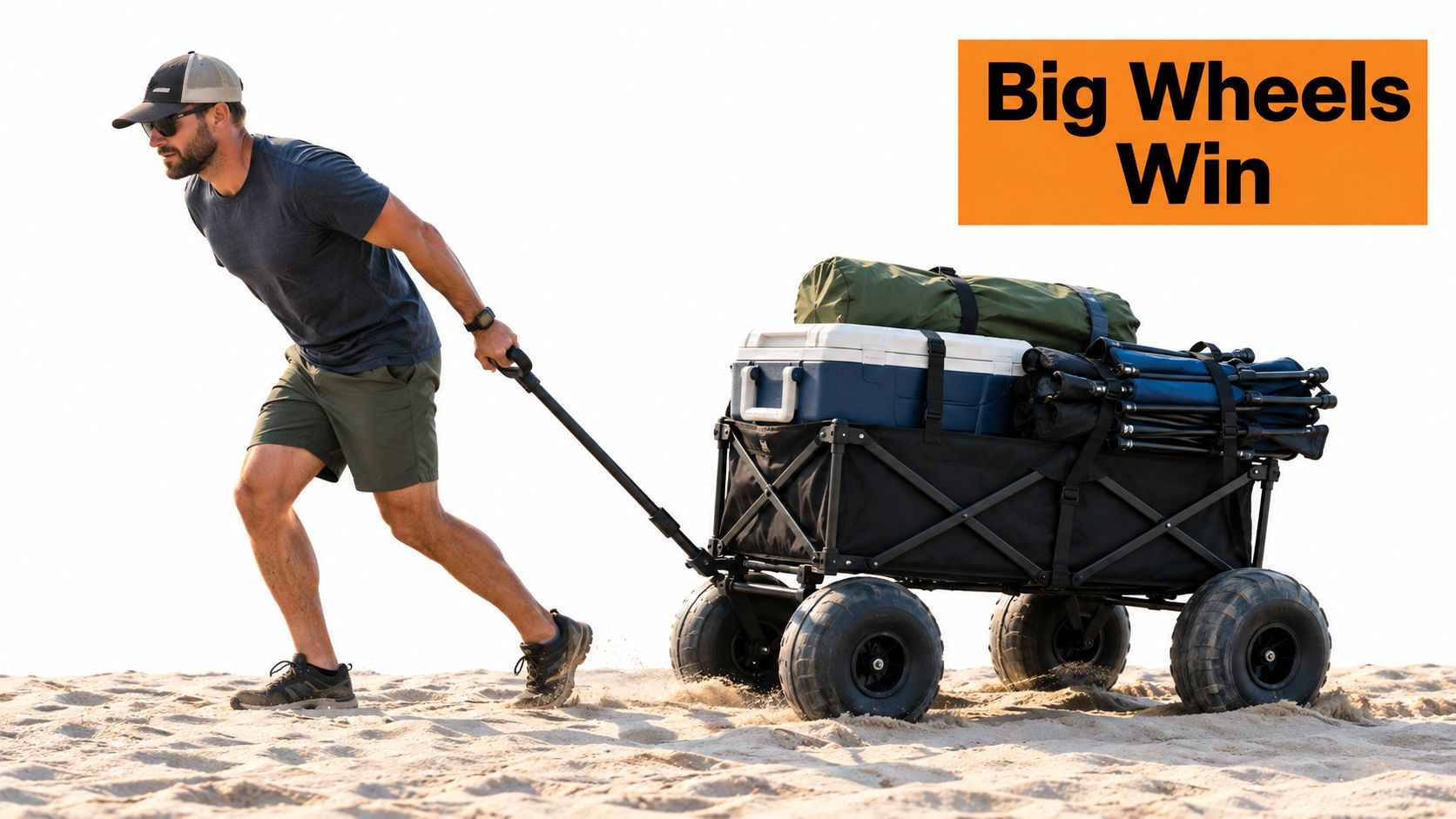
The first bad part of a beach or tournament day is usually the walk before the fun starts. You juggle a cooler, chairs, towels, and a bag of kid gear, then make two or three trips across sand, grass, or a gravel lot while everyone else is already settling in. Big wheeled wagons cut that shuffle down to one calm pull, and a 2-in-1 design like the Lounge Wagon can haul the load first, then turn into a place to sit after you arrive.
A wagon with oversized wheels matters because rough ground punishes small wheels hard. On soft sand, uneven turf, and crushed-stone paths, the right wheel size changes whether the day feels manageable or miserable. For a closer look at wheel design, see the puncture-proof wheel guide while you read.
Why Big Wheels Change the Whole Day
The worst part is the parking-lot-to-shoreline walk when you've already packed everything you think you'll need. One person takes the chairs, another grabs the cooler, and you still end up with a second or third trip for toys, shade, and snacks. By the time you get there, the day feels like work.
A wagon with large wheels changes that rhythm immediately. Instead of dragging gear in pieces, you consolidate it into one load and keep moving. That matters at beaches, soccer complexes, festivals, campgrounds, and pier entrances where the ground shifts from hardpack to soft, uneven surfaces without warning.
Practical rule: if the route includes sand, grass, gravel, or worn paths, a bigger wheel usually saves more effort than a compact wheel ever will.
The historical logic is the same one that made Conestoga wagons important long before railroads. The Smithsonian records early examples around 1750, and the wagon's big, boat-shaped body helped keep cargo centered on rough roads. That same broad, practical thinking is why modern outdoor wagons with oversized wheels still make sense today. The right wagon doesn't just carry things, it changes how the whole outing feels.
How Bigger Wheels Actually Roll
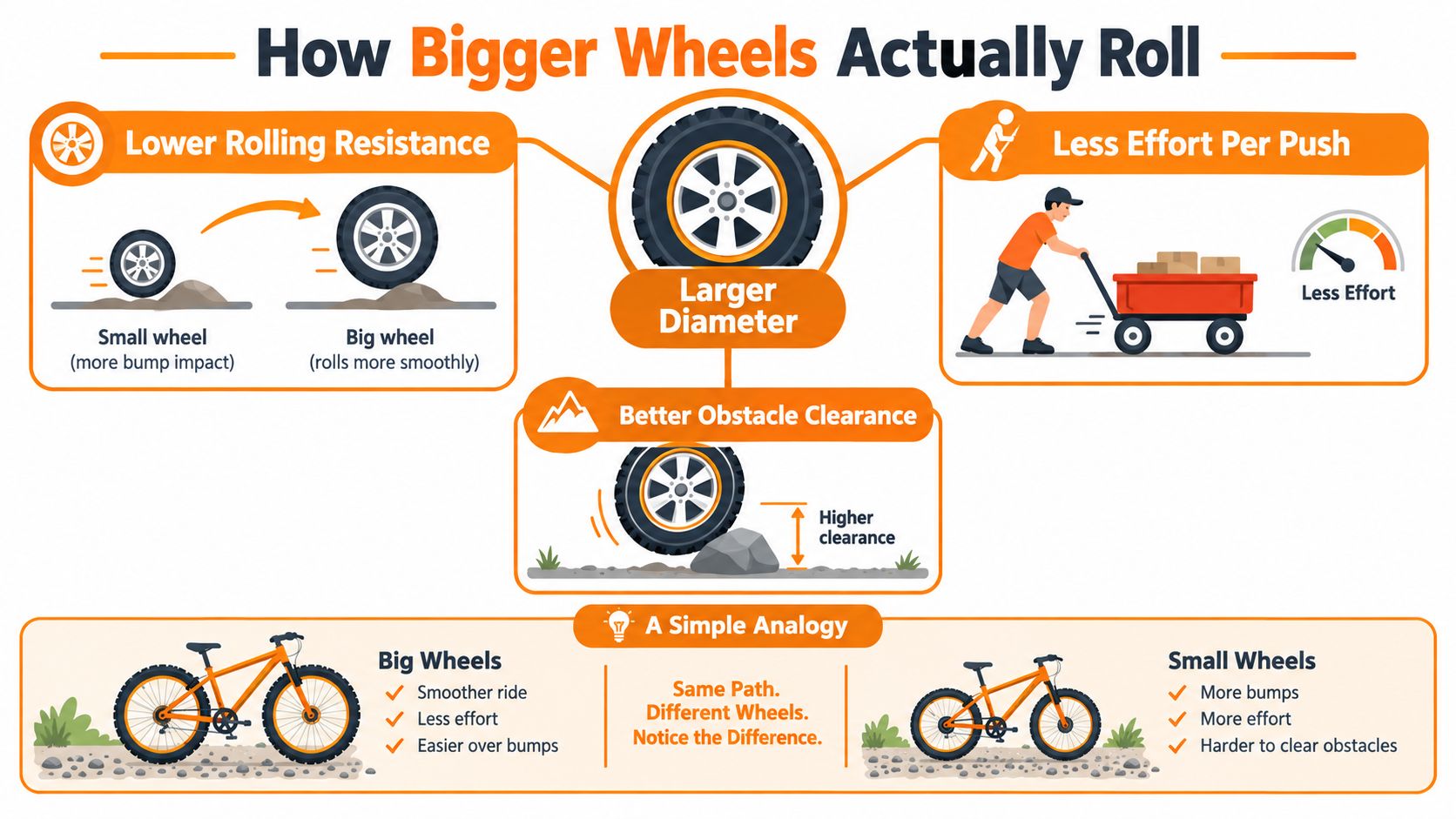
A larger wheel gives the axle an easier path over bumps, ruts, and little obstacles. That's the whole trick. The wheel doesn't magically remove resistance, it reduces how sharply the wagon has to climb over whatever is in front of it.
The geometry that saves energy
The World Bank's engineering guidance says rolling resistance drops as wheel diameter increases, and larger wheels cross small obstacles more easily on rough ground. That's because the obstacle is smaller relative to the wheel radius, so the wheel doesn't have to “fall into” and climb out of every little dip. On a grass field with uneven seams or a gravel lot with loose stones, that difference shows up fast in your hands and shoulders.
A smaller wheel hits the same bump at a steeper angle. A larger wheel spreads that contact out and feels smoother because the wagon keeps more of its momentum. That's why a wagon can seem easy on pavement and stubborn on rough turf, even when the load hasn't changed.
What that means in the real world
-
Bigger diameter helps: the wagon rolls over roots, stones, and shallow ruts with less abrupt drag.
-
Not every wheel is equal: diameter helps, but width, tread, axle alignment, and total weight still matter.
-
Look past the spec sheet headline: a wheel can be large and still perform poorly if it's narrow or badly matched to the surface.
If you want a compact way to compare wheel families, the pull-a-wagon guide is a useful follow-up for deciding how the wagon will feel in motion, not just how it looks folded up.
Sand, Grass, Gravel, and Uneven Ground
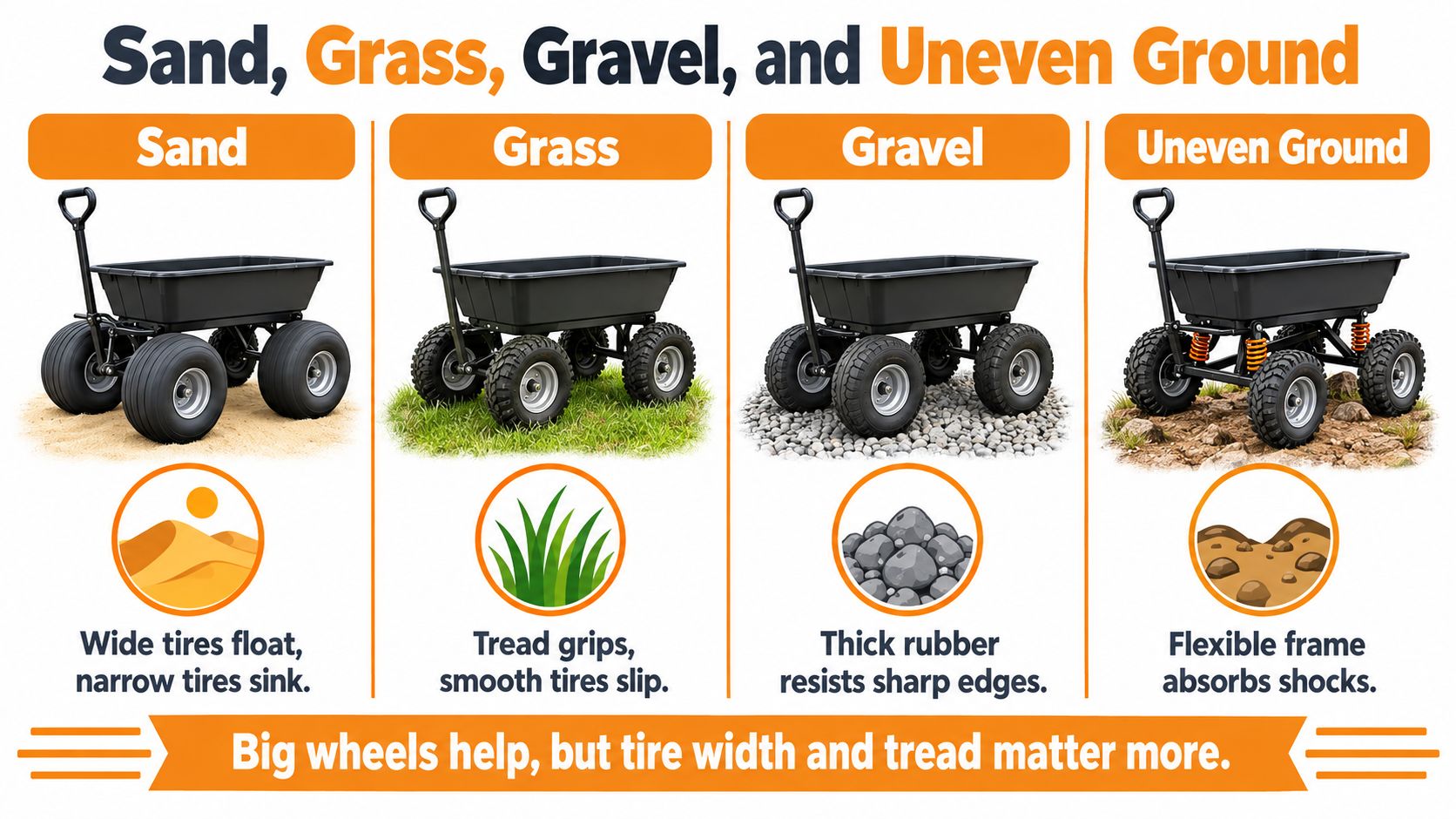
Soft beach sand is the most demanding surface because it changes under load. Compacted wet sand near the waterline can behave almost like a hard path, while dry loose sand farther inland can swallow a wagon that felt fine fifty feet earlier. That's why route choice matters as much as wheel design.
The World Bank notes that ground pressure and inflation pressure affect soil disturbance and energy loss, and that's the part most shoppers miss. A wheel that looks great on paper can still sink if the contact patch is too small for loose sand. Bigger wheels help, but on deep sand, width and pressure distribution often matter just as much.
Field note: if the wagon rolls well on grass but bogs down on dunes, the problem usually isn't the handle. It's sinkage.
Four surfaces, four different realities
-
Sand: wider contact helps more than a narrow wheel. A loaded wagon on dry, loose sand needs flotation, not just toughness.
-
Grass: moisture and rutting change everything. A wheel that grips well can still feel sticky on soft turf.
-
Gravel: sharp edges punish flimsy tires, so puncture resistance matters when you cross parking lots or rough paths.
-
Uneven ground: hidden holes, sprinkler heads, and erosion cuts can jolt a wagon hard, even if the route looks smooth from a distance.
For buyers, the honest answer is that all-terrain doesn't mean every terrain. It means the wagon has enough wheel diameter, tire width, and load balance to stay usable across mixed outdoor surfaces. If you want a practical sand-specific decision tree, the wagon-for-camping-gear guide is useful because camping routes often combine hard ground, grass, and softer shoulder areas.
Inside a Purpose-Built All-Terrain Wagon
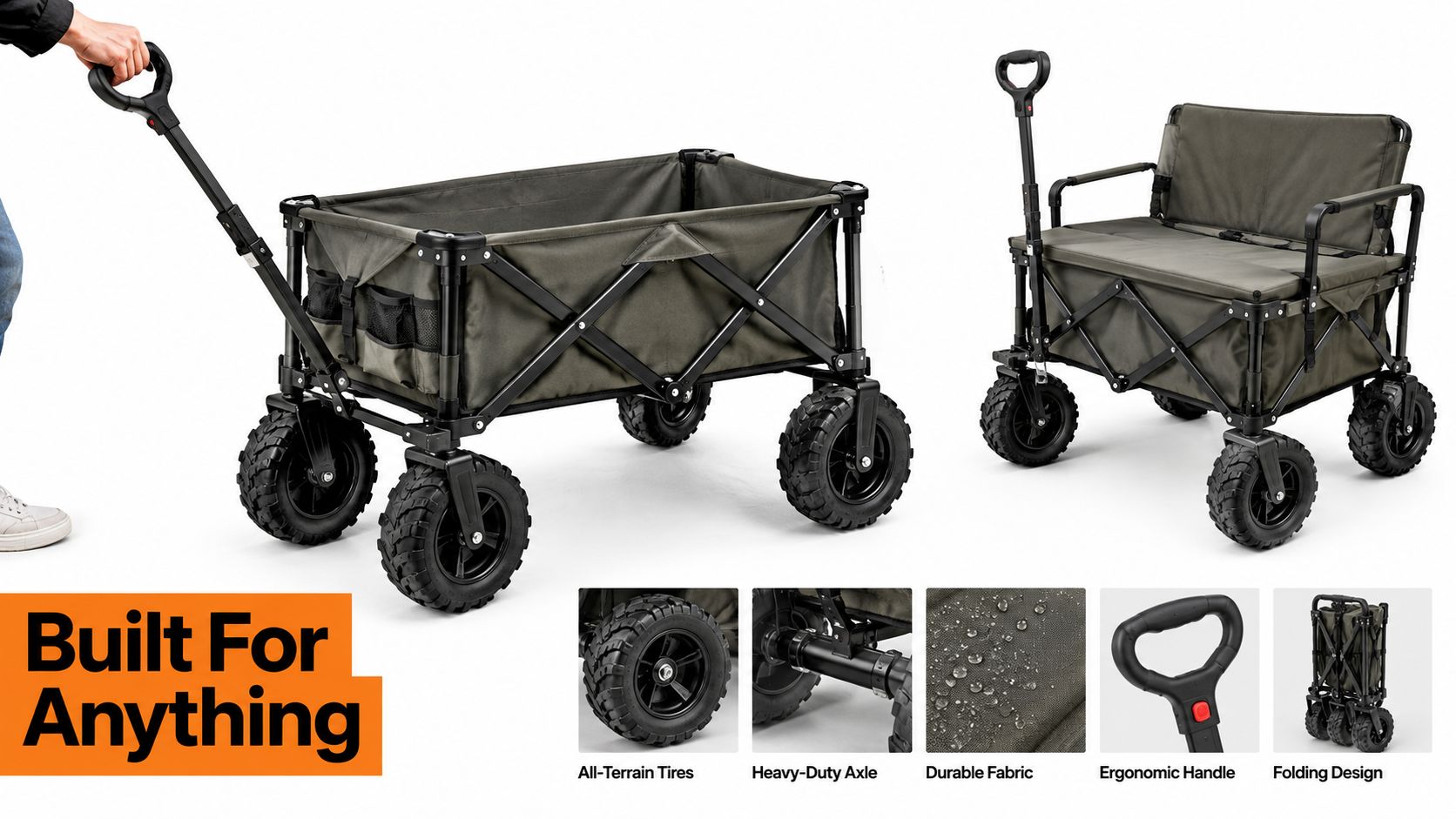
A good outdoor wagon is a system, not just a frame with wheels. The frame, axle, tire shape, handle, and bench conversion all need to work together or the thing feels awkward the second it's loaded. That's especially true when you're hauling gear one minute and using it as a rest stop the next.
What each part should do
-
Frame: A reinforced frame keeps the wagon from flexing when the load shifts, which means less wobble when you turn or stop.
-
Wheels and tires: Large, puncture-proof tires reduce interruptions from gravel and rough ground, so you spend less time checking for flats and more time moving.
-
Handle geometry: A handle that feels comfortable to pull matters because bad leverage makes every yard feel longer.
-
Fabric and storage: Durable fabric with pockets and cup holders gives the wagon somewhere to put the small stuff that otherwise gets lost in the bottom.
The Lounge Wagon is one example of this category. It uses a reinforced steel frame, 10-inch puncture-proof wheels, a 500 lb capacity, and a 2-in-1 seating setup that converts into a bench for two adults. That combination is useful because it handles cargo first, then gives you a place to sit without hauling a second piece of gear.
A wagon that can haul gear and then become seating is only useful if both modes feel stable when loaded.
A fold-down design still has to fit your vehicle and your storage space. That's why a product page or bundle like the Beach Day Bundle is worth checking early, before you commit to a wagon that solves one problem and creates another. The point isn't just capacity, it's whether the wagon works at the shoreline, the sideline, and the parking lot.
Real-World Use Cases for Big Wheeled Wagons
The Sideline Elite parent isn't buying a toy hauler, they're trying to get a cooler, a tent, and folding chairs across grass and gravel without missing half the first game. In that setting, big wheels matter because the wagon has to move through chopped-up turf, not glide across a showroom floor. The win is arriving with enough energy left to enjoy the second match.
The Sand-Sovereign family has a different problem. Umbrellas, snacks, buckets, and towels all get heavy fast when the sand is soft, and that's where a wagon either earns its keep or becomes dead weight. The route from parking to beach access matters just as much as the wagon itself, especially on loose sand where wheel width and total load start fighting you.
Different users, different priorities
-
Front-Row Regular: festivals and markets reward a wagon that can carry blankets, purchases, and a place to rest between sets.
-
Grand-Packer: grandparents need a seat that sits high enough to get up from without turning every stop into a struggle.
-
Mobile Angler: pier and shore fishing loads are long, awkward, and often wet, so stable hauling matters more than compactness.
-
Weekend Warrior: tailgaters and campers need one item that can move gear and still save trunk space.
-
Event Pro: volunteers and coaches need a cart that can move supplies and still provide a brief place to sit during downtime.
If you're mapping an outing around local walking routes, Riverwalk walks and playgrounds in Jenks is a good example of the kind of mixed-surface environment where a wagon can help, but only if the route is realistic for the load.
The hard truth is that no wagon fixes a bad route. A good wagon makes a workable route easier, and a poor route still punishes the person pulling it. That's why the wagon towing capacity guide is worth checking if you're deciding between a light family load and a packed event day.
Stability, Seating, and Safe Use on Uneven Ground
A cargo rating is not the same thing as a safe seating setup. A wagon can technically move a heavy load and still feel wrong when two adults sit in it, especially if the ground slopes or the cargo shifts. The center of gravity rises, balance gets less forgiving, and the wagon starts acting like a moving bench instead of a parked one.
Seat height matters for older adults because getting up from a low surface takes more effort. In a controlled study of older participants, muscle activation during sit-to-stand rose sharply, and higher seats reduced hip and knee demands. Another study found that raising the seat made chair rises easier, which is exactly why a wagon bench should be treated as a comfort and mobility decision, not a casual add-on.
Safe use checklist
-
Park on level ground: uneven surfaces make tipping more likely.
-
Secure the wheels: use brakes or chocks before anyone sits down.
-
Remove or stabilize cargo: loose gear shifts the center of gravity fast.
-
Check seat height: the bench should let the user stand without a hard push-off.
-
Use it as a rest point, not a mobility aid: if a boardwalk, ramp, or adaptive cart is safer, use that instead.
A wagon with seating is useful when it's stationary, balanced, and loaded with care. It's not a substitute for a proper mobility device, and it shouldn't be treated like one. If you're considering the braking side of that equation, the wagon brake system guide is the right next read.
Field-Tested Buying and Loading Checklist
Start with the route, not the marketing. If you'll cross sand, grass, or gravel, look first at wheel diameter, tire width, and whether the wheel design matches the softest surface you expect to face. A wagon that folds neatly but drags in the sand will still waste your energy.
Then check the load plan. A high cargo rating is only useful if the wagon stays balanced, the handle feels natural, and the seated setup is safe for the people who'll use it. Keep heavier items low, avoid loading one side unevenly, and test the wagon on the same surface you'll use on game day or beach day.
Quick buying checklist
-
Wheel setup: large enough for the surface, wide enough for the softest ground.
-
Puncture resistance: especially important for gravel lots and rough paths.
-
Payload versus seated use: cargo capacity and seating safety aren't the same thing.
-
Bench height: match it to the adults or grandparents who'll sit there.
-
Handle and fold size: the wagon has to fit your hands and your vehicle.
-
Loading protocol: pack low, keep balance centered, and don't overload one end.
If you want a wagon that hauls first and then becomes a place to rest, Lounge Wagon is built around that two-mode use case. The value is simple, one wagon for the gear, another for the sit-down moment, without packing a second chair. Ready to stop hauling in circles and start making one clean trip? Visit Lounge Wagon and choose the wagon that fits your sand, grass, and game-day routine.


