TL;DR: The best beach rod holders match the holder type to the sand, resist salt with corrosion-resistant hardware, and get tested before you trust them with a rod. Spikes suit firm sand, augers grip loose ground, and clamps or weighted bases work better on rigid structures or calm shorelines. Last Updated: October 2026
The first trip carries the cooler. The second takes chairs, bait, tackle boxes, umbrellas, and rods. By the third walk, soft sand has turned a short approach to the water into a workout, and the rod still has nowhere dependable to rest. You balance it on the butt while baiting a hook, turn to reach the net, and watch the whole setup slide toward the wet sand.
That routine wastes time and invites damage. A rod that tips can crack guides, bury a reel in grit, or disappear into shallow surf when a fish strikes. The right beach rod holder gives the tackle a stable working position, while a purpose-built transport system reduces the exhausting haul. For a practical shore-fishing setup, start with this shore fishing setup guide, then choose support based on the actual sand and surf in front of you.
The Shoreline Struggle and Why You Need Support
A beach rod holder earns its place before the first cast. Surf anglers need both hands for threading bait, cutting leader, landing fish, checking drag, and helping children move safely around the wash. Resting a rod against a cooler or chair doesn't solve the problem because those objects shift, sink, or sit too low when wind and waves start working against them.
The frustration gets worse during active fishing. You may set a rod down for only a moment, but that moment is enough for a wave surge to pull the butt sideways or for a fish to load the blank unexpectedly. A holder keeps the rod raised and gives the angler a predictable reference point, but it still needs to be anchored in ground that can carry lateral force.
The cost of a casual setup
Broken guides are only one consequence. Sand in a reel seat, a scuffed blank, a lost rig, or a wet tackle box can turn a productive morning into cleanup and repair. A holder also helps separate the rod butt from abrasive grit, although it can't protect equipment if the base itself is sinking or leaning.
Saltwater participation makes this a broad equipment issue, not a niche concern. The National Marine Manufacturers Association reports that 15.1 million people participated in saltwater fishing in the United States during 2024, within an overall recreational fishing audience of 57.9 million people aged six and older. New and returning anglers need a setup that remains manageable after the walk from the car, not just a holder that looks solid on a store shelf.
Practical rule: If you wouldn't trust the sand with your phone, don't trust it with an unattended rod.
A good transport plan matters just as much as rod support. Carrying tackle, bait, coolers, chairs, and multiple rods by hand leaves less attention for the tide and children. A stable holder at the fishing spot and an efficient way to reach that spot work together, but neither replaces active supervision of the line, drag, swell, wind, or sudden strike.
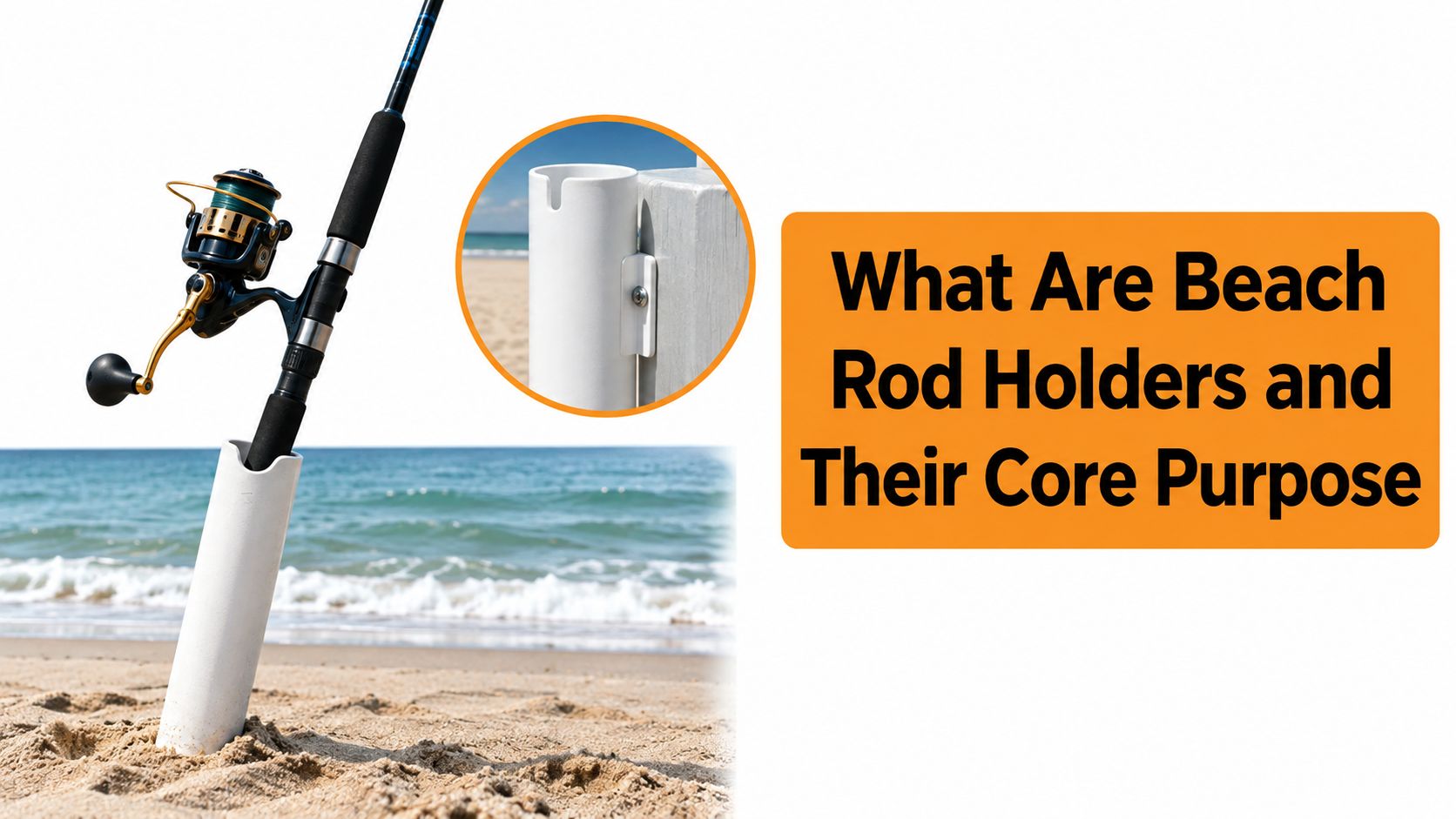
What Are Beach Rod Holders and Their Core Purpose
A beach rod holder is a stabilizing appliance that supports a fishing rod while the angler handles bait, manages a catch, adjusts terminal tackle, or takes a short break. Unlike a casual rod rest, it must deal with unstable ground, salt exposure, wind, wave action, and the sideways torque created when a fish loads the line.
The design problem has been recognized for decades. A U.S. fishing rod holder patent was filed on June 26, 1959, and granted on August 22, 1961, establishing that purpose-built rod support has been part of angling equipment for more than six decades. The patent distinguished surf fishing from freshwater, still fishing, and ice fishing, noting that surf applications require a larger and heavier construction. Read the original fishing rod holder patent for the historical design context.
How the holder carries load
The rod's vertical weight is only part of the task. A fish pulling sideways creates torque at the holder mouth, while wind and wave surge can move the rod and its line in different directions. A long spike, broad auger, or properly weighted base counters those forces differently.
Choose the holder by asking three questions:
Where does the base get its resistance? Sand penetration, a rigid rail, or dead weight each has different limits.
What can move first? Watch the spike, clamp, threads, liner, and rod butt, not only the holder tube.
Can you remove and clean it? Salt and sand need access to joints, drains, threads, and sleeves.
The holder's purpose is not to let you walk away from the rod. It creates a controlled resting position while you stay close enough to respond to a strike or changing conditions. That distinction separates useful support from false confidence.
Understanding Spike Types and Mounting Options
Mounting style determines whether a holder works with the beach or fights it. A spike needs penetrable sand, an auger relies on thread engagement, and a clamp needs a rigid structure that won't rotate. Weighted bases avoid penetration but become awkward to carry and vulnerable to lateral movement when surf or wind rises.
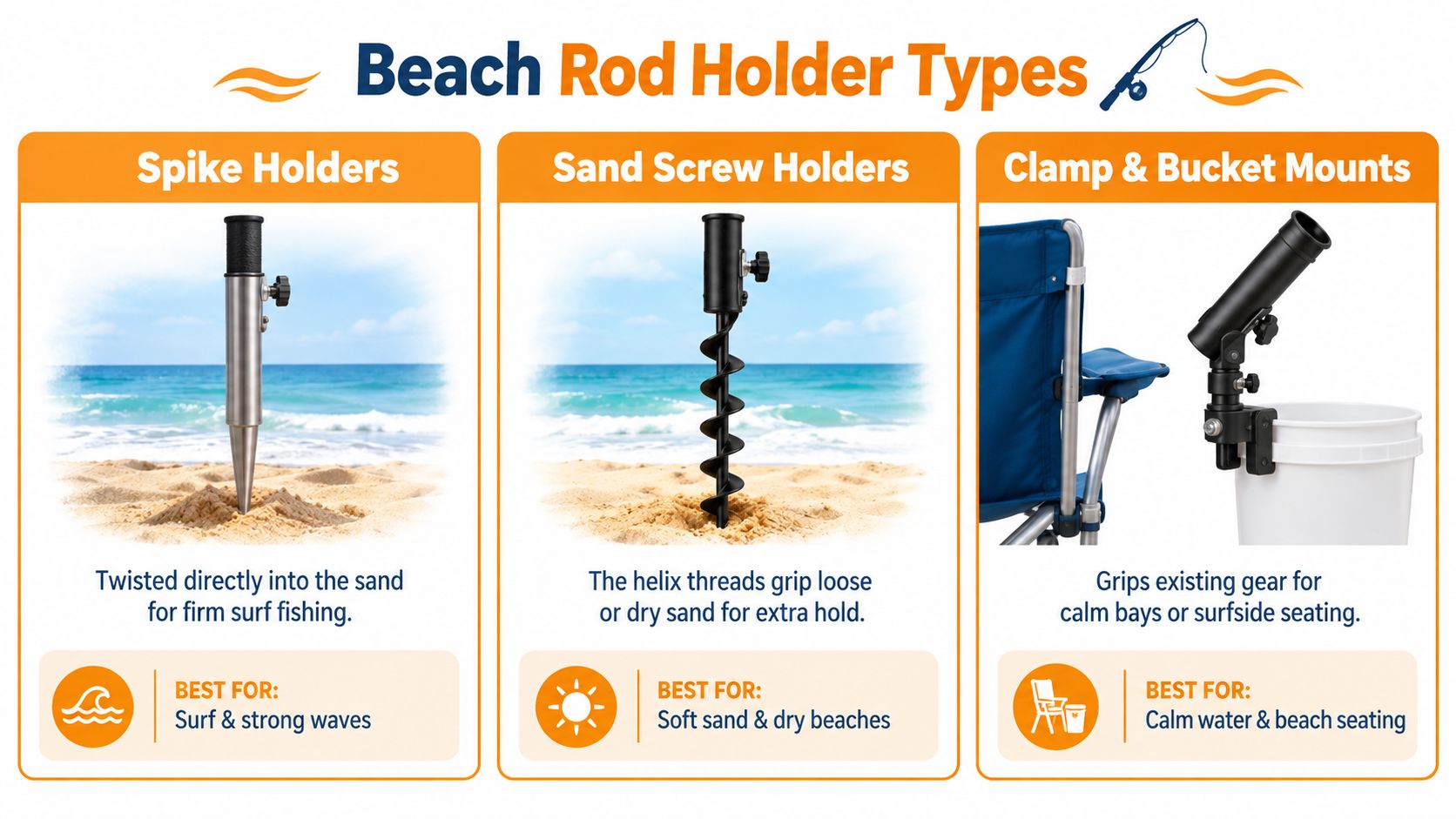
Spike holders
Traditional spikes are driven or pressed into workable sand. Their strength comes from the surrounding material gripping the shaft, so length, width, insertion depth, and the moisture profile all matter. They're straightforward and fast on a shoreline with firm, cohesive sand, but they can tilt when the sand is loose or saturated.
A spike works best when you can push it in all the way, align it with the expected pull, and test it before loading the rod. It doesn't become secure merely because the tip disappeared below the surface.
Sand screw holders
Auger or sand-screw holders twist into the ground and use helical threads to increase contact with loose material. They can outperform a plain spike in dry or shifting sand because the threads spread resistance along the shaft, but they still fail when the surrounding sand is too wet to hold its shape.
Install slowly, keep the shaft aligned, and stop if the auger turns without gaining purchase. Over-tightening can disturb the sand around the threads and create the very looseness you're trying to avoid.
Clamp and weighted bases
Clamp holders suit pier railings, beach chairs, buckets, and other rigid supports. They're convenient where penetration isn't allowed or practical, but uneven rocks, flexible chair frames, and moving gear can let the clamp twist. A clamp is only as stable as the structure beneath it, so don't treat a chair arm as equivalent to a fixed pier rail.
Weighted bases offer portability and quick placement on hard-packed shorelines, decks, or calm bays. They consume more carrying capacity and can slide when a rod loads suddenly, so they're a poor choice for strong surf unless the base is designed for that environment. Anglers working around fixed structures can also use the pier fishing cart guide to think through transport and mounting constraints together.
Mounting style
Strength
Main weakness
Best fit
Spike
Fast, simple, light to transport
Can lean or sink in unsuitable sand
Firm, workable shoreline sand
Sand screw
More thread engagement in loose ground
Loses purchase in overly saturated sand
Loose or shifting sand when tested carefully
Clamp
No ground penetration required
Depends on a rigid support
Piers, rails, and sturdy fixed structures
Weighted base
Quick placement on hard surfaces
Heavy and prone to sliding under lateral load
Calm shorelines and non-sandy platforms
Choosing Materials for Salt and Sand Exposure
Material choice affects reliability, but marine-grade doesn't mean maintenance-free. Salt deposits collect around fasteners, joints, clamps, and moving parts, while sand adds abrasion whenever a sleeve telescopes or a threaded connection turns. The holder body may look intact even as a hidden fastener pits or a weld begins to weaken.
Stainless steel suits applications that need rigidity and resistance to rough-water loading. Nylon, fiberglass, and aluminum can also serve in the right design, but each still needs appropriate mounting hardware. Marine guidance recommends stainless mounting hardware even when the holder body uses another material, as explained in this rod-holder installation guidance.
Inspect the parts that actually fail
Look beyond the tube. Check:
Fasteners and threads: Search for pitting, discoloration, seized nuts, or rough engagement.
Welds and joints: Examine stress points for cracking, distortion, or salt trapped in seams.
Liners and grips: Remove grit before it scores the rod butt or jams a clamp.
Drain paths: Water trapped inside a holder or sleeve extends salt exposure after the trip.
Untreated steel may appear acceptable after a few outings, then deteriorate where you can't see it. Aluminum can resist corrosion well but still suffer from abrasion and galvanic problems when paired with unsuitable hardware. Polymer components avoid some metal corrosion, yet they can crack, deform, or retain grit around inserts.
Rinse with fresh water after every saltwater session, let the holder dry completely, and inspect it before the next trip. A useful storage habit is to keep the holder out of a damp vehicle compartment, where salt residue can continue attacking fasteners between outings. The same salt awareness applies to transport equipment, including the care principles described in protecting gear from salt water.
Reading the Sand for Stable Anchor Points
The firmest-looking sand isn't automatically the best anchor point. Dry sand can resist penetration because it packs and collapses around the shaft, while overly saturated sand loses the internal strength needed to grip it. Near the waterline, insertion may become easier as the sand moistens, but increasing saturation can reduce holding reliability.
That contradiction catches anglers off guard. They push a spike into wet sand, feel initial resistance, and assume the setup is secure. The sand can then drain, slump, or shear under repeated loading from wind, waves, and a fish.
A simple stability test
Test the ground before placing an expensive rod in the holder:
Insert the holder without the rod. Keep it aligned with the direction of expected pull.
Apply side pressure by hand. Push from several directions and watch for rotation or progressive tilt.
Pull upward gently. A holder that lifts easily has little useful purchase.
Observe the surface. Cracking, flowing grains, or a widening hole indicate weakening ground.
Recheck after the tide changes. Rising water can alter saturation and undermine a previously acceptable anchor.
A spike that begins to lean is already giving you information. Remove it and reposition rather than packing extra loose sand around the shaft. A sand screw that spins freely without advancing has lost engagement, and a weighted base that creeps across the surface should not carry a rod in active surf.
A holder can be mechanically sound and still be unsafe if the ground beneath it can't carry the load.
Wave surge and wind deserve the same attention as the sand. Don't place a rod where the wash can reach the reel, and don't leave gear unattended just because the holder passed a hand test. If you use other beach-mounted equipment, the anchoring principles in this beach flag pole guide reinforce the same lesson: ground conditions determine whether a vertical object stays where you put it.
Local rules matter too. California's Department of Fish and Wildlife states that beach anglers may actively use no more than two rods at one time. That limit applies to California, not every coastline, so check the applicable state, park, or local regulation before planning a multi-rod setup. Read the California beach-fishing regulations before you cast there.
Maintaining Holders to Prevent Salt Damage
A freshwater rinse is the starting point, not the entire maintenance routine. Salt crystals hide under sleeves, inside threads, and around clamp pivots, while sand turns those areas into abrasive grinding surfaces. Corrosion-resistant materials slow the process, but friction and trapped residue still shorten service life.
Use this post-trip sequence:
Flush first: Run fresh water through tubes, drains, threads, clamps, and moving joints instead of wiping only the visible surfaces.
Disassemble where practical: Separate removable liners, caps, sleeves, and fasteners so salt doesn't remain trapped beneath them.
Dry completely: Open telescoping sections and allow internal surfaces to dry before storage.
Inspect under tension points: Check welds, pivots, threads, and rod-contact surfaces for roughness or pitting.
Lubricate suitable moving parts: Apply a compatible lubricant to pivots and threads after cleaning, keeping the product away from areas where it can contaminate line or bait.
Store separately: Don't leave wet holders pressed against reels, tackle, upholstery, or vehicle trim.
The reel deserves a separate inspection. Elevating the rod butt helps keep the reel away from sand and splash, but a dirty holder can transfer grit into the butt section, clamp, or sleeve. If a joint feels gritty, don't force it. Flush it again, dry it, and identify whether the grit or corrosion has already damaged the surface.
Simplifying the Gear Haul to the Beach
You feel the haul before you make the first cast. Rods knock into chair legs, a cooler shifts sideways, and wheels that looked fine in the parking lot start trenching into wet-soft sand near the wash line. A solid rod holder helps once you are set up, but the trip in matters too. Across rough outdoor surfaces, rolling resistance climbs fast, and a peer-reviewed review of rolling resistance on outdoor surfaces found that properly inflated pneumatic tires can produce up to 91% less resistance than solid tires or solid inserts. The study covers wheelchairs, not fishing carts, but the mechanical point carries over. Soft ground punishes narrow, rigid wheels.
Build the beach load as one working system, not as a pile of separate items. Large, compliant, or wide-profile wheels help keep the cart riding over sand instead of plowing through it. Wheel choice is only part of the job, though. The load has to stay balanced, the rods need to ride clear of loose sand, and the frame layout should not turn every umbrella, chair, and rod tip into a snag point on the walk down.
Pack by access and by weight.
Rods and holders: Keep them secured high enough that the butt and guides stay out of blowing sand.
Tackle and bait: Put the items you reach for often where you can grab them without unpacking the whole carrier.
Cooler and water: Keep dense weight low so the cart stays steadier over ruts and sloped approaches.
Shade and seating: Treat them as part of the same transport plan, not as extra trips after the first load.
The beach wagon for fishing guide helps when you are comparing how the carrier, rods, holders, and shoreline layout work together. If you also bring shade, an instant portable sun shelter can make a long session easier, as long as you secure it properly for local wind and beach rules.
A multifunctional carrier cuts clutter if it replaces separate gear instead of adding more bulk. The Lounge Wagon combines a 500 lb capacity gear hauler with 2-in-1 seating, and its 10-inch puncture-proof wheels are intended for sand, grass, and gravel. That kind of setup can remove a separate bench from the load and keep the walk simpler. Check the Lounge Wagon product details if you want to compare whether one carrier can cover hauling and seating in the same footprint.
Keep the workflow disciplined. Test the holder where you plan to fish, watch it as the sand firms up or loosens with water, then rinse and dry the whole setup after the trip. Salt does not stay on the obvious surfaces, and sand works into every joint that flexed on the walk in. A simpler haul helps, but only if the system still stays stable at the shoreline and survives the ride home.
Choosing a selection results in a full page refresh.
This pad is perfect for kids or dogs to be comfortable inside the moving wagon, and very nice after you set everything up and want to sit for extra padding.
Having the umbrella this summer has been easy to use and a must to make sitting and watching the parade so nice when there isn't any shade. My dogs laid on the wagon padding and enjoyed the day without getting too hot. I enjoyed the shade too.