TL;DR: An all-terrain wagon with a canopy is worth buying when it combines wide, capable wheels, a strong frame, dependable shade, and seating that works on level ground. Lounge Wagon's 2-in-1 design hauls outdoor gear, then converts into a bench for two, reducing trips between the car, beach, field, or festival.
Last Updated: October 2026
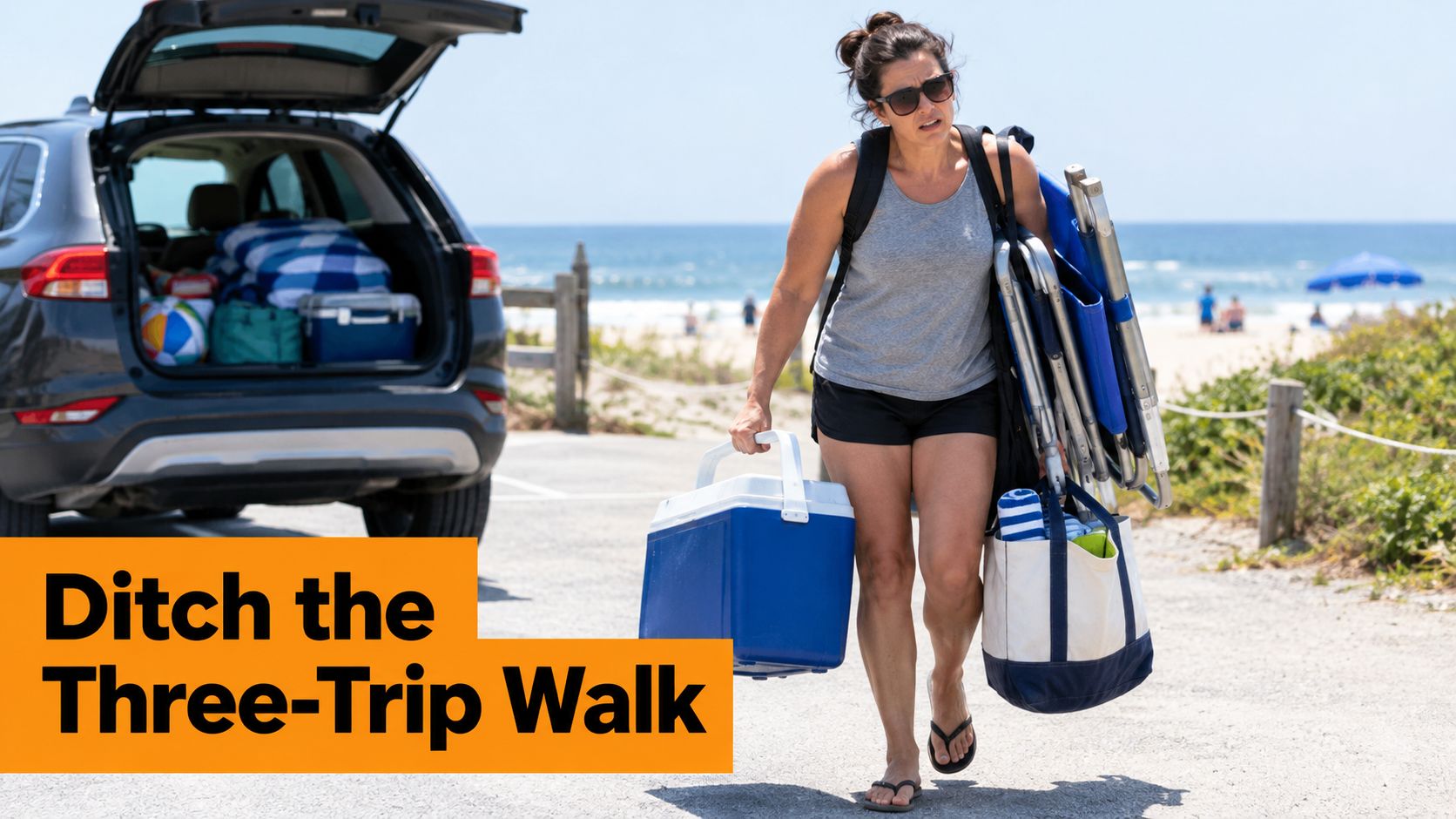
The three-trip walk from the parking lot is familiar. First comes the cooler, then the folding chairs and sports bags, followed by the umbrella, blankets, toys, and everything someone forgot. By the time you reach the beach or soccer field, the morning has already become work.
An all terrain wagon with canopy can consolidate that load and create a shaded place to rest. Lounge Wagon combines a reinforced steel frame, a 500 lb capacity, 10-inch puncture-proof wheels, and 2-in-1 seating that converts the hauler into a padded bench for two adults. You can explore the Lounge Wagon for the product configuration and accessories.
The One-Trip Solution for Outdoor Logistics
Outdoor recreation is no longer a niche pastime. 175.8 million Americans aged six and older participated in outdoor recreation in 2023, equal to 57.3% of the eligible U.S. population, according to the Outdoor Industry Association's participation report. That audience includes beach families, anglers, campers, grandparents, festival attendees, and tournament parents who all face the same practical problem, moving equipment from the vehicle to the destination.
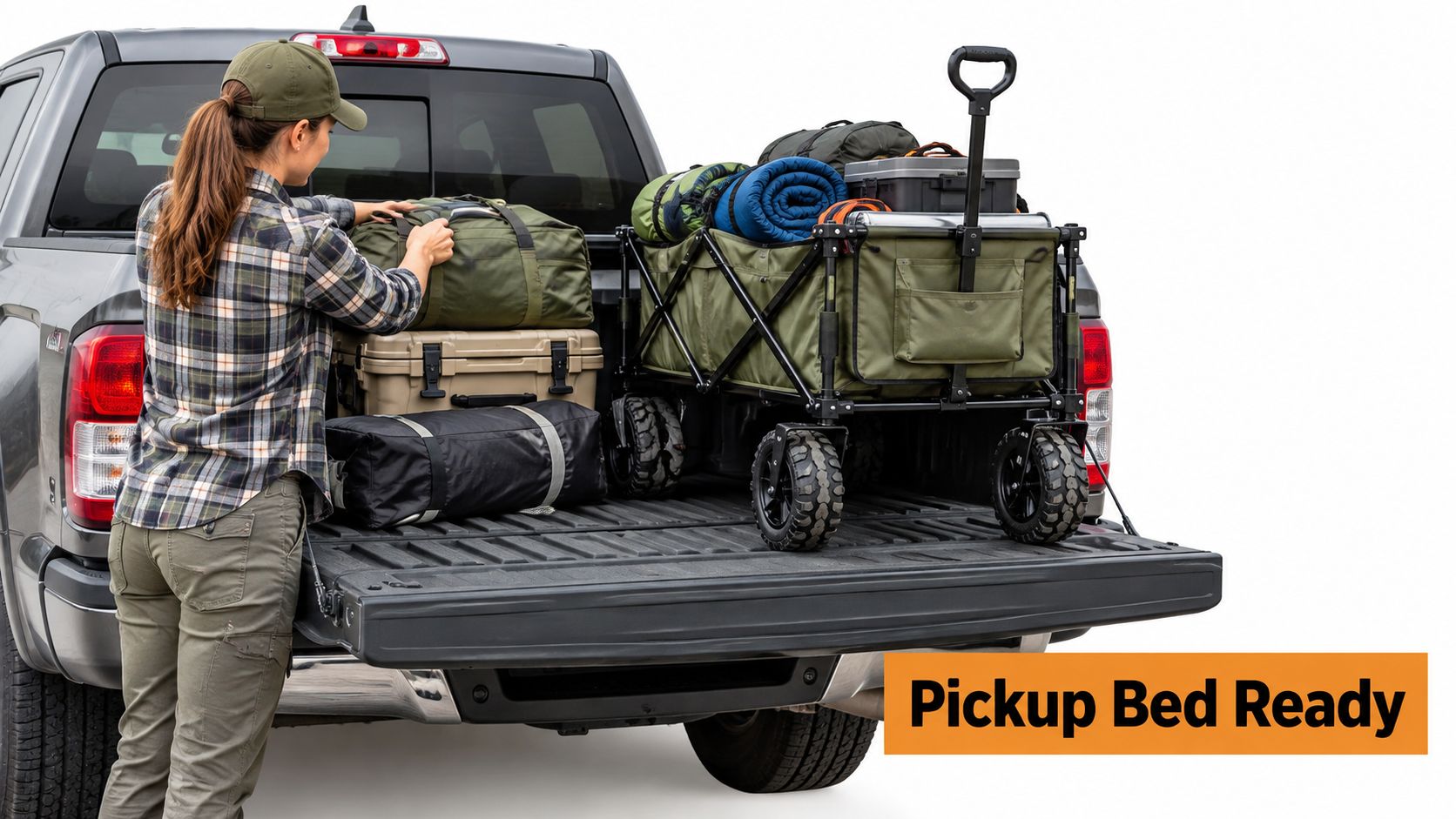
At a youth soccer complex, the load often includes a team cooler, hydration supplies, blankets, a tent, balls, and personal bags. At the Florida Gulf Coast, it may be an umbrella, sand toys, towels, snacks, and a second cooler. Carrying separate chairs makes both situations harder because the chairs occupy space in the vehicle and add another item to manage once you arrive.
The Lounge Wagon's practical distinction is its 2-in-1 design. The reinforced steel frame and 500 lb capacity provide a substantial hauling platform, while the integrated seat lets the same unit become a double-seater bench. That means 2-in-1 seating isn't an accessory you remember after unloading. It's part of the equipment plan from the beginning.
Why one trip changes the day
A good wagon doesn't eliminate effort. It concentrates effort into one controlled movement and reduces the number of objects you have to carry, drag, or leave unattended. Integrated cup holders and storage pockets also keep smaller essentials from disappearing beneath a cooler or sports bag.
For festival organizers and attendees, the same principle applies to supplies, blankets, signs, and personal gear. Event teams looking beyond equipment transport can also review why festivals choose EventUploader when planning guest communication and event logistics.
The important distinction is capacity versus usability. A wagon may hold a large load, but it still needs wheels that suit the route and a handle that lets you control the weight. For a closer look at beach-cart setup and hauling considerations, see this guide to a large beach cart.
Wheel Specs and Sand Performance
A high weight rating doesn't guarantee easy movement. The surface determines whether the wagon rolls or sinks, and dry beach sand is where many supposedly all-terrain designs expose their limits.
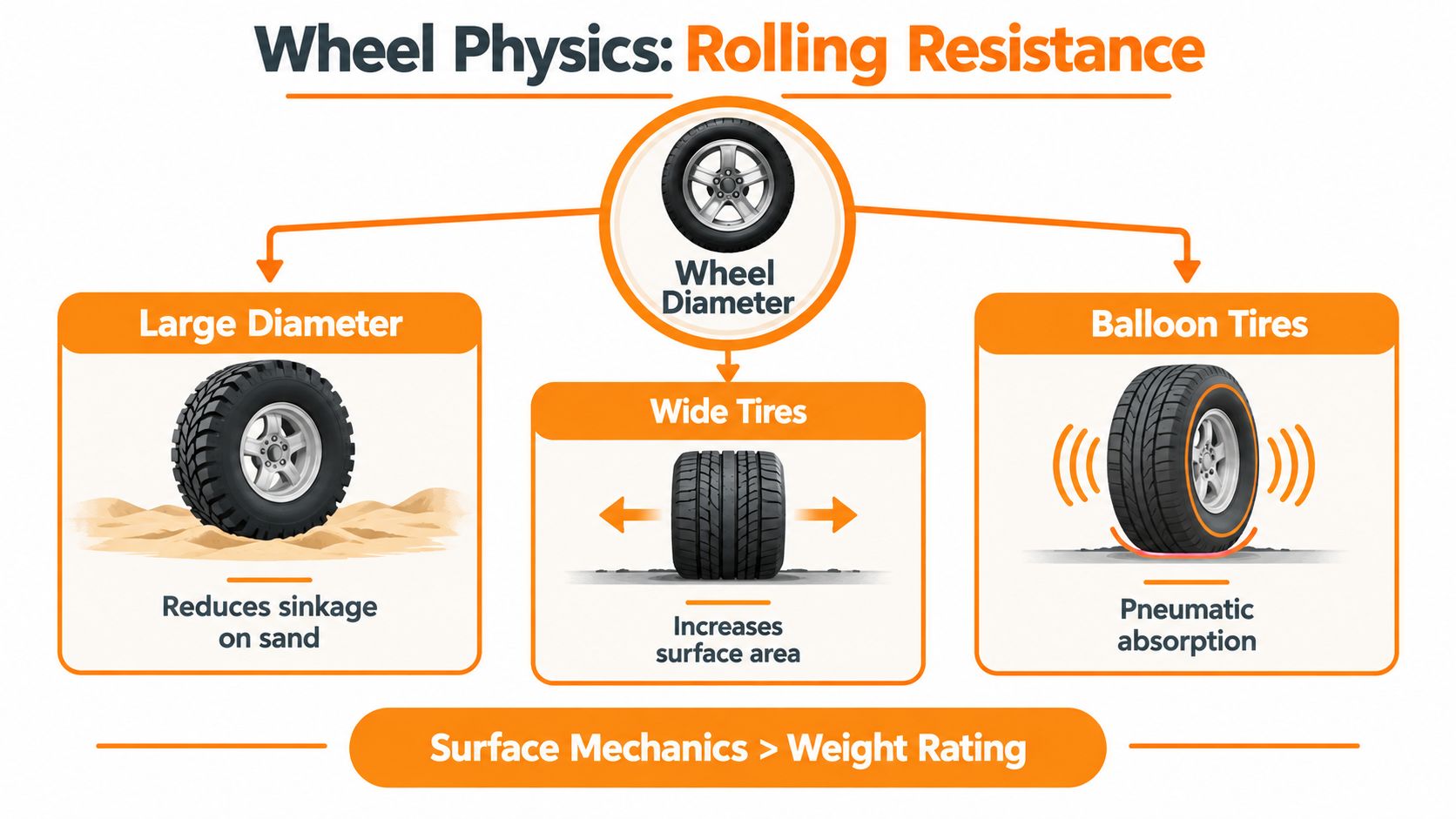
U.S. transportation research on wheeled vehicles operating on sand found that performance improved as ground-contact pressure decreased, with wide wheels reducing sinkage and plowing resistance on dry, loose shoreline sand, as documented in this transportation research on wheeled vehicles in sand. The takeaway is simple: wheel width, contact-patch area, load distribution, and tire pressure matter alongside diameter.
A 10-inch wheel helps on grass, gravel, field edges, and uneven paths because it approaches holes and bumps with a less abrupt vertical interruption. Guidance from the National Institute for Occupational Safety and Health identifies wheels of at least 6 inches as easier to move over irregularities. Wheel material, tread, axle design, maintenance, and payload still influence the result.
What beach-ready really means
A 500 lb capacity describes structural capability. It doesn't mean a fully loaded wagon will be comfortable to pull through loose powder sand, particularly uphill or across a long beach approach. A realistic buyer should separate maximum capacity from a practical beach-ready payload.
Use these checks before trusting an all-terrain claim:
Measure the route: Dry, loose sand demands more flotation than wet, compact shoreline sand.
Inspect wheel width: Narrow wheels can dig in even when the diameter looks impressive.
Distribute the load: Keep dense items near the center rather than concentrating them over one axle.
Test occupied seating: If the wagon becomes a bench, assess stability only when it's stationary on level ground.
Consider tire pressure: Pneumatic balloon-style tires can enlarge the contact patch, but the recommended pressure must come from the manufacturer.
Pushing can also be easier than pulling because body weight assists the effort. OSHA's guidance on pushing outdoor equipment recommends handles positioned in the user's power zone and warns that rough terrain can create jarring impacts that contribute to strain.
Practical rule: Judge an all-terrain wagon by how it moves at the load and surface you actually use, not by the headline capacity alone.
The Lounge Wagon wheel guide is useful when comparing wheel size, surface conditions, and the difference between rolling across grass and traveling through soft sand.
Evaluating Canopy Durability and Shade
A canopy earns its place when it provides reliable shade without becoming a fragile panel attached to a strong cart. The fabric, seams, attachment points, frame, and ventilation all matter.
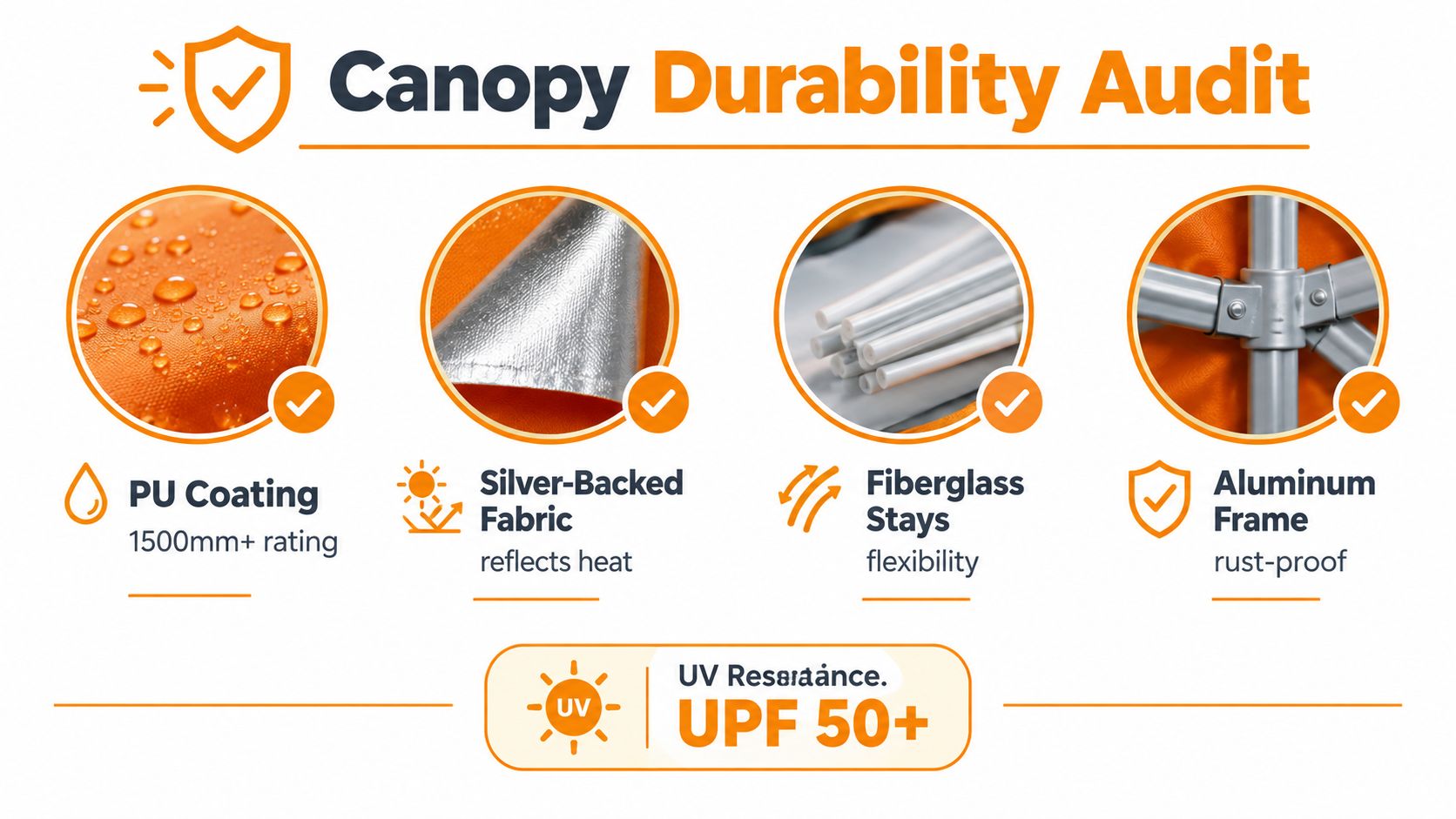
Solution-dyed polyester and acrylic are common canopy materials, but the label alone doesn't establish service life. Outdoor-fabric engineering guidance explains that weave, coating, seam design, and testing method work together, with benchmark values including at least 500 hours of UV exposure and grab strength of 400 pounds in the warp direction. The canopy-fabric specification guide outlines the testing considerations.
What to inspect before buying
A practical canopy audit should focus on failure points rather than marketing language:
Fabric field: Look for a stated fiber type and weathering protocol, not just “UV resistant.”
Seams: Check whether hems are reinforced and whether thread is designed for outdoor exposure.
Attachment points: Frame connections and tie-down interfaces need reinforcement because localized tearing often begins there.
Ventilation: Full overhead coverage can reduce direct sun but may restrict cross-breeze in still, hot conditions.
Storage behavior: A canopy adds utility, but it can also increase folded bulk and complicate vehicle packing.
Weather limits: Shade fabric isn't a substitute for a storm shelter. Wind, rain, and uneven ground change the risk profile.
The Lounge Wagon canopy article offers more context on using shade in parks and at beaches. The useful standard is not “does it have a canopy?” but “does the canopy remain practical after repeated setup, folding, transport, and exposure?”
Shade also supports safer event planning, but it doesn't replace hydration or breaks. New York City Health recommends creating shade, making water accessible, and encouraging breaks from physical activity and sun exposure during outdoor events in its heat-safety guidance.
The 2-in-1 Bench Advantage for Sidelines
A standard utility wagon solves transport, then leaves you carrying or storing the seating. That arrangement works for short outings, but it becomes inefficient during long tournament days, crowded festivals, and multigenerational trips where rest isn't optional.
The Lounge Wagon's 2-in-1 seating changes the packing equation. The wagon carries equipment on the way in, then becomes a bench for two adults once the group reaches its location. The 500 lb capacity handles the hauling role, while the seat addresses the separate problem of where people will rest.
Feature
Standard Utility Wagon
Lounge Wagon (2-in-1)
Primary use
Gear transport
Gear transport and seating
Seating
Separate chair required
Bench for two adults
Capacity
Varies by model
500 lb capacity
Wheel approach
Varies by model
10-inch puncture-proof wheels
Shade
Often separate accessory
Canopy-compatible configuration
Storage impact
Wagon plus chairs
One multifunction unit
Seating for older adults and grandparents
Accessibility guidance for outdoor events emphasizes back support and armrests because they help older users maintain posture and rise from a seated position. The same guidance favors firm, level seating, which is why a wagon bench should be treated as a stationary rest seat, not a moving passenger carrier.
Check these details before using convertible seating:
Seat height: A higher, stable seat can make standing easier than a low ground chair.
Back support: A supported back reduces the fatigue associated with waiting between activities.
Arm support: Armrests can help with controlled sit-to-stand movement.
Surface: Use the bench on level ground, away from slopes, ruts, and crowded traffic lanes.
Occupant limit: Confirm the manufacturer's combined occupant limit separately from the hauling rating.
Tournament parents also benefit from the footprint. A separate folding chair can get buried under bags, while the integrated bench stays attached to the hauler and remains available when needed. The 2-in-1 wagon guide shows how the convertible format fits into a broader outdoor setup.
Matching the Wagon to Your Use Case
The right configuration depends on the route, the load, and how long people will stay outside. A beach family, a tournament parent, and a mobile angler may all need an all-terrain wagon, but they shouldn't evaluate it using the same priorities.
The sideline elite
For soccer and lacrosse complexes, prioritize organization and repeated movement across grass or gravel. The load may include coolers, tents, balls, blankets, uniforms, and personal bags, so the wagon should remain controllable rather than only capable of holding everything.
Team sports have a substantial participation base. The 2024 State of Play report found that 39.8% of U.S. children ages 6–17 regularly participated in a team sport in 2023, according to Project Play's youth-sports coverage. For families attending multi-game days, integrated seating can remove the need to pack separate bag chairs.
The sand sovereign
For deep beach powder, prioritize contact-patch width and load control over the largest possible capacity label. Pack dense items low and near the center, keep the route as firm as possible, and avoid assuming that a 500 lb capacity translates into comfortable movement on every beach.
A canopy is valuable for overhead exposure, but it needs airflow and careful anchoring. On hot shoreline days, combine shade with water, breaks, and sensible timing.
The mobile angler
Fishing gear creates awkward loads. Tackle boxes, bait buckets, rods, and coolers can shift weight toward one side, increasing steering effort and the risk of catching a wheel on uneven ground. Use pockets and compartments for small items, and keep heavy containers low.
The wagon becomes more useful when the seating role is planned before arrival. At a pier, jetty, or shoreline, it can carry the equipment and provide a place to rest once parked, provided the ground is level and the brakes or wheel-lock system hold securely.
This walkthrough shows how an all-terrain utility wagon can fit into a broader camping and hauling routine.
The festival and market setup
Festival attendees and market shoppers need a compact home base for blankets, purchases, water, and personal supplies. The integrated bench avoids carrying a second seating product, while the canopy can provide a defined shaded area in an otherwise exposed event ground.
For crowded venues, keep the wagon parked where it doesn't obstruct accessible routes, emergency paths, or other guests. A multifunction design saves vehicle space, but it still needs disciplined placement once you arrive.
Upgrade Your Outdoor Experience Today
The best all-terrain wagon with canopy isn't the one with the largest capacity. It's the one whose wheels suit your route, whose frame handles your real load, whose canopy survives repeated outdoor use, and whose seating remains stable and supportive when parked.
Use this final checklist before buying:
Wheel performance: Confirm diameter, width, material, puncture resistance, and suitability for sand, grass, and gravel.
Surface testing: Look for realistic guidance that distinguishes dry loose sand from compact shoreline sand.
Frame strength: Check the hauling rating, axle construction, load distribution guidance, and maintenance requirements.
Seating design: Verify that the 2-in-1 bench is intended for stationary use and check occupant limits.
Accessibility: Look for firm seating, back support, arm support, sensible entry, and stable placement.
Canopy quality: Seek information about fabric, seams, attachment points, weathering, ventilation, and folded storage.
Heat planning: Pair shade with water, rest breaks, and route choices that reduce unnecessary exposure.
A 500 lb capacity and 2-in-1 seating can make one wagon more useful than a transport-only cart plus separate chairs, but the design still has to match the terrain. The strongest setup reduces trips, keeps heavy items organized, gives older adults a proper rest point, and leaves more room in the vehicle for the people and equipment that matter.
Ready to stop hauling and start lounging? Lounge Wagon combines a heavy-duty hauler, 2-in-1 bench seating, and canopy-ready outdoor comfort for beaches, tournaments, festivals, and camping trips. Visit Lounge Wagon and plan your next outing around one controlled trip instead of three exhausting ones.
Choosing a selection results in a full page refresh.
This pad is perfect for kids or dogs to be comfortable inside the moving wagon, and very nice after you set everything up and want to sit for extra padding.
Having the umbrella this summer has been easy to use and a must to make sitting and watching the parade so nice when there isn't any shade. My dogs laid on the wagon padding and enjoyed the day without getting too hot. I enjoyed the shade too.