TL;DR: A wagon with balloon tires can make beach, field, and gravel hauling easier because its wide, low-pressure wheels spread weight over a larger footprint. Performance depends on matching tire pressure to terrain, respecting load ratings, packing evenly, and choosing wheels large enough for loose sand. Lounge Wagon adds 2-in-1 seating for two.
Last Updated: May 2026
The three-trip walk from the car to the beach starts innocently. One trip for the cooler, another for towels and toys, then a final run for chairs, shade gear, and the bag someone forgot. By the time you reach the shoreline or soccer sideline, your morning has already become a workout.
A wagon with balloon tires addresses the part most ordinary wagons get wrong. Its wider, low-pressure wheels spread the load across more ground, helping the wagon roll over soft sand instead of cutting into it. For a setup that combines hauling and seating, you can View the Beach Day Bundle and compare the available Lounge Wagon configuration with your usual gear list.
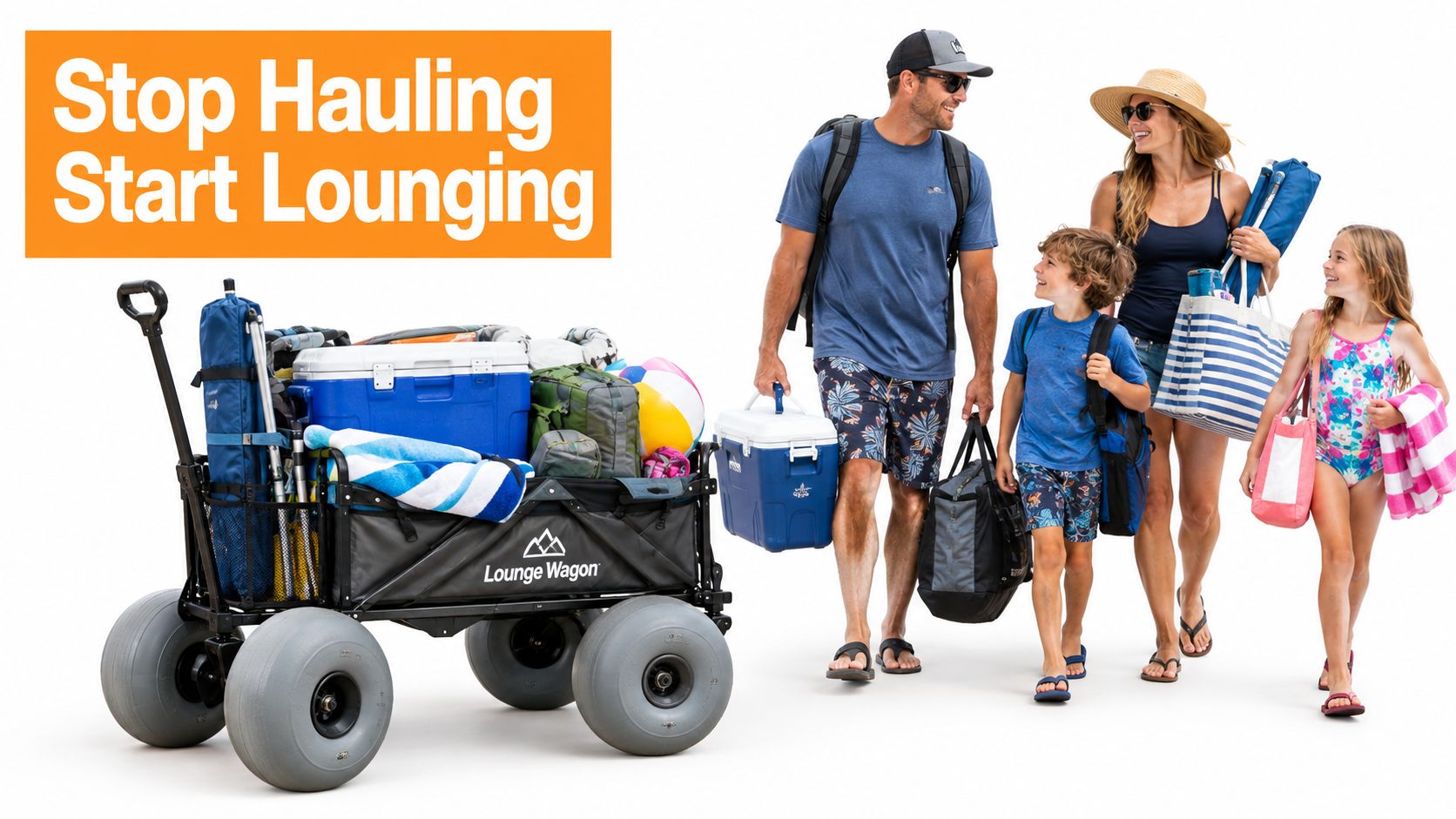
Stop Hauling and Start Lounging With the Right Wagon
At a crowded beach access point, the difference between a useful wagon and a frustrating one appears quickly. Narrow wheels dig into dry sand, the handle gets harder to pull, and every cooler or umbrella adds resistance. A wagon that rolls easily on pavement can feel like a dead weight cart once it reaches the loose section near the water.
That's where balloon-style wheels earn their place. They use a broad contact patch and low inflation to reduce how much the wheels sink, so you spend less effort dragging the frame through a trench. The result isn't magic, and it won't overcome careless loading or unsuitable pressure, but it gives the wagon a better starting position on soft terrain.
The one-trip test
Field use exposes the practical question: can one person move the gear without stopping to unload half of it? Beach families, tournament parents, festival-goers, and anglers all face the same problem, bulky equipment must travel farther than it looks.
A capable wagon should help with more than transport. Lounge Wagon is designed as a gear hauler that converts into 2-in-1 seating for two, with a 500 lb capacity, integrated cup holders, and storage pockets. Those features matter after arrival because you're not forced to carry separate chairs to have somewhere to sit.
Why the wheel choice matters
The phrase “all-terrain” doesn't tell you how a wagon behaves in powdery sand. Wheel width, inflation, load distribution, and terrain firmness work together. A larger wheel can help clear uneven ground, but it still needs the right footprint and pressure to avoid plowing.
For a deeper look at how wheel design affects a wagon's behavior, use this practical guide to tires for a wagon. The useful buying question isn't only whether the wagon folds. It's whether it can carry your actual load, cross the softest part of your route, and remain useful once you stop walking.
What Balloon Tires Are and How They Actually Work
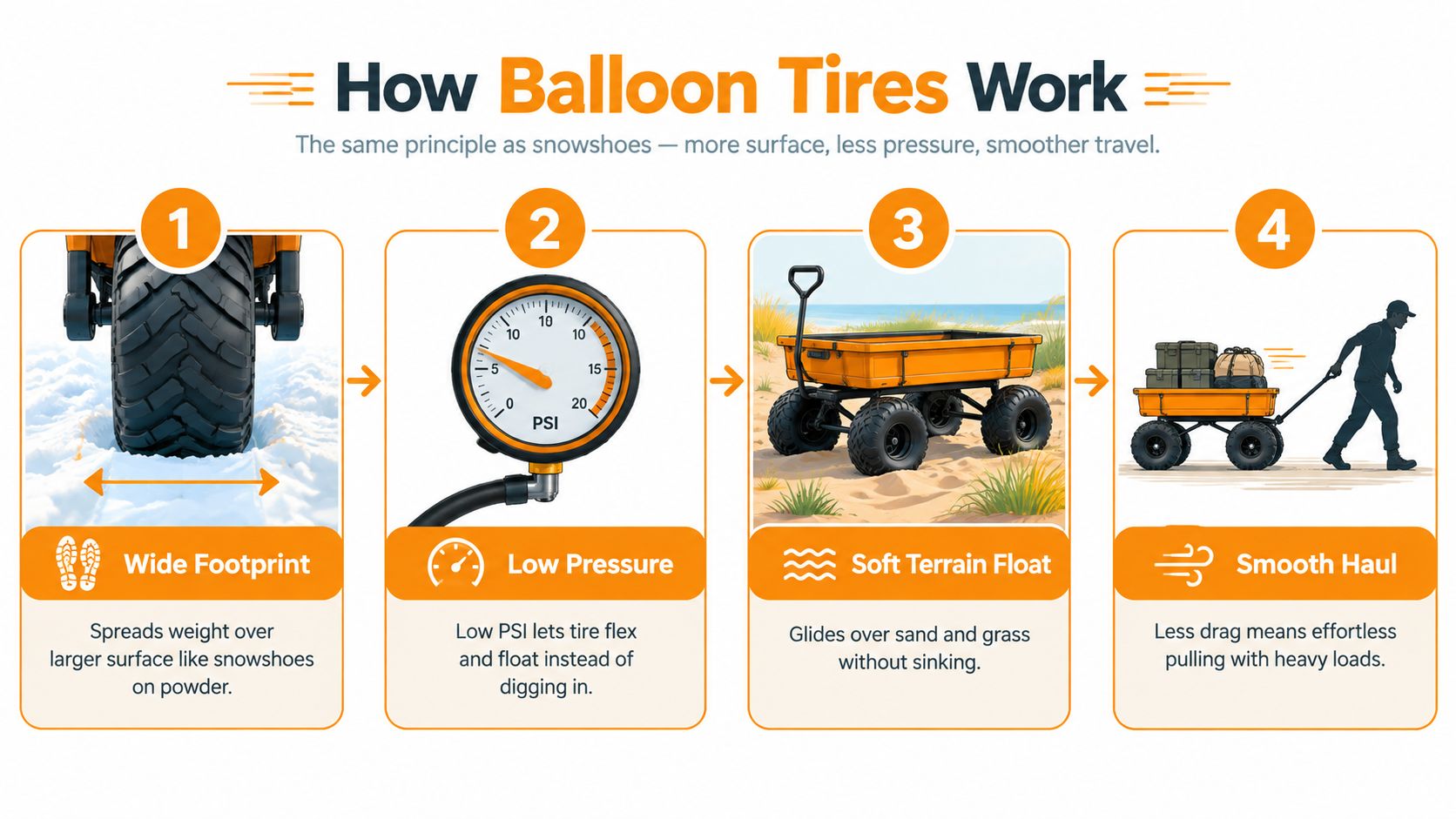
Start with snowshoes. A person wearing narrow shoes sinks more easily into powder, while snowshoes spread the same body weight across more surface area. Balloon tires apply a similar idea to a wagon, using width and flexible low-pressure construction to distribute load over a broader patch of ground.
That larger contact patch lowers ground pressure. Instead of forcing a narrow edge into sand, the tire flexes and supports the wagon over more of the surface. The wheel can roll forward with less digging, which is why this design suits beaches, grass fields, and other surfaces that yield under weight.
From bicycle tires to utility wagons
The engineering idea has a long history. Dunlop's pneumatic tire concept dates to 1888 for bicycles, and Buick was experimenting with balloon tires by the summer of 1922, according to the Lemelson-MIT history of John Dunlop. Factory production of the industry's first low-pressure balloon tire began on April 5, 1922, while Firestone began producing balloon tires in April 1923.
By 1925, balloon tires had moved from novelty toward broad factory adoption across major American brands, including Ford, Chevrolet, and Dodge, while U.S. tire output in 1924 was reported at 47,000,000 units, as described in the same historical account. The important lesson for today's wagon buyer is that balloon tires represented a shift in how engineers managed comfort, contact area, and surface interaction.
Flotation is the point
A narrow hard wheel transfers the wagon's weight through a small area. A wider, lower-pressure tire spreads that force, reducing sinkage and helping the wheel maintain momentum. That distinction matters most when the surface is soft enough to deform beneath the load.
Core concept: Balloon tires don't make a wagon weightless. They help the wagon stay on top of soft ground instead of forcing the wheels to plow through it.
The central advantage is ground pressure. One technical buying guide describes balloon wheels operating at 5 to 15 PSI, compared with 35 to 70 PSI for standard tires, and gives an example in which a 4-inch-wide balloon tire at 8 PSI produces roughly one-fifth the ground pressure of a 1.75-inch road tire at 45 PSI. See the balloon wheel technical guide for the engineering comparison.
On soft sand, that difference changes the feel at the handle. Standard narrow wheels tend to cut downward, creating ruts that increase resistance. Balloon-style wheels spread the load, so the wagon is more likely to roll across the surface rather than repeatedly climb out of its own tracks.
Grass fields reward the same design in a different way. A broader tire is less likely to leave deep tracks in damp or soft turf, and the larger footprint can make a fully loaded wagon feel steadier across uneven ground. At youth soccer complexes, that means fewer abrupt stops when you move from a parking lot onto the field perimeter.
Gravel lots add another benefit. A flexible, wide tire can absorb some of the small irregularities that make narrow rigid wheels chatter and catch. You still need to slow down around large stones, but the wagon's load feels less exposed to every surface change.
Feature and benefit comparison
| Feature |
Wagon with Balloon Tires |
Standard Narrow Wheels |
| Ground contact |
Broad footprint distributes weight |
Smaller footprint concentrates weight |
| Soft sand |
Better flotation and less digging |
More likely to sink and plow |
| Grass |
More stable over yielding turf |
Can leave deeper tracks when loaded |
| Gravel |
Smoother response over small irregularities |
More vibration and sharper jolts |
| Load support |
Works best when pressure and load are matched |
Performance drops quickly as the surface softens |
| Seating utility |
A Lounge Wagon setup offers 2-in-1 seating for two
|
Generic hauling designs commonly focus on transport only |
| Capacity reference |
Lounge Wagon lists a 500 lb capacity
|
Capacity and terrain performance vary by product |
A wide wheel isn't automatically a balloon tire, and a large diameter alone doesn't guarantee easy pulling. Read the manufacturer's pressure guidance, inspect the load rating, and think about the softest surface you'll cross. This guide to carts with big wheels can help you compare wheel proportions before choosing a setup.
A loaded Lounge Wagon crossing soft sand can start easily, then bog down when a cooler, chairs, and field gear settle over one axle. Balloon tires prevent that sudden struggle only when tire pressure, wheel size, and cargo weight work together. Lower pressure spreads the contact patch, like snowshoes distributing a person's weight, while excessive pressure narrows that footprint and makes the wagon dig in. Too little pressure can make the tire unstable or allow the rim to contact the ground on firmer surfaces.
Practical off-road guidance commonly places sand pressure in the 10 to 20 PSI range. It suggests about 15 to 20 PSI as a starting point for soft sand and 12 to 15 PSI for very soft conditions, according to this sand-driving pressure guide. Wagon tires may have different specifications, so use those figures as terrain references, then follow the product manual.
Pressure is a terrain setting
Pressure should match the surface you will cross. Pavement and packed paths usually need a firmer setting, while loose sand benefits from a larger footprint. The tire should flex enough to float, without folding excessively or letting the rim strike the ground.
Use this check before leaving:
-
Measure cold pressure: Check every tire before loading. Appearance alone cannot show whether pressure is even.
-
Set pressure for the route: Use lower pressure for soft sand and the manufacturer's firmer setting on hard surfaces.
-
Recheck after loading: A full cooler or dense equipment changes how the tires sit and flex.
-
Confirm the load rating: Make sure the stated rating applies to the pressure and surface you plan to use.
A quick pressure adjustment can matter more than adding another accessory. Carry a suitable gauge, and inspect the tires again if the route changes from beach sand to pavement.
Load balance matters as much as size
A wide tire still sinks when too much weight sits above one axle. Put dense items low, center them between the wheels, and secure tall or awkward gear so it cannot shift during turns. A wagon that rolls well empty may bog down once a heavy cooler is pushed to one side.
Recent buying guidance places roughly 9 inches as a minimum diameter for softer sand, with 12 to 13-inch options performing better in deep, powdery conditions, as discussed in this 2026 balloon-wheel buying guide. For more sizing detail, see the guide to 10-inch wheels. Choose for the softest section of the route, not the easy pavement beside the parking area.
Capacity labels also need context. A heavy-duty collapsible utility wagon lists a 265 lb, or 120 kg, maximum load rating, with firm, level surfaces and evenly distributed cargo specified in its manufacturer product listing. A steel utility wagon guide notes advertised capacities from 400 to 1,200 lb, while practical working capacity can be 20% to 30% lower than the stated maximum. Treat the rating as a limit, not a promise of easy pulling on sand.
Choosing Your Setup for Beach Tournaments Festivals and Beyond
The best setup depends on the job. A Florida Gulf Coast beach family has different priorities from a tournament parent crossing a gravel complex, but both benefit from a wheel system that reduces sinkage and a frame that keeps cargo stable.
The Sand-Sovereign family
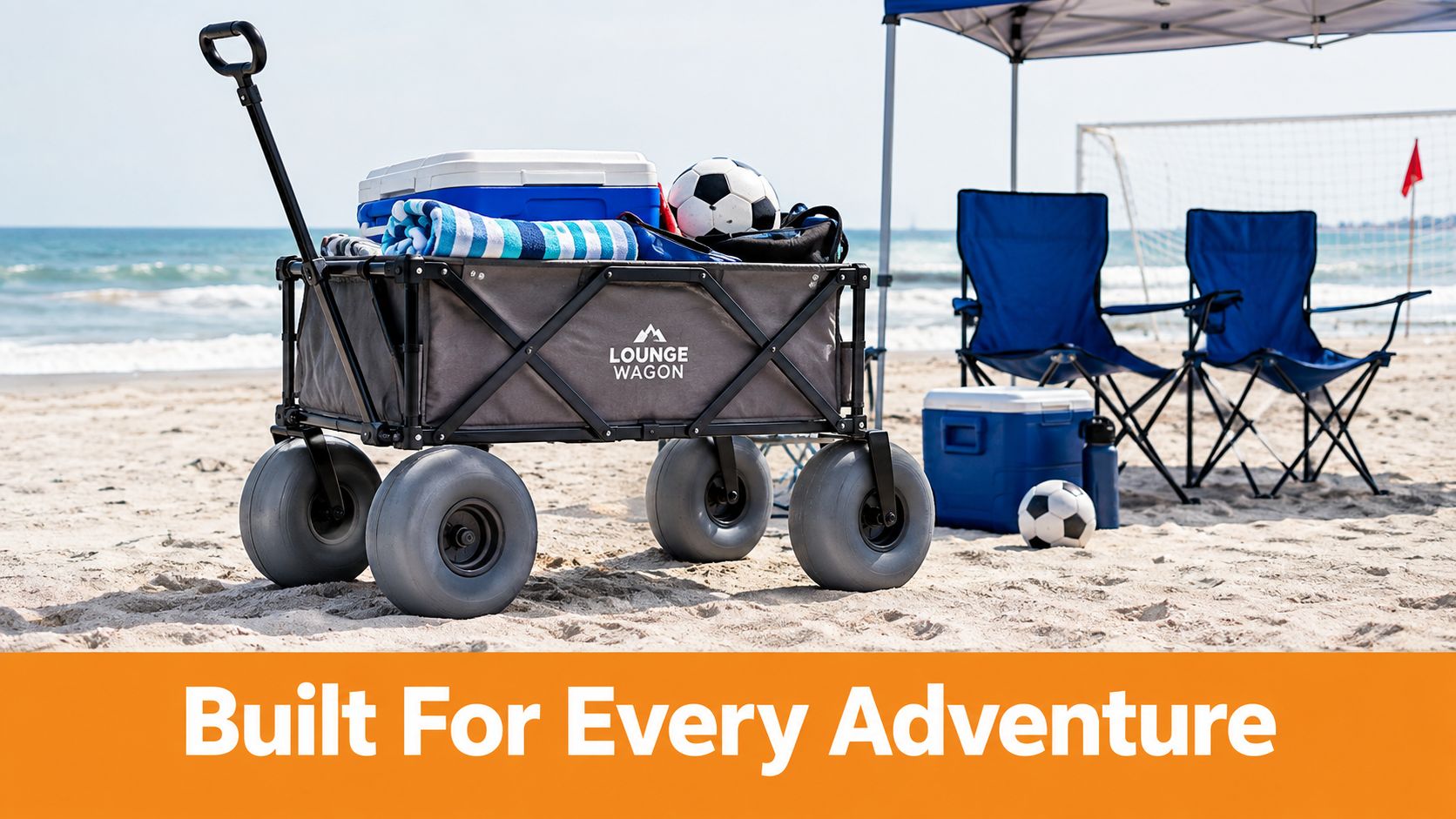
A family heading across soft beach sand may pack umbrellas, towels, sand toys, refreshments, and a cooler. Balloon-style wheels help because the load is broad and awkward, while 2-in-1 seating for two gives parents a place to rest without adding separate chairs.
A reinforced frame, powder-coated steel, and durable fabric such as 1000D Polyester can also matter for repeated outdoor use. The wheel choice handles the surface, while the frame and interior determine whether the cargo stays organized.
The Sideline Elite parent
At a youth soccer complex, the route often runs from asphalt to grass, then across uneven ground to the field. A wagon with a 500 lb capacity gives parents room for team drinks, shade equipment, bags, and folding accessories, while the bench conversion turns downtime between matches into actual sitting time.
The tournament wagon guide is useful for evaluating this mixed-terrain role. What we've found at crowded sports complexes is that seating isn't an accessory when you're spending a long day beside multiple fields. It's part of the logistics.
The Front-Row Regular
Festival-goers and farmers market visitors need a mobile base for blankets, purchases, refreshments, and personal items. Large wheels help with grass and uneven event grounds, while the seat function avoids carrying separate folding chairs through crowded entrances.
Keep the load balanced so the wagon remains easy to steer around people. A lower center of gravity also helps when the wagon is parked on a slight grade.
The Mobile Angler
An angler may need to move tackle, bait buckets, rods, and a cooler along a pier or shoreline. The useful feature isn't only carrying capacity. Integrated seating means you can pause to rig, wait, or watch the water without bringing a separate stool.
The Weekend Warrior
Tailgaters and car campers often need gear that earns its storage space. A wagon that carries supplies and becomes a bench can reduce the number of separate items competing for trunk room.
Balloon tires help when the route crosses grass, gravel, or soft ground near the event area. Pressure still needs to match the surface, and heavy cargo should stay centered rather than piled against one end.
Maintenance Sizing and Care Tips to Keep You Rolling
Low-pressure tires need attention because appearance can be misleading. A tire may look acceptable while carrying a different pressure from its partner, causing uneven tracking or extra drag. Use a suitable gauge, follow the wagon's manual, and avoid adding air to make the tire look fuller.
One beach balloon tire manual calls for inflation around 0.3 to 0.20 bar and warns against over-inflation because correct low pressure supports performance on sand and other soft terrain, as described in the balloon tire manual. The manual's range should take priority over generic off-road advice for that product.
A short pre-trip checklist
-
Inspect every wheel: Look for cuts, embedded debris, loose hardware, or uneven wear.
-
Measure pressure: Check before loading and after the wagon has been packed.
-
Balance dense cargo: Place coolers, water, and heavy bags low and near the center.
-
Confirm the route: Choose a pressure that suits the softest surface you'll cross.
-
Pack a pump: A compact hand pump helps when terrain changes during the day.
Sand and salt deserve same-day cleanup. Rinse exposed wheels and frame areas with fresh water, remove grit from folding joints, and let the fabric dry fully before storage. Salt residue and trapped moisture can create avoidable wear over time.
In our testing, small maintenance habits make the wagon feel more predictable. For a fuller care routine, follow this wagon maintenance guide.
Choose size by terrain
Roughly 9-inch wheels can be a starting point for softer sand, while 12 to 13-inch wheels are better suited to deep powdery conditions, according to the earlier buying guidance. For mixed routes, select the largest practical wheel that still fits your storage and transport needs.
Remember that a rated capacity may apply only to firm, level surfaces with evenly distributed cargo. Treat beach hauling as a more demanding use case, especially when the sand is loose and the wagon is fully loaded.
Make It a One Trip Walk to the Shore
Soft sand turns a short walk from the car into repeated trips unless the wagon can spread its load and keep moving. Balloon tires help reduce sinkage, while even packing keeps coolers, chairs, and bags from pulling the frame off line.
That matters after arrival, too. A 500 lb capacity supports one organized haul, and 2-in-1 seating for two lets the wagon serve as part of a beach base, tournament sideline, festival setup, or tailgate. You carry fewer separate items and avoid storing another seat.
A Lounge Wagon includes 10-inch all-terrain wheels, a reinforced steel frame, and a padded double-seat conversion with cup holders and storage pockets. Explore the Lounge Wagon to match its configuration to your terrain and load.
The family shown in the article image is using a fully loaded Lounge Wagon as a beach hauler. The practical benefit is the change from transporting gear to having a comfortable place to sit, without making another trip.
Load evenly, set pressure for the softest surface, and leave room for the wagon's seating function. This approach helps a single walk cover the gear, the people, and the time spent at the shore.
Lounge Wagon combines a heavy-duty gear hauler with comfortable 2-in-1 seating for beach days, tournament sidelines, festivals, and other one-trip outings.


