A wagon for hauling camping gear should do more than carry a cooler. The practical choice matches wheel size to terrain, capacity to your real load, and folded dimensions to your vehicle. A 2-in-1 design adds the missing advantage: it hauls the gear in and becomes seating at camp, reducing both the cargo load and the number of trips.
Last Updated: September 2026
The three-trip walk from the car is familiar. First comes the cooler, then the tent and bags, then the chairs, table, toys, and everything someone remembered only after you've reached the campsite. By the time you return for the last load, the morning's energy has already gone into logistics.
That's where a 2-in-1 wagon for hauling camping gear earns its space. A capable wagon can carry bulky equipment across grass, gravel, pavement, or suitable sand, then convert into a place to sit instead of forcing you to pack separate chairs. For a practical starting point, compare the large beach cart and camping-hauling setup before choosing accessories or packing around a standard cart.
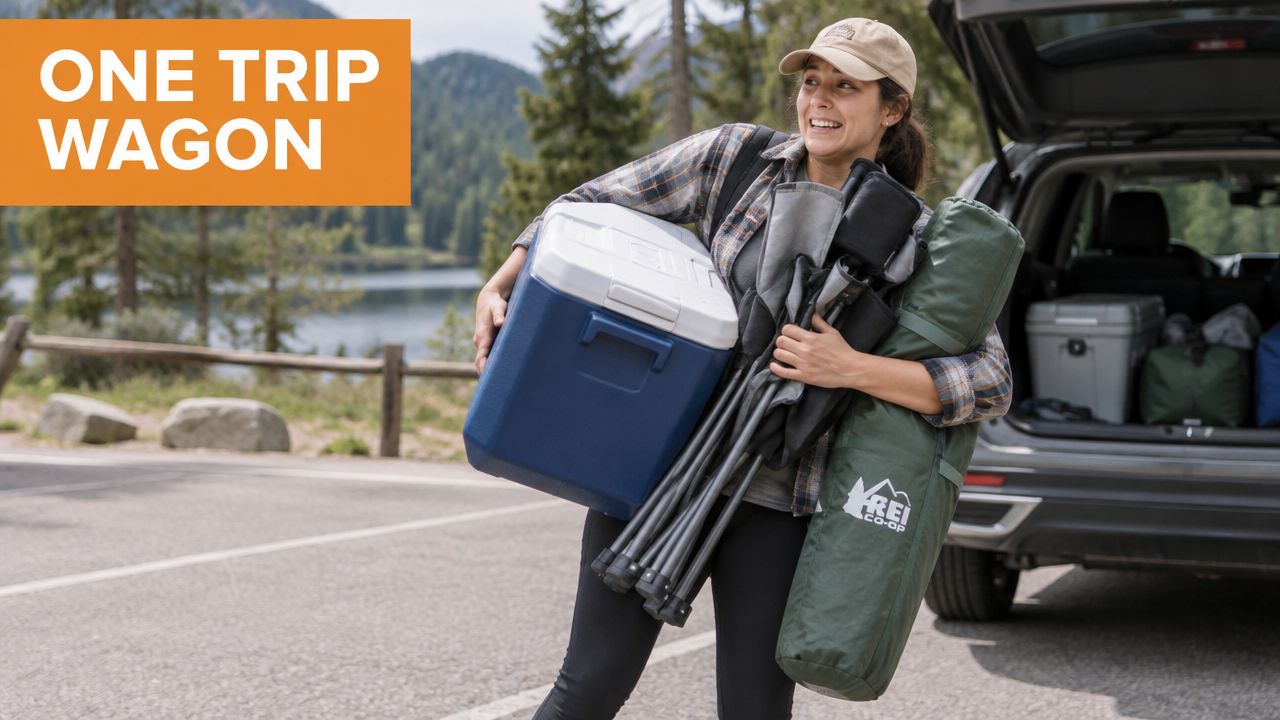
Stop Making Three Trips to the Car
The real cost of separate gear
At a family campsite, the difficult part usually isn't the tent itself. It's the collection of awkward items around it, a full cooler, folded chairs, a shelter, sleeping bags, toys, food bags, and loose footwear. A regular folding cart may move most of that cargo, but it still leaves you carrying seating separately.
A 2-in-1 seating wagon changes the packing equation. Instead of treating chairs as another load, you use the wagon's seating function after arrival. That matters at crowded campgrounds, tailgates, youth soccer complexes, and shoreline access points where the distance from parking to your destination can turn a simple outing into repeated manual handling.
Field rule: If the wagon only solves transport, it may still leave half the setup problem in the trunk.
The one-trip test
I judge a camping wagon by one question: can the heaviest normal load move in one controlled pull without burying the wheels, and can the wagon become useful furniture when it stops? A product that passes both tests earns its place in a family vehicle because it replaces tasks, not just equipment.
The Lounge Wagon is designed around that combined job, with a cargo mode and a bench-style seating mode. Its product information describes a 500 lb capacity, 10-inch puncture-proof wheels, integrated cup holders, storage pockets, and seating for two adults. Those features should still be checked against your own terrain, load, and vehicle space before purchase.
A good setup also protects your energy. Put the cooler and dense items low, keep long gear against the sides, and leave the conversion area clear. You should arrive with a wagon that can become a seat in moments, not a tightly packed box that has to be emptied first.
What a Wagon for Hauling Camping Gear Really Does
A modern folding wagon works as a compact transport system for several outdoor jobs. It carries camping equipment from the vehicle to the campsite, moves beach supplies over the access route, holds sports gear at a field, and gives families a place to organize loose items. The important distinction is that it can remain useful after the hauling ends.
The simplest analogy is a small pickup truck that becomes a patio bench when you reach the destination. The cargo body handles the awkward load during the walk, while the seating function removes the need for separate chairs in the final setup. That dual role is especially useful when trunk space is limited or when every extra item creates another carrying task.
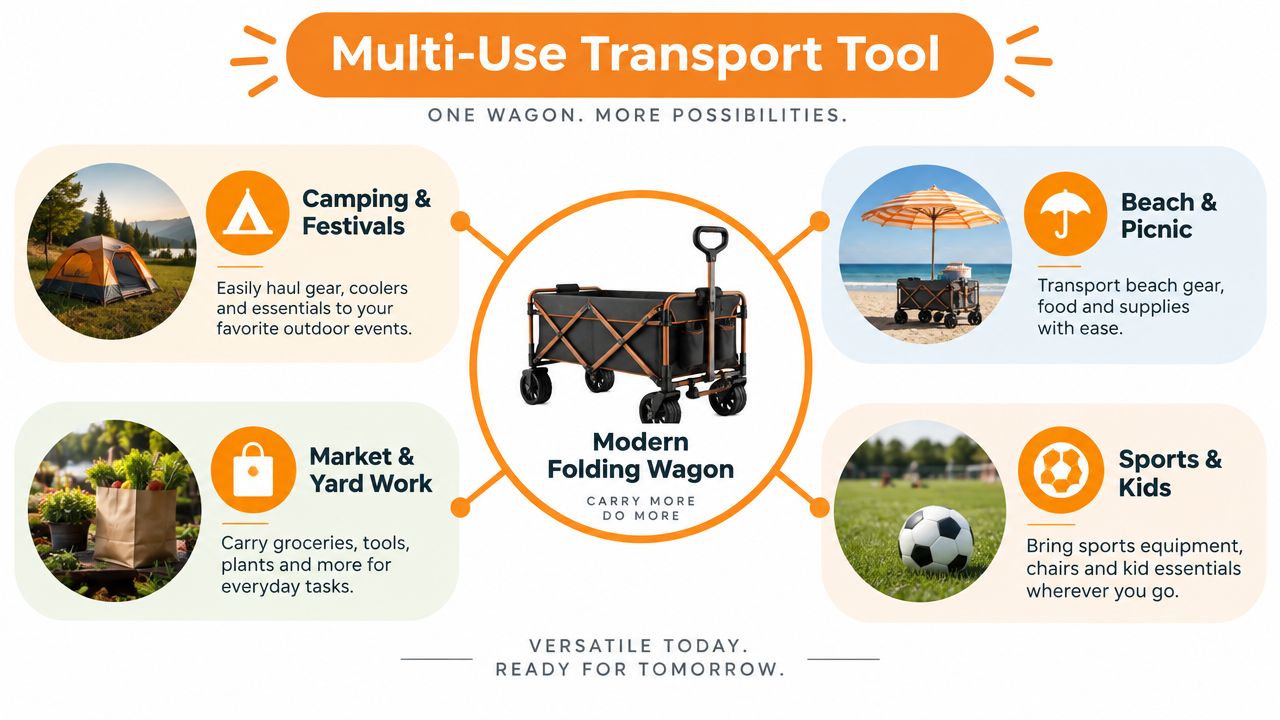
Why the hauling problem has lasted
The need to move bulky camping supplies efficiently is older than the modern folding cart. The Stewart Auto Camp Wagon appeared in 1906 and is described as an early utility trailer adapted for camping use, bridging horse-drawn camping wagons and automobile-drawn camping trailers in the history of outdoor travel logistics (historical folding-wagon background).
That history helps explain why camping transport remains a practical design problem. Tents, food, water, chairs, blankets, and recreation equipment have always been easier to manage when one rolling platform carries them together.
Cargo first, comfort second
The best sequence is straightforward:
-
Load: Place the dense, stable items in the cargo area.
-
Pull: Match the wheels to the surface rather than assuming every “all-terrain” label means beach-ready.
-
Settle: Park on a stable surface and engage the wagon's brakes or wheel locks where available.
-
Convert: Shift the seating components into position without unloading the main camp supplies.
-
Use: Keep drinks, small essentials, and personal items in reachable pockets or holders.
That sequence makes the wagon more than a container. It becomes the base of the outing, carrying the equipment in and supporting the people once they arrive. The 2-in-1 wagon guide shows why combining transport and seating can be more useful than choosing a cart based only on cargo volume.
How to Choose Wheels Capacity and Build That Actually Work
Wheel choice should follow the ground under the wagon. Standard 6 to 8 inch hard plastic wheels can roll acceptably on pavement and packed gravel, but independent guidance notes that they tend to dig into soft sand. Wider all-terrain or balloon-style wheels spread the load over more surface area, reducing the trenching that makes a loaded cart feel stuck (camping wagon wheel guidance).
For soft dry sand, guidance commonly points to at least 8 to 9 inch rubber all-terrain wheels, while deep powdery sand may call for 9 to 13 inch balloon-style tires (beach wagon wheel guidance). All-terrain wagons are also commonly described with 12 to 16 inch wheels, compared with the smaller wheels used on standard wagons, because added diameter helps the wheel climb over uneven ground (all-terrain wagon guidance).
Translate each feature into a benefit
Ten-inch puncture-proof all-terrain wheels offer a useful middle ground for grass, gravel, pavement, and firmer outdoor routes. Their benefit is less maintenance and more predictable movement, especially where an air-filled tire could lose time to a flat. They won't turn every wagon into a deep-sand specialist, so beach users should evaluate width and surface conditions as carefully as diameter.
A 500 lb capacity is a heavy-duty benchmark used in outdoor utility cart listings, including products with 10-inch pneumatic tires (500 lb utility wagon example). That rating gives a wagon room for substantial equipment, but the actual usable load still depends on terrain, wheel design, balance, and whether the manufacturer distinguishes hauling from stationary seating.
Typical moderate camping loads often reach 110 to 150 lb after adding a large cooler, two chairs, a tent, and loose bags. Expert guidance recommends at least a 150 lb-rated wagon for moderate trips, with more capacity when several people's gear is combined (camping wagon capacity guidance). Choose based on your heaviest ordinary load, not an optimistic packing list.
Compare the practical specification categories
| Feature |
Lounge Wagon |
Generic Folding Wagon |
| Hauling capacity |
Listed 500 lb capacity
|
Often selected around the load rating needed for the trip |
| Seating |
Converts into a 2-in-1 bench-style seat for two adults
|
Usually focused on cargo, with seating unavailable or accessory-dependent |
| Wheel approach |
10-inch puncture-proof all-terrain wheels |
Commonly smaller hard plastic wheels |
| Terrain fit |
Grass, gravel, pavement, and suitable outdoor routes, with sand performance dependent on wheel setup |
Pavement and firm ground are generally more forgiving |
| Cargo organization |
Storage pockets and cargo-hauling accessories |
Varies by frame and fabric design |
| Main trade-off |
More multifunctional equipment may require more vehicle space |
Smaller carts may store easily but still require separate chairs |
Frame and fabric matter as much as the headline rating. A reinforced steel frame provides a sturdy platform for heavy gear, while 1000D Polyester fabric can resist abrasion from coolers, tent poles, and rough campsite handling. The trade-off is weight. Heavier construction may feel more substantial on the trail but less convenient when lifting the folded wagon into a vehicle.
For a closer look at flat-resistant wheel construction and the maintenance benefit, use the puncture-proof wheel information. If you're also comparing rolling luggage for personal travel rather than campsite cargo, this bag on wheels luggage guide offers a useful contrast in how wheels and storage serve different jobs.
Foldability Storage and Durability Without the Trade Offs
A wagon can be excellent on the trail and still be wrong for your vehicle. The folded footprint determines whether it fits through the cargo opening, whether it can turn inside the trunk, and whether it leaves room for the cooler, tent, and family bags that travel with it.
Measure the vehicle before judging the wagon. Check the folded width and height against the trunk opening, then account for the interior turn. A wagon that fits when pushed straight in may fail when you need to rotate it around a cooler or load it beside a second row of seats.
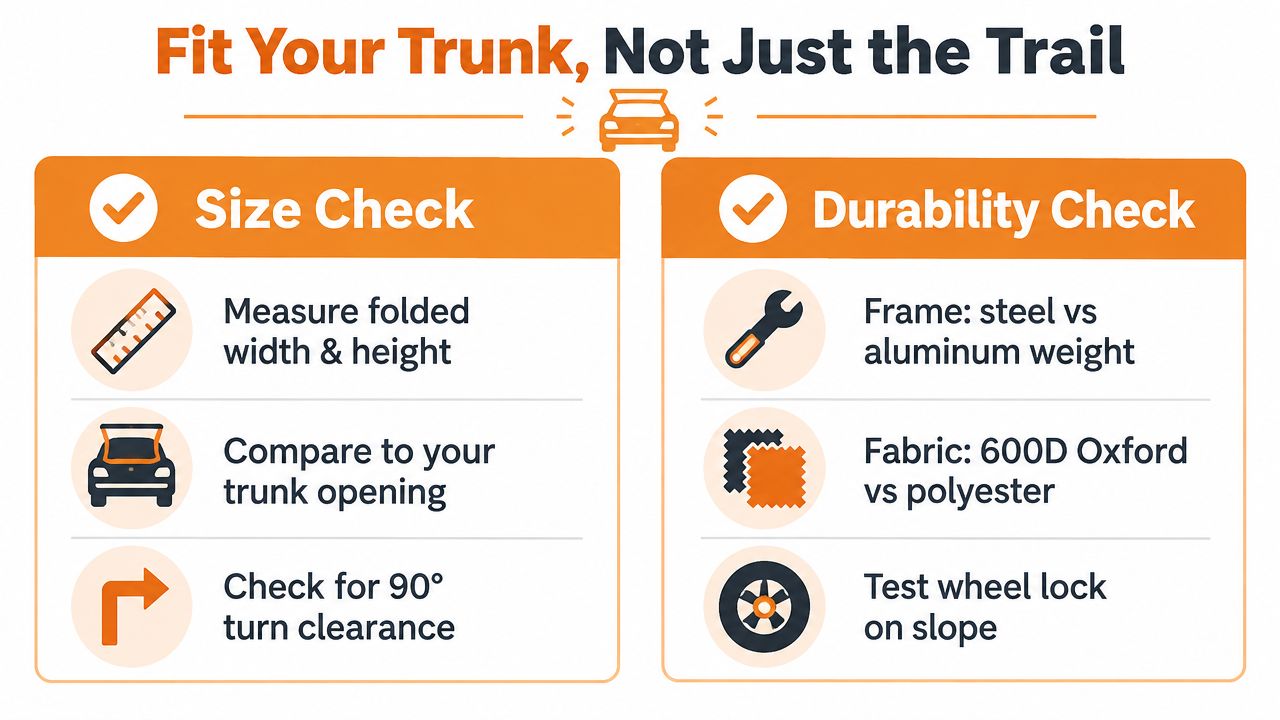
Use the folded size as a buying filter
Review coverage consistently treats folded size, weight capacity, wheel type, fabric quality, and frame material as central buying factors. It also emphasizes matching the collapsed wagon to the vehicle, especially for car camping and family travel (folding utility wagon buying factors).
A useful check looks like this:
-
Opening test: Measure the narrowest cargo opening, not the widest interior section.
-
Turn test: Confirm the wagon can make the required turn without striking the hatch, seats, or side panels.
-
Shared-space test: Leave room for the equipment that won't fit inside the wagon, such as a tent pole bag or cooking box.
-
Lift test: Consider whether one adult can lift the folded frame safely after a long day outdoors.
Build quality determines the service life
A powder-coated steel frame can handle the repeated loading, folding, and dragging that camping equipment demands. 1000D Polyester fabric adds resistance to scuffs from gravel, sharp tent hardware, and damp ground, but it still needs cleaning and drying after exposure to sand or moisture.
Wheel construction affects downtime. Foam-filled or puncture-proof tires remove the flat-tire problem associated with air-filled tires, which is valuable on gravel routes where a failure can leave you carrying the same load the wagon was supposed to move.
A realistic capacity decision starts with the heaviest normal load plus a safety margin, then checks whether that load still moves comfortably across your most difficult surface.
Storage is part of durability, too. Shake out sand before folding, dry wet fabric, and avoid storing the wagon compressed while it's dirty. Those habits protect the fabric, wheels, and frame while keeping the wagon ready for the next campground loop or sports weekend.
The foldable flatbed cart overview is useful when you're comparing compact storage with open cargo access. Flatbed-style designs can simplify oversized loads, while enclosed wagon bodies usually contain smaller items more effectively.
Packing and Organization Tips for a True One Trip Haul
One-trip packing works best when the wagon carries both the gear and the seating plan. Put the cooler low and near the center so its weight does not pull the frame sideways. Line long items along the walls, then fill gaps with soft equipment.
Aim for a balanced load, not maximum density. Keep the bench surface, cup holders, and access pockets clear so the wagon can become a seat without a full unload.
Pack by weight and access
Use this order:
-
Heavy low: Set the cooler, water containers, and dense cooking supplies on the floor.
-
Long along the sides: Place folded chairs, tent bags, shade poles, and umbrellas against the side walls.
-
Soft on top: Add sleeping bags, blankets, jackets, and pillows to cushion smaller equipment.
-
Secure loose pieces: Use a cargo net, built-in straps, or a suitable bungee to stop toys and bags from bouncing out.
-
Protect the conversion area: Leave the bench surface, cup holders, and access pockets free from hard items.
A low, centered load rolls more predictably and keeps arrival simple. You should not have to remove half the gear before anyone can sit.
Make the wagon your campsite base
Keep frequently used items at the top or in external pockets. Sunscreen, cups, towels, snacks, phones, and first-aid supplies should remain reachable instead of buried under the cooler.
At camp, park the wagon beside the main sitting area rather than treating it as temporary transport. The bench can face the fire ring, picnic table, or play space, while the pockets keep small essentials off the ground.
Sort shared equipment before loading with this family camping gear checklist. A checklist helps prevent the last-minute additions that create an uneven load or leave key items behind.
Home storage also affects the next trip. This guide from Standby Self Storage offers practical ways to group tents, bags, and accessories between outings. Store straps and wheel accessories with the wagon so the two-in-one setup is ready for one-trip packing.
Best Use Scenarios From Campsite to Tailgate
The route from the car determines which wagon setup earns its space. Match the wheels to the surface, then check the venue's cart rules and the distance you will cover. A model that rolls easily on pavement may bog down in loose sand, while beach-ready wheels can add bulk for short park trips.
Car camping and campground loops
Campground roads usually combine grass, packed dirt, gravel, and pavement. For these routes, puncture-resistant all-terrain wheels and a stable frame offer a practical balance. Pack the cooler, tent, chairs, and bags so the load stays centered while you pull between the vehicle and the site.
Distance matters more than appearance. If the parking area sits far from the campsite, choose wheels that roll over gravel without constant lifting. At a nearby site, compact storage and quick folding may matter more than maximum off-road performance.
Once the wagon reaches camp, keep it beside the main sitting area. It can hold items that need repeated access, such as drinks, towels, snacks, and jackets, instead of sending someone back to the car.
Beach-adjacent camping
Beach access exposes weak wheel choices quickly. Firm or damp sand may be manageable, but dry, loose sand needs a wider wheel footprint that stays on top of the surface rather than cutting into it.
A narrow-wheeled wagon can roll from the parking lot to a packed access point, then stall where the sand softens. For beach-heavy trips, judge wheel width and diameter before pockets, color, or branding. If the walk is short and the route stays firm, a lighter general-purpose setup may be easier to store and pull.
Tailgates and festivals
Tailgates and festivals often involve long walks, crowded paths, and venue restrictions. Before loading, check whether wagons are permitted and whether the site limits cart dimensions. A wagon that passes through a gate can serve as a mobile base for coolers, blankets, food, and personal bags.
Keep frequently used items near the top, because unloading on a crowded lawn is inconvenient. Use pockets for small supplies and secure loose pieces before crossing uneven ground. The seating conversion also keeps the arrival setup focused on one piece of equipment rather than a separate chair load.
Youth sports complexes and park picnics
Soccer and lacrosse complexes commonly require travel across grass, gravel, and uneven paths. Puncture-proof wheels around the size used for mixed terrain handle these surfaces more reliably than small plastic wheels. A team cooler, tent, balls, blankets, and personal bags should be arranged by frequency of use, with sideline items accessible first.
For park picnics, measure the route from the vehicle to the table or play area. The Lounge Wagon sports and outdoor setup suits families that need one organized pull, then a practical place to sit while the wagon remains beside the group.
Ready to Haul More Sit Better and Stay Longer
A wagon for hauling camping gear earns its place when it solves two logistics problems at once. The wheels must suit the route, the capacity must handle the load, and the folded footprint must fit the vehicle without displacing other equipment.
The bigger decision is whether it replaces a second load of chairs and tables. A cargo-only wagon can work for occasional hauling, while a model that converts to seating can carry coolers and tents, then provide a place to sit. That trade-off matters for families, tournament parents, tailgaters, and campers crossing grass, gravel, or sand.
Match the setup to the destination. Campgrounds call for puncture-resistant wheels and balanced storage. Beaches demand close attention to wheel width and sand conditions. Sports fields and festivals reward organized cargo, stable seating, and quick conversion.
Pack by the one-trip test: can the wagon carry the gear, seating, and small essentials in one organized pull? Review the Lounge Wagon product details and the family camping gear resources before loading.
Lounge Wagon combines a heavy-duty gear-hauling platform with 2-in-1 seating, so you can carry coolers, tents, and outdoor essentials before converting the wagon into a comfortable bench for two. Choose a setup for one pull from car to campsite.


