Last Updated: September 2026
Meta description: Essential padded bench with storage guide for beaches and sidelines. Compare comfort, storage, and portability, then shop smarter.
A padded bench with storage is worth buying if it solves two jobs at once: hauling gear and giving you a stable place to sit when you arrive. For beaches, tournaments, and festivals, skip decorative indoor benches and focus on seat height, foam support, storage access, wheel design, and real outdoor durability.
The problem isn't just clutter. It's the ugly, sweaty shuffle from the car to the sand, the sideline, or the event gate. You carry towels first, then the cooler, then the chairs, and by the time you're set up, you already need a seat.
That's why this category matters more outdoors than it does in an entryway. A real padded bench with storage isn't décor. It's logistics gear that also lets you sit down before your back and patience start barking.
Need an example of the hauling problem in plain English? Read how to haul heavy gear to the beach alone. It's the exact headache most families and team parents are trying to fix.
The Three-Trip Problem and a Smarter Seat
You know the walk. One hand has towels and a wet bag. The other has chairs banging your leg. The cooler comes next, then the umbrella, then the thing you forgot on the first trip. On hot sand or a crowded sports complex, that routine drains you before the day starts.
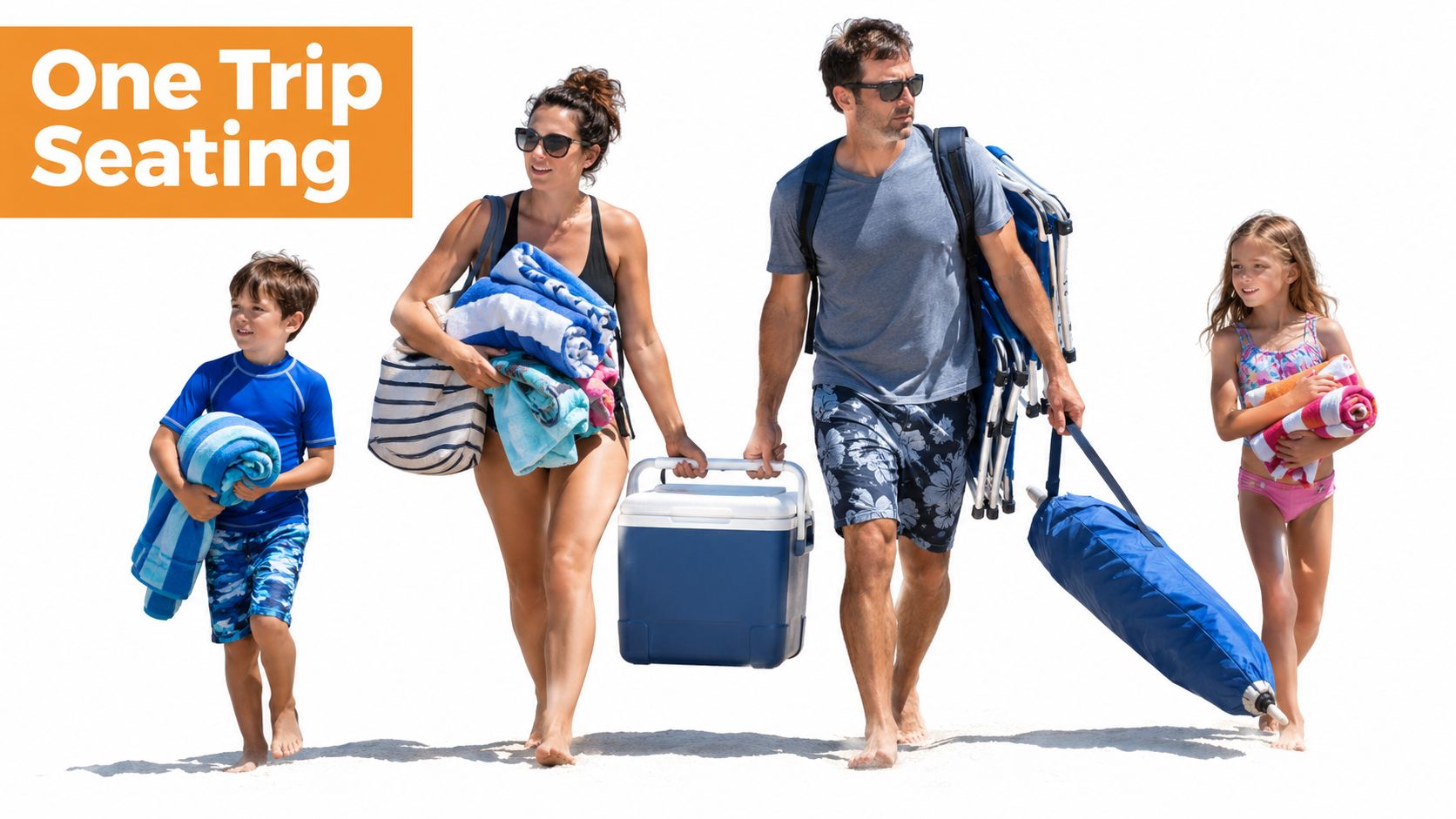
What I've found at crowded tournaments is simple. People don't need another bag. They need one piece of gear that carries the load, stays organized, and becomes usable furniture when they stop moving.
Why the old setup fails
A pile of separate gear creates three problems fast:
-
Too many hand carries: You waste energy making repeat trips instead of getting set up once.
-
Nowhere to rest: After hauling everything, you still have to unfold chairs or sit on a cooler edge.
-
Messy access: Snacks, sunscreen, dry clothes, and valuables get buried under everything else.
That's why a padded bench with storage makes sense outdoors. It combines a seat and a gear bay in one footprint, so your setup gets simpler instead of multiplying.
Practical rule: If one item can replace both a chair and a hauler, it earns trunk space. If it can't, it's dead weight.
What changes when the seat is part of the system
The big shift is mental. You stop treating the bench as furniture and start treating it as part of your transport plan. That matters at beaches, youth soccer fields, gravel parking lots, and festival lawns where setup speed decides whether the outing feels easy or annoying.
This category also isn't some tiny niche. One market estimate values the global storage bench market at USD 2.1 billion in 2025, with a projected rise to USD 2.8 billion by 2034 at 5.2% CAGR, while another forecast places it at USD 3.44 billion by 2033 with 5.8% growth from 2025 to 2033. The same market view says upholstered storage benches represent 28.3% of the market, worth about USD 594.3 million in 2025, and growing at 6.8% CAGR according to Market Intelo.
Those numbers matter for one reason. Buyers clearly want storage plus comfort, not just an empty box with a lid.
What a Padded Bench With Storage Actually Is
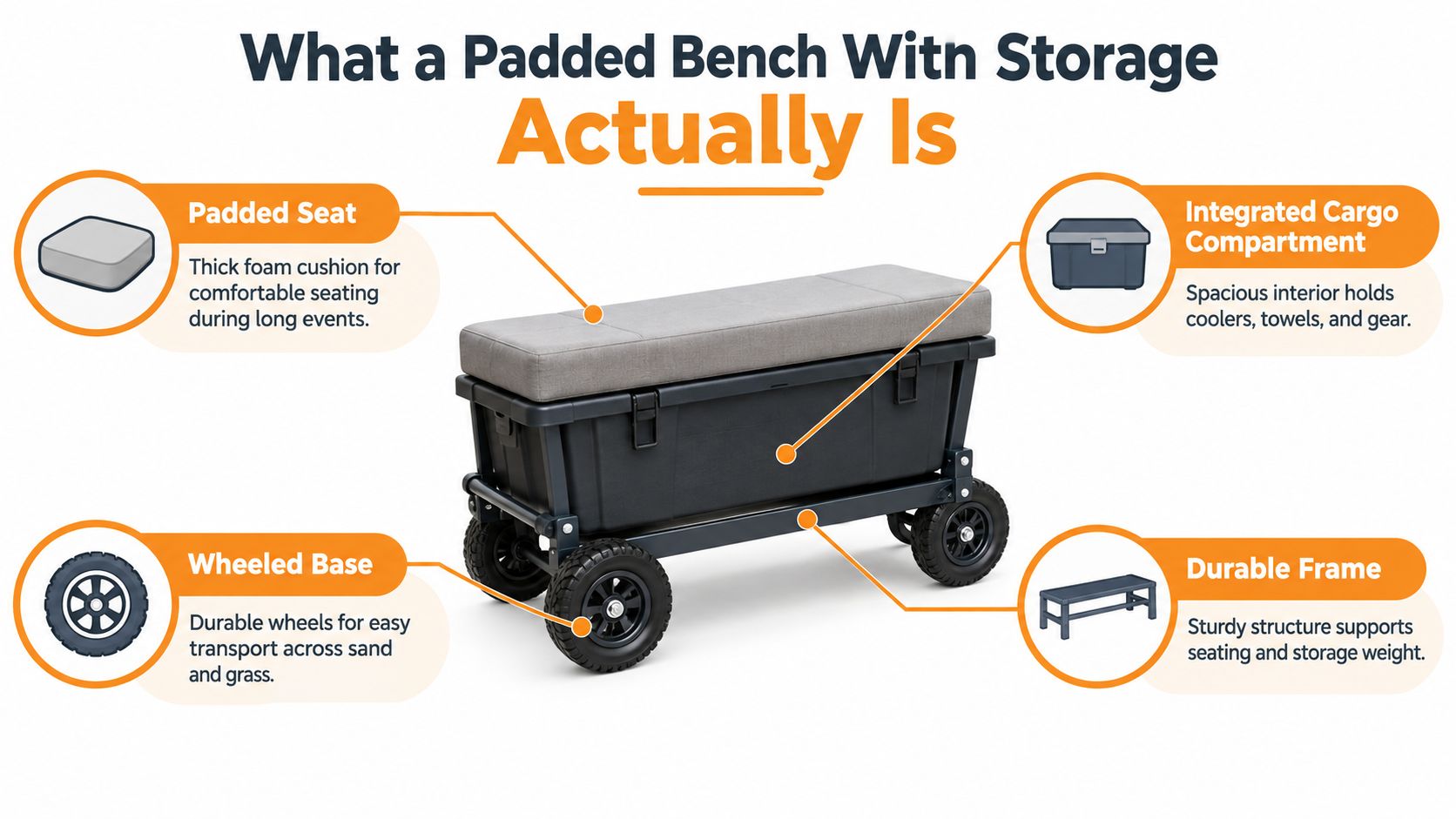
A padded bench with storage is a hybrid. It's a seat on top, a cargo area underneath or inside, and in outdoor-friendly versions, a rolling base that lets you move gear instead of carrying it.
Think of it as a cooler-sized hauler with a built-in bench. That's a lot closer to the actual use case than comparing it to a cute entryway ottoman.
The four parts that matter
Most buyers should judge the category by these components:
-
Padded seat: This is the part your hips and lower back will remember. Cushion design matters more than plush marketing copy.
-
Storage compartment: Open, lidded, or zippered. The access style changes how you pack and how fast you can grab things.
-
Frame: This decides whether the bench feels planted or flimsy once an adult sits down.
-
Rolling hardware: Wheels and axle design decide whether the bench moves well on grass, gravel, or sand.
A plain storage ottoman fails outdoors because it's built for floors, not terrain. It usually lacks weather resistance, rolling support, and a frame meant to handle repeated load-in, load-out, and seating.
Why the cushioning deserves more attention
Shopping this category backward is a common approach. Shoppers obsess over storage volume first and ask about comfort later. That's a mistake if you'll sit for any length of time.
Independent foam guidance for benches points to medium-to-high density polyurethane foam in roughly 1.8 to 2.5 lb/ft³ for everyday seating, with firmer commercial applications moving up to about 2.8 to 3.6 lb/ft³ and target compression around 14% to 30%, depending on use from this bench cushion foam density guide. In plain terms, denser foam usually resists body impressions better and lasts longer under repeat loading.
A thick cushion that bottoms out is worse than a firmer cushion that holds you up.
If you're storing delicate gear inside, moving gear between house and vehicle, or protecting hard-edged equipment in transit, Padded Removal Blankets Protection can also be a practical add-on. They're useful when the bench doubles as a mobile gear box and you don't want metal parts or corners rubbing against everything else.
Storage format changes behavior more than most buyers realize. The way a bench opens determines how you pack, how fast you unload, and whether you keep wet, sandy, or valuable items separated.
For outdoor use, I sort these into three groups: open bins, lift-top lids, and enclosed compartments. Each one solves a different annoyance.
| Format |
Access Style |
Best For |
Typical Capacity |
| Open bin |
Drop-in top access |
Beach towels, toys, wet gear |
Capacity is often listed by liters or gallons |
| Lift-top lid |
Full top access to one main compartment |
Parents packing layered loads like snacks, wipes, changes of clothes |
Capacity is often listed by liters or gallons |
| Enclosed cabinet or zippered compartment |
Protected access with more separation |
Event volunteers carrying paperwork, small tools, chargers, and valuables |
Capacity is often listed by liters or gallons |
Which style fits which job
Open bins are the least precious. That's why I like them for beach mess. You can toss in sandy toys, damp towels, and extra layers without babying the interior, and the open format makes air-drying easier once you're done.
Lift-top designs are stronger for family use because they let you stack a day's worth of supplies in one chamber and still reach the bottom without unloading the whole unit from the side. Major retail coverage has pushed these designs as practical storage for blankets, pillows, and toys, while broader home and organizing coverage keeps emphasizing hidden or dual-purpose storage as a growing preference in 2026 as discussed by House Beautiful.
Capacity matters less than access
A lot of outdoor bench listings advertise volume in liters or gallons. That's useful, but only if the opening lets you reach what you packed. Storage-bench listings show the format can be substantial, with examples around 70 gallons with a 551 lbs seating capacity and another outdoor category around 60 gallons or 227 L of storage from this outdoor storage bench roundup.
If you want a broader look at portable carry-and-store designs, this guide to a folding wagon with cup holders and storage is worth a read. The same rule applies. Easy access beats big capacity you can't use cleanly.
Materials Weight Capacity and Real-World Comfort
Marketing words like “heavy-duty” and “premium comfort” are mostly noise. Look at foam spec, frame material, seat geometry, and what the weight rating means when someone sits down, shifts, and stands back up ten times in a row.
Cheap benches get exposed fast.
Material and Capacity Comparison
| Component |
Budget Option |
Mid-Range |
Heavy-Duty |
| Cushion foam |
Low-spec foam with vague comfort claims |
Better recovery and firmer support |
Higher-density foam suited for repeated loading |
| Outer cover |
Basic fabric with limited weather resistance |
Water-resistant fabric and easier cleaning |
More abrasion-resistant, outdoor-focused coverings |
| Frame |
Light-duty metal or polymer |
More stable mixed-material frame |
Reinforced steel-style construction for repeated hauling and seating |
| Wheels |
Small, hard wheels |
General-purpose outdoor wheels |
Larger all-terrain wheels for sand, grass, and gravel |
| Weight rating |
Works for light seating or occasional use |
Better for regular family use |
Better for adults plus gear in outdoor duty |
The comfort specs I actually care about
Cornell ergonomics guidance is more useful than most bench ads. It notes bench cushions are often most effective at about 1.5 to 2 inches thick, should be firmer at the back and thicker toward the rear, and warns that too much softness can restrict movement. It also recommends layered construction with a softer top layer around 25% ILD over a much firmer bottom layer around 65% ILD in Cornell's seating ergonomics notes.
That matters because a bench isn't a mattress. If the lid flexes and the foam collapses, standing back up becomes awkward, especially for older adults or anyone sitting between games for long stretches.
Field note: Support beats squish. A bench that feels slightly firm for the first minute usually feels better at the forty-minute mark.
Weight ratings and outdoor use
I trust higher capacities because outdoor seating takes abuse. People sit down sideways. Kids bounce. Adults lean back while digging through bags. Gear gets piled on before anyone sits.
Outdoor storage bench listings commonly show support for two adults and around 250 kg in retail specs, with one example listing a 250 kg bearing limit and another advertising seating for two adults plus 227 L of storage from this outdoor bench listing. If you're looking at a hauler-bench design, I'd rather see a 500 lb capacity and 2-in-1 seating than a vague promise about being strong enough.
For buyers focused on sit-time rather than just cargo, comfortable outdoor seating is the right lens. Comfort isn't a bonus feature. It's the whole point once the hauling is done.
Matching the Bench to Your Audience
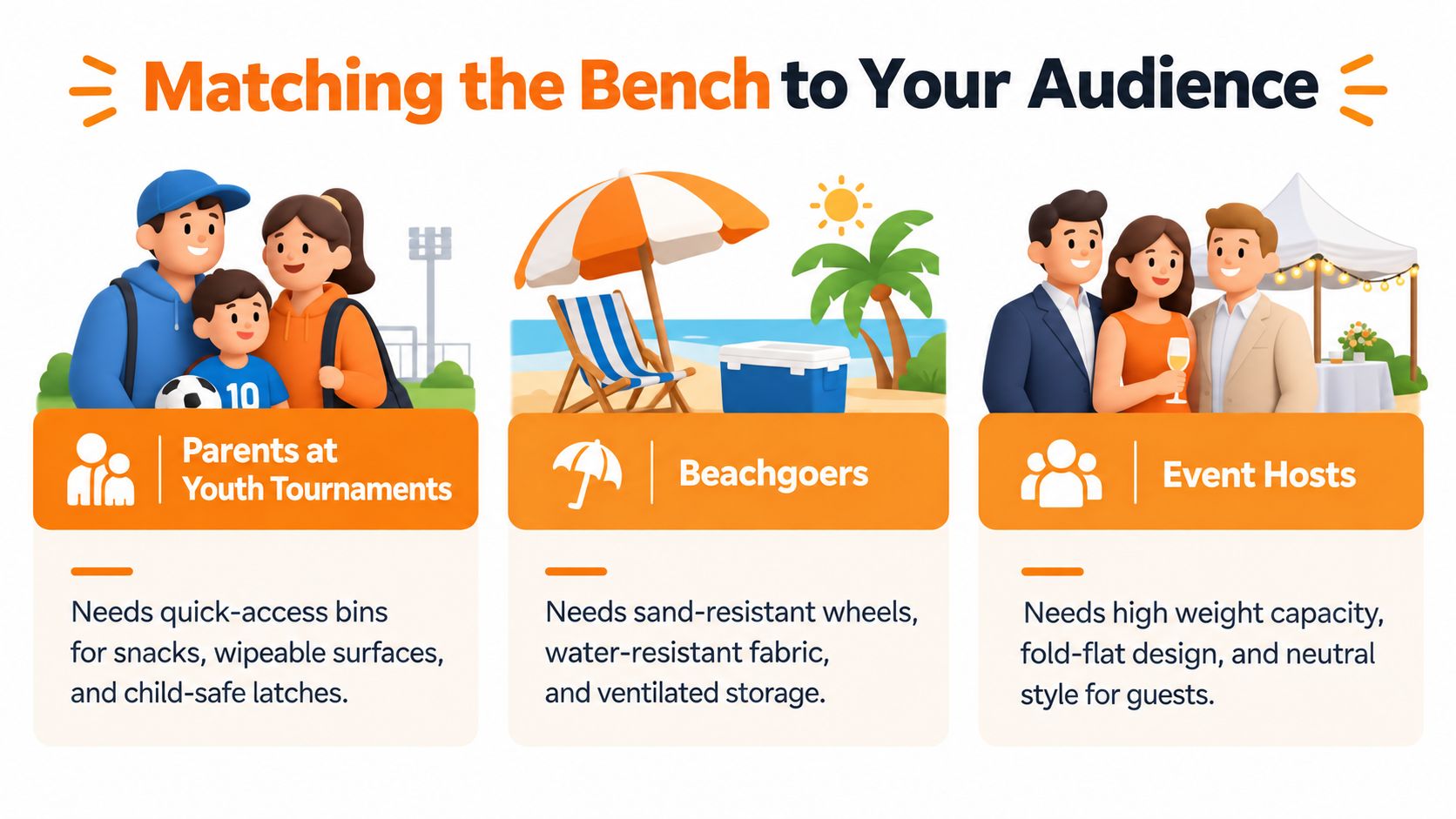
Not every padded bench with storage should be bought for the same reason. Parents, beach families, volunteers, and seniors punish gear in different ways. Buy for your worst day, not your easiest one.
Parents at youth tournaments
Tournament parents need fast access and wipe-clean surfaces. The bench gets used as a seat, snack station, and temporary stash zone all day.
Non-negotiables:
-
Quick-access storage: You need to grab drinks, sunscreen, and extra layers without unloading half the bench.
-
Stable seating surface: Kids climb on everything. The top needs to stay planted and predictable.
Worth paying extra for:
-
2-in-1 seating with real load support: A 500 lb capacity matters when adults and gear are rotating through one setup.
Beachgoers and coastal families
Beach use is brutal. Sand gets into everything, salt chews hardware, and soft ground exposes weak wheels instantly.
Two must-haves:
-
All-terrain wheel design: Small wheels are a dealbreaker on soft approaches.
-
Water-tolerant, easy-clean materials: Wet suits, damp towels, and sunscreen leaks are standard.
Luxury upgrade:
-
A seat built for two adults: That sounds simple, but it changes the whole outing when you don't need separate chairs for a rest stop.
Event volunteers and hosts
Event crews need organization more than they need style. They're moving supplies, then standing around registration tables or sidelines with nowhere to sit.
What I'd insist on:
-
Protected storage zones: Small equipment, paperwork, chargers, and personal items need some separation.
-
A reinforced base: The floor takes concentrated loads from bins, signage, and cooler corners.
If you host longer outdoor stays in a trailer, camper, or paddock setup, it also helps to browse RV cabin makeover tips. Not because an RV remodel equals a bench purchase, but because smart mobile spaces follow the same rule: one item should solve more than one problem.
Seniors and multigenerational crews
Seniors don't need a low sling seat that's hard to exit. They need stable sit-stand support and a bench height that doesn't force a deep drop.
Independent guidance for real-world bench ergonomics puts recommended bench height around 18 to 20 inches, seat depth around 15 to 17 inches, and notes that 24 to 30 inches of clear front space helps comfortable use. It also warns that foam compression can pull a 20-inch seat down to about 18.5 inches in practice from this entryway bench ergonomics guide.
For this group, arm support and easy standing matter more than oversized storage. If that's your use case, start with heavy-duty folding wagon options for seniors and judge every bench by exit ease, not looks.
A Practical Buying Checklist for 2026
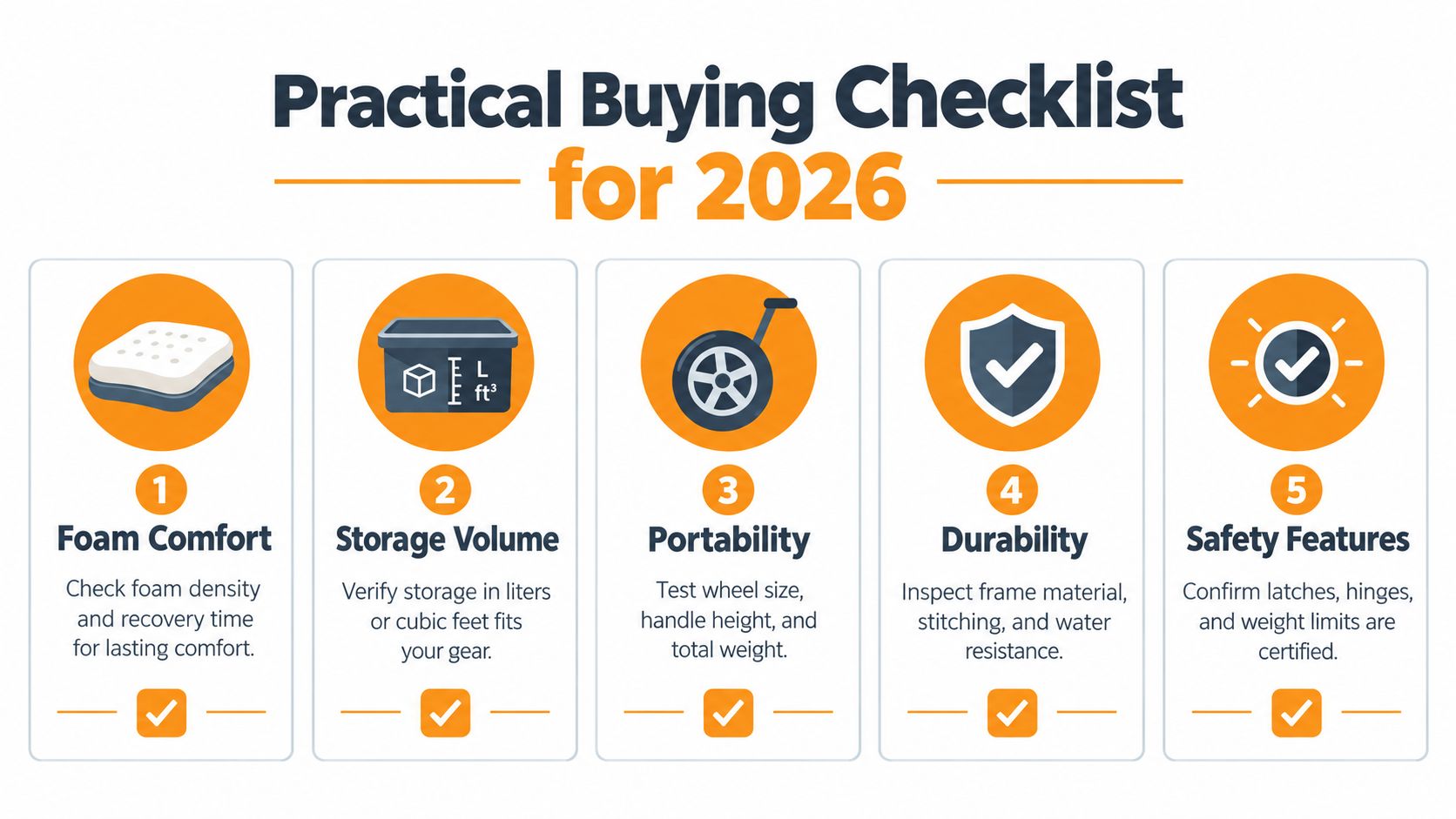
Most shoppers compare padded benches with storage the wrong way. They pick the one with the prettiest cushion photo or the biggest compartment claim. That misses the test, which is whether the bench stays comfortable, organized, and mobile on the kind of ground you use.
Use this checklist instead.
The five checks that matter
-
Seat support first: Ask what kind of foam is used and whether the seat is designed for repeated adult sitting, not just occasional perching.
-
Storage access second: Don't just ask how much fits. Ask how fast you can reach the bottom of the compartment with dirty hands and a kid asking for snacks.
-
Terrain match: Grass, gravel, and beach sand punish wheels differently. Buy for your roughest surface.
-
Stand-up ease: Seat height and stability matter if you'll use it for long games, parades, or waiting lines.
-
Combined load confidence: The rating should cover the person sitting and the gear inside, not just one or the other.
What I'd buy for outdoor use
For outdoor buyers, I'd lean toward a rolling 2-in-1 design instead of a static storage bench. A hauler-bench format solves the transport problem and the seating problem in one unit, which is the whole point. Among that group, the Lounge Wagon is one example built around a 500 lb capacity, 2-in-1 seating, all-terrain use, integrated cup holders, and gear-hauling duty rather than indoor décor assumptions.
That combination makes more sense for beach families, tournament parents, and event volunteers than a flat storage ottoman with a cushion glued on top.
Bring a real first-aid setup if the bench is part of a full-day outdoor loadout. These Adventure Medical Kits recommendations are a useful place to start when you're packing for sports fields, shore days, or festivals.
A quick pass-fail screen
If a listing can't clearly answer these questions, move on:
- Can two adults use the seat without the top feeling soft or unstable?
- Can you access stored gear without a full unpack?
- Can the wheels handle your normal route from car to setup spot?
- Will the materials tolerate wet gear, sand, and repeated loading?
That filter cuts through most bad options quickly.
Make It a One-Trip Walk to the Shore
The payoff is simple. You stop arriving tired. That changes the whole day.
At the beach, the bench-hauler rolls in loaded instead of forcing three carry trips. At a tournament, the gear stays together, the drinks stay close, and your seat is already there when the game pauses. At a festival, you claim a home base without dragging chairs, tote bags, and random loose items through a crowd.
Why this category is really about logistics
A padded bench with storage sounds like furniture language. Outdoors, it's really transport language. The seat just happens to be the part you appreciate most after the hauling is over.
That's why I don't recommend buying another decorative box for outdoor duty. Buy the version that treats storage, mobility, and sitting comfort as one system.
For readers comparing larger outdoor carry setups, this look at a large beach cart helps frame the trade-offs. More cargo only helps if the cart is still usable once you stop moving.
My blunt recommendation
If your day involves sand, sidelines, fields, parks, parking lots, or event grounds, skip anything that only solves one job. A good padded bench with storage should move gear cleanly, give you a dependable seat fast, and hold up through repeated trips without turning into a sagging mess.
Buy for the hardest outing on your calendar. That's the gear you'll keep.
Stop juggling chairs, bags, and a separate cart when one piece of equipment can handle the whole job. Lounge Wagon offers a 2-in-1 outdoor setup built for hauling gear and giving you a real padded seat when you get there. If you want fewer trips, better sideline comfort, and a smarter beach loadout, it's worth a close look.


