Last Updated: September 2026
The right outdoor bench seat should do more than give you somewhere to sit. For mobile outings, choose a 2-in-1 wagon bench that hauls your gear on wide all-terrain wheels, carries a 500 lb load, and converts into double-seater seating when you arrive. Fixed benches still win for permanent patios, but a wagon bench wins wherever the car park is far away.
The three-trip walk from a packed parking lot to the beach is where a pleasant morning starts to unravel. One trip carries the chairs, another takes the cooler and umbrella, and the last leaves someone balancing sand toys while a child asks why you're still not at the water.
A traditional outdoor bench seat solves only the sitting problem. A wagon-bench format solves the logistics first, then gives you a place to rest, which is why the large beach cart guide is worth reading before you buy separate furniture and a hauler.
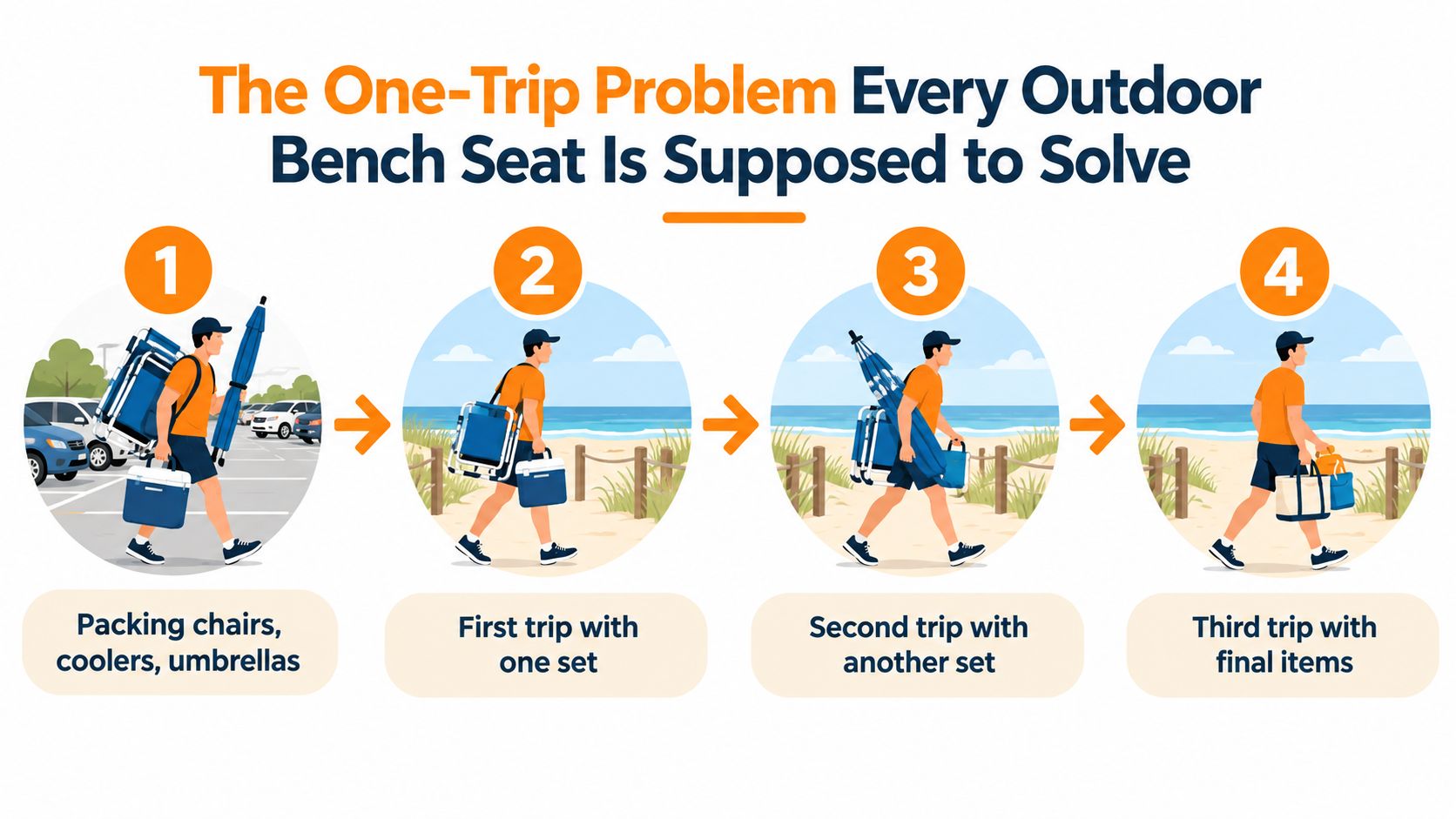
The One-Trip Problem Every Outdoor Bench Seat Is Supposed to Solve
A useful outdoor bench seat should reduce work, not add another item to carry. On a beach day, parents need to move chairs, coolers, towels, umbrellas, and children's equipment over ground that punishes narrow wheels. A bench that stays in the garage because it's too awkward to transport isn't a seating solution.
The better approach is a 2-in-1 wagon-bench. You load the gear once, pull it to the destination, then convert the wagon into a seat for two adults. That changes the buying question from “Which bench looks comfortable?” to “Which piece of gear replaces the separate trips and chairs?”
Field rule: If your outdoor bench seat can't travel with the rest of your kit, it only solves half the problem.
A 500 lb capacity matters here because the load isn't just a cooler. It includes folding chairs, beach shelters, towels, toys, food, and the equipment that families add without noticing. A strong wagon frame gives that pile one stable home instead of forcing every adult to carry a separate bag.
The terrain makes the difference even clearer. Standard small casters tend to dig into soft sand, while broad, puncture-proof wheels keep the load moving across sand, grass, and gravel. The human benefit is simple: fewer stops, fewer dropped items, and less time acting as the family's pack animal.
The same logic works at a youth sports complex. A wagon can carry the team cooler and sideline equipment, then become a double-seater bench between matches. At a festival, it creates a home base for supplies and a supported place to sit without adding a separate chair bag.
What Actually Matters When Buying an Outdoor Bench Seat
Most bench guides begin with appearance. Field use exposes the weaknesses that photographs hide: poor seat height, a deep platform, weak joints, wheels that sink, and materials that struggle with weather.
Start with the five specifications below, then match them to the way you travel.
Materials, dimensions, and load
A powder-coated steel frame offers the rigid structure needed for hauling and repeated setup. Teak and recycled poly lumber can make sense for a fixed patio or public-facing installation, especially where appearance and low routine maintenance matter. Salt air, wet grass, and muddy fields still demand attention to coatings, fasteners, and drying.
For comfort, public recreation guidance commonly places the front edge of a bench seat at 17 to 19 inches above the ground, with a clear adjacent space of 36 by 48 inches for accessible use, as outlined by the Washington Recreation and Conservation Office. Standard bench guidance commonly places depth around 15 to 20 inches, while some accessible designs use 20 to 24 inches, so don't choose a deep seat without checking whether shorter users can keep their feet supported. See the practical convertible outdoor bench guide for a mobility-first way to think about the format.
Ergonomics beat thick padding. A seat-back angle around 95 to 105 degrees and a slight rearward seat slope of roughly 2 to 10 degrees can support relaxed sitting, while around 500 mm of width per person is a useful starting point for ordinary clothing and bags, according to inclusive seating guidance from Broxap.
| Criterion |
Target Spec |
Why It Matters |
| Seat height |
17 to 19 inches |
Helps many adults transfer and sit with usable foot contact |
| Seat depth |
About 15 to 20 inches for standard use |
Keeps smaller users from losing back support |
| Adjacent clear space |
36 by 48 inches where accessibility applies |
Allows wheelchair positioning beside the bench |
| Seat-back angle |
About 95 to 105 degrees |
Supports upright, comfortable sitting |
| Person width |
About 500 mm minimum guidance |
Leaves room for ordinary movement and belongings |
| Working load |
500 lb for a wagon-class option |
Handles people and equipment in one mobile unit |
| Wheel design |
Wide, puncture-proof all-terrain wheels |
Reduces digging and drag on soft ground |
For weddings, markets, and managed gatherings, hire outdoor furniture for your event can be more sensible than purchasing permanent seating. For family outings and repeated sports days, portability earns its space because the bench works where you park.
Fixed Bench vs 2-in-1 Wagon Bench Compared
A fixed outdoor bench seat is the right tool when it lives on a deck, beside a fire pit, or along a permanent garden path. It doesn't need wheels, conversion hardware, or storage compartments. Once you start walking from a car to a beach, field, or festival site, those advantages disappear.
A 2-in-1 wagon bench costs more in exchange for doing two jobs. It hauls equipment on wheels, then becomes seating for two adults, with the cargo space no longer competing with a separate chair. The trade-off is physical bulk. A wagon-bench unit may weigh 25 to 35 pounds, while a fixed bench may weigh around 12 pounds, as reflected in the supplied comparison guidance.
Decision matrix
| Feature |
Fixed Outdoor Bench Seat |
2-in-1 Wagon Bench |
| Best location |
Deck, patio, garden, permanent site |
Beach, sports field, festival, tailgate |
| Main job |
Stationary seating |
Gear hauling and seating |
| Capacity |
Sized for seated users |
500 lb hauling capacity plus seating use |
| Seating |
One fixed surface |
Double-seater mode for two adults |
| Wheels |
None |
All-terrain wheels for mobile routes |
| Storage |
Usually separate from the bench |
Cargo storage under or within the seat system |
| Setup |
Minimal after placement |
Load, pull, park, and convert |
| Main weakness |
Can't move gear or follow the activity |
Heavier and more mechanically involved |
The choice is scenario-driven. Buy fixed if you'll sit in the same place all season. Choose a mobile format if you park somewhere and walk, especially when children, coolers, or bulky equipment come along.
The wagon that converts to chairs shows why this category isn't a folding bench with wheels. The important feature is the conversion, because the same frame carries the load on the way in and supports people once the work is done.
Setup Care and Converting From Hauler to Bench
Treat a portable outdoor bench seat like equipment, not disposable furniture. Before its first outing, remove packaging carefully, inspect the frame, and confirm that every locking point moves cleanly. A few minutes of inspection is cheaper than discovering a loose connection beside a crowded sideline.
Check the wheels before loading. Look for punctures, uneven wear, trapped debris, and pressure that feels inconsistent from one side to the other. Then test the frame lock with the wagon empty, because a lock that doesn't seat properly won't improve when the wagon is full.
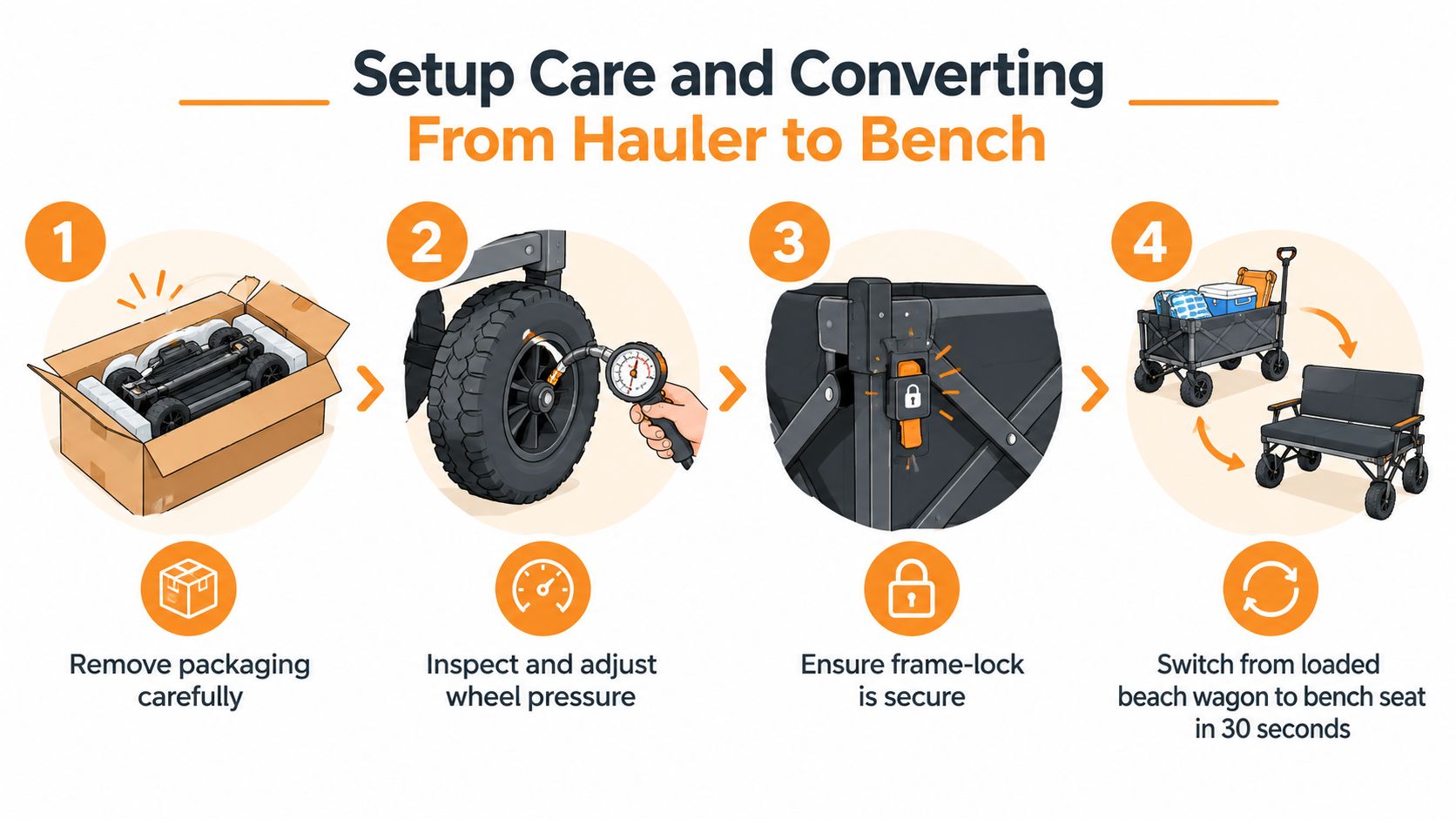
The conversion routine
Once you reach the destination, don't unload everything just to create seating. Use a controlled sequence:
-
Park on stable ground: Lock or position the wheels so the wagon won't roll while people sit.
-
Pull the handle clear: Keep hands and loose straps away from hinges and joints.
-
Flip the side panel: Make sure the panel lies flat and the seat surface is fully supported.
-
Lock the rear crossbar: Check the frame alignment before anyone takes a seat.
A clean conversion should feel deliberate and quick. If the panel resists, the frame is probably misaligned or the wheels aren't settled. For a more detailed care routine, use the wagon maintenance guide.
Salt and sand are the long-term enemies. Rinse saltwater residue from exposed hardware after coastal use, brush sand away from moving parts rather than forcing it deeper, and wipe fabric before storing it. Let everything dry fully, keep fabric out of prolonged direct sun between outings, and store the wagon loosely covered and off the garage floor.
Field care checklist
-
Tires: Inspect for damage and embedded grit before each trip.
-
Fabric: Brush off sand and mud, then allow it to dry completely.
-
Hardware: Rinse coastal residue and check for corrosion or looseness.
-
Frame: Test the lock and crossbar after heavy loading.
-
Storage: Keep the folded wagon dry, ventilated, and raised from damp flooring.
Best Outdoor Bench Seat Picks by Real Scenario
The best outdoor bench seat depends on what you're hauling, where you're walking, and who needs to sit. A beach family has different priorities from a tournament parent, and neither should shop from a generic patio checklist.
| Scenario |
Terrain |
Best Pick |
Key Feature |
| Beach day |
Soft sand and packed shoreline |
Mobile wagon bench |
Wide-tread wheels and 500 lb capacity
|
| Soccer sidelines |
Grass, gravel, crowded complexes |
Low-profile wagon bench |
Double seating with storage access |
| Music festival |
Crowded paths and uneven ground |
Narrow mobile seat |
Compact footprint and supported backrest |
| Fishing trip |
Piers, shore paths, and rough surfaces |
Stable utility bench |
Secure platform for tackle and rest breaks |
| Tailgating |
Parking lots and grass |
Hauler-seat combination |
Cargo space that becomes seating |
Beach days
For coastal families, the load usually grows around the children. Coolers, umbrellas, towels, sand toys, and spare clothing all compete for space, and soft sand exposes weak wheels immediately. A wagon with 10-inch puncture-proof wheels keeps the route manageable, while the 500 lb load rating gives the family room for bulky equipment without splitting the haul.
Once parked, 2-in-1 seating means two adults can sit without unpacking separate chairs. That matters when one parent is supervising children and the other is trying to open the cooler.
Sports and festivals
At a soccer or lacrosse complex, the useful feature isn't luxury. It's having a reliable place to sit between games while the wagon holds the team cooler, bags, and shade equipment. Festival regulars need the same basic function in a tighter setting, with storage that stays close and a backrest that beats sitting on a blanket.
Fishing trips favor stability and easy access to tackle. Tailgaters want a platform that carries supplies from the vehicle and turns into a seat beside the grill. In each case, the mobile bench earns its keep because it replaces equipment rather than adding to it.
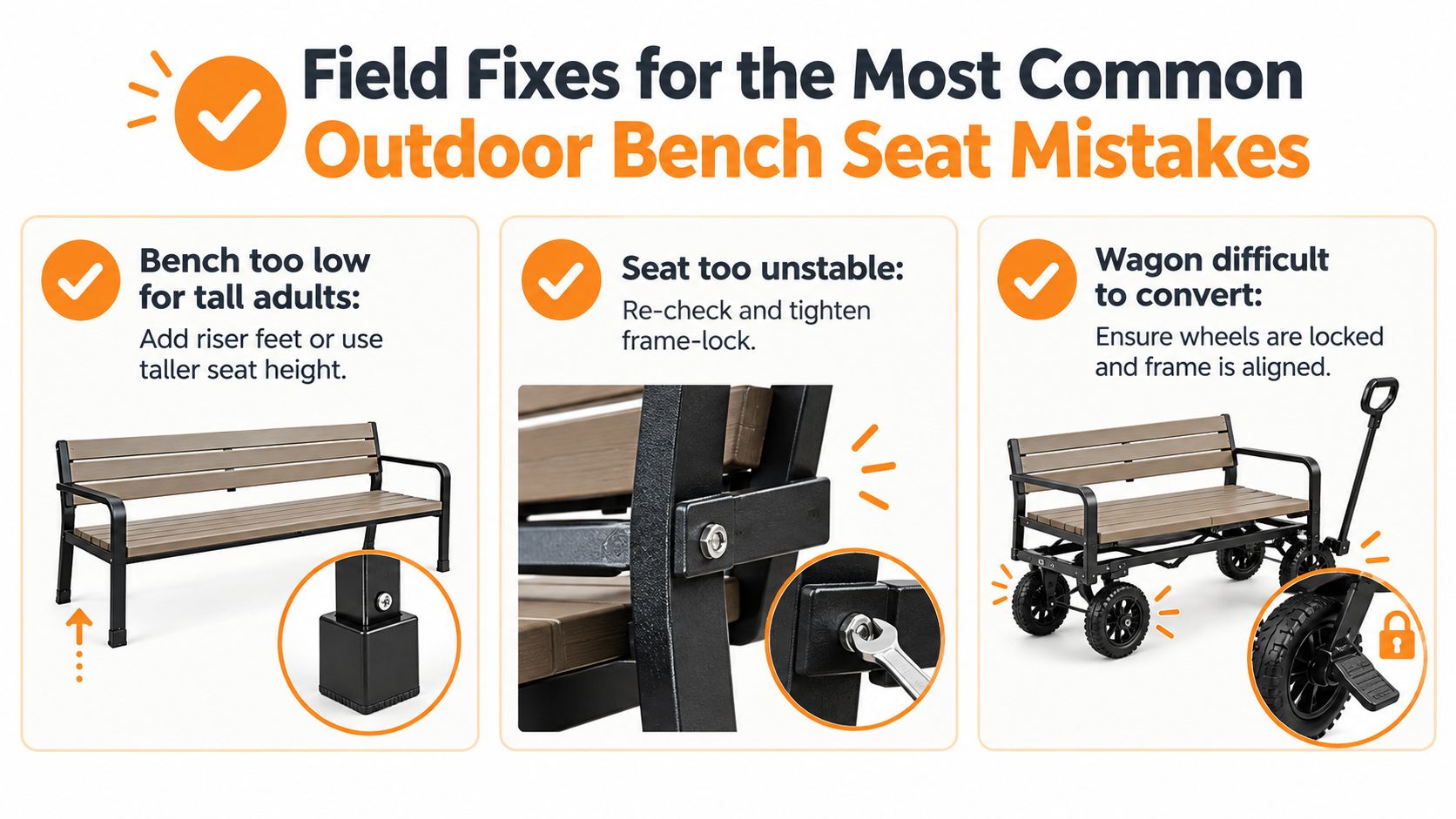
Field Fixes for the Most Common Outdoor Bench Seat Mistakes
A portable bench usually fails in predictable ways. Fix the mismatch between the seat, the terrain, and the user instead of blaming the entire design.
-
Bench too low for tall adults: Add riser feet only if the frame remains stable, or choose a taller seat height for the next outing.
-
Seat too deep for children: Place a rolled towel behind the lower back so smaller users keep support without sliding forward.
-
Wheels sink in soft sand: Reduce tire pressure by 4 to 6 PSI and use wide-tread balloon tires, following the wheel manufacturer's safe range.
-
Frame wobbles after a season: Re-torque the crossbar bolts and check that the lock pin is fully seated.
-
Fabric fades in strong sun: Rotate the bench 90 degrees between outings and store the fabric out of direct exposure.
-
Conversion feels stiff: Lock the wheels, realign the frame, and never force the side panel across a skewed chassis.
The biggest mistake is buying for an imagined use. A light patio bench may be pleasant on a deck but frustrating on sand, while a deep cushioned seat may suit a tall adult and leave a child unsupported. Match the equipment to the people who'll use it most.
Make It a One-Trip Walk to the Shore
The practical test is simple. Pack once, pull once, park, and sit down before anyone starts asking who left the umbrella in the car.
A mobile wagon bench earns its place when it carries the full outing rather than one category of gear. With a 500 lb capacity, it can handle chairs, umbrellas, coolers, towels, and a family's sand equipment in one load. Its 2-in-1 seating then turns the parked hauler into a supported bench for two adults, so the gear you brought doesn't leave you standing.
That matters beyond the beach. A family can move through a sports complex without carrying a separate chair bag, a festival regular can keep supplies in one home base, and a tailgater can use the same unit for transport and seating. If you're planning a backyard gathering around that home base, these fun backyard game ideas can help turn the seating area into part of the event.
Wide wheels are the feature that decides whether this plan works on soft ground. A wagon that rolls well on pavement but trenches into sand still creates the same exhausting problem, which is why the beach cart that won't sink in soft sand deserves attention before you commit to a standard garden bench.
The right outdoor bench seat isn't necessarily the prettiest stationary model. For mobile days, it's the piece that removes the extra trip, protects your back from unnecessary carrying, and gives you somewhere dependable to sit when you arrive. Parents, sideline families, and festival regulars shouldn't have to serve as sherpas for their own weekends.
Lounge Wagon combines a heavy-duty gear hauler with a padded 2-in-1 bench seat, integrated cup holders, storage pockets, and a 500 lb capacity for mobile outdoor days. Visit Lounge Wagon to replace the separate haul-and-sit routine with one trip from the car to the shore, sideline, or festival.


