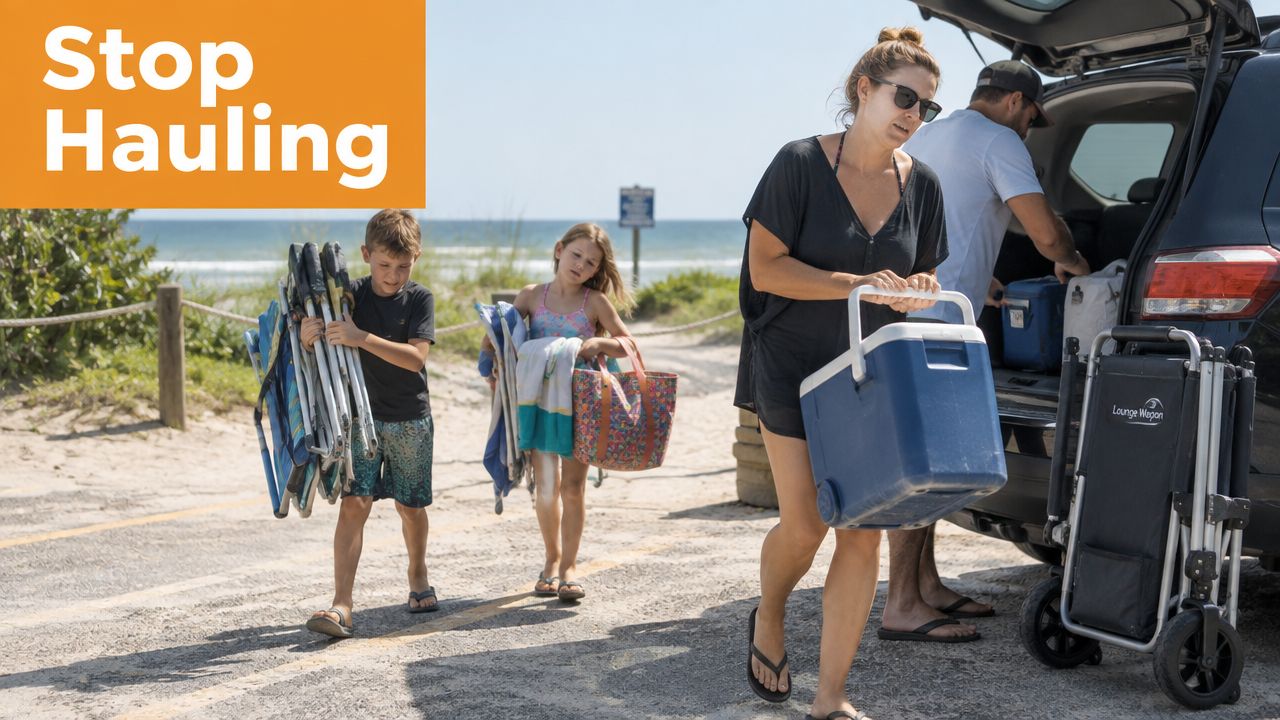
The three-trip walk from a car to the beach or soccer sideline is the problem folding wagon reviews often miss. Lounge Wagon approaches it differently, combining gear hauling with a padded bench. The right choice depends on wheel geometry, terrain, usable capacity, foldability, and whether you'll sit comfortably after arriving.
Last Updated: May 2026
You load the cooler, umbrella, towels, chairs, and beach toys. Then you make one trip to the shoreline, another for the forgotten canopy, and a third because someone needs water. By the time everything arrives, the morning has already taken more effort than the beach day deserves.
The same frustration appears at youth soccer complexes. A wagon may carry equipment, but parents still bring separate chairs, and the best resting spot is often a patch of uneven grass. In our testing across Florida Gulf Coast sand and crowded sports fields, that split between hauling and sitting is where many folding wagon reviews fall short.
The Lounge Wagon is designed around both jobs. It carries gear on a reinforced steel frame with a 500 lb capacity, then converts into a padded 2-in-1 bench for two adults. You can view the Lounge Wagon to see how the product handles that combined use.
The broader category has moved beyond niche camping equipment. Independent market research valued the global folding wagon market at USD 1.54 billion in 2025 and projects it to reach USD 3.12 billion by 2034, with a projected 8.1% CAGR. North America represented about 37.5% of global revenue in 2025, or roughly USD 578 million, according to Verified Market Reports' folding wagon market data.
Field-tested takeaway: A wagon that only carries cargo solves half the outdoor logistics problem.
Stop Hauling and Start Lounging
The best folding wagon reviews should answer a practical question: will this wagon reduce work after you leave the car, and will it give you a comfortable place to stay? Capacity matters, but it doesn't tell you whether wheels will cross loose sand or whether parents can rest between games.
That distinction is becoming more important as products mature. One 2026 consumer review tested 13 models and selected the Mac Sports Collapsible Folding Outdoor Utility Wagon as its best all-around option for basic hauling. Another 2026 review highlighted a leading model with 47,736 Amazon reviews averaging 4.8 stars, showing how review volume and buyer satisfaction now shape category expectations. Those details appear in recent folding wagon market coverage.
The three-trip test
A folding wagon earns its place when it replaces separate carrying trips and separate seating equipment. On a Gulf Coast beach, that means moving bulky items over the access path and across sand without turning every load into a drag. At a tournament, it means carrying coolers and supplies while remaining useful during the long gaps between matches.
The Lounge Wagon's practical proposition is straightforward:
Hauling: It carries beach gear, field equipment, coolers, and event supplies.
Mobility: Its all-terrain wheel design targets grass, gravel, and sand rather than pavement alone.
Seating: Its padded bench creates a resting place without adding separate chairs.
Organization: Integrated cup holders and storage pockets keep small essentials within reach.
The trade-off is that no folding wagon eliminates terrain resistance. Deep, dry sand can defeat even a high-capacity design if the tires are too narrow or the wagon is loaded too close to its limit. The useful test isn't whether a product looks rugged in a parking lot. It's whether the combination of wheels, frame, load, and seating fits the place you'll use it.
The review framework
I judge folding wagons through four practical questions:
Can it roll across the terrain you use?
Does its frame remain stable with a realistic load?
Can it replace another piece of equipment?
Will adults want to sit in it after arrival?
That last question changes the buying decision. A wagon that hauls well but leaves you carrying chairs still adds to the setup. A 2-in-1 design can reduce that duplication, provided the seat height, padding, and support work for your group.
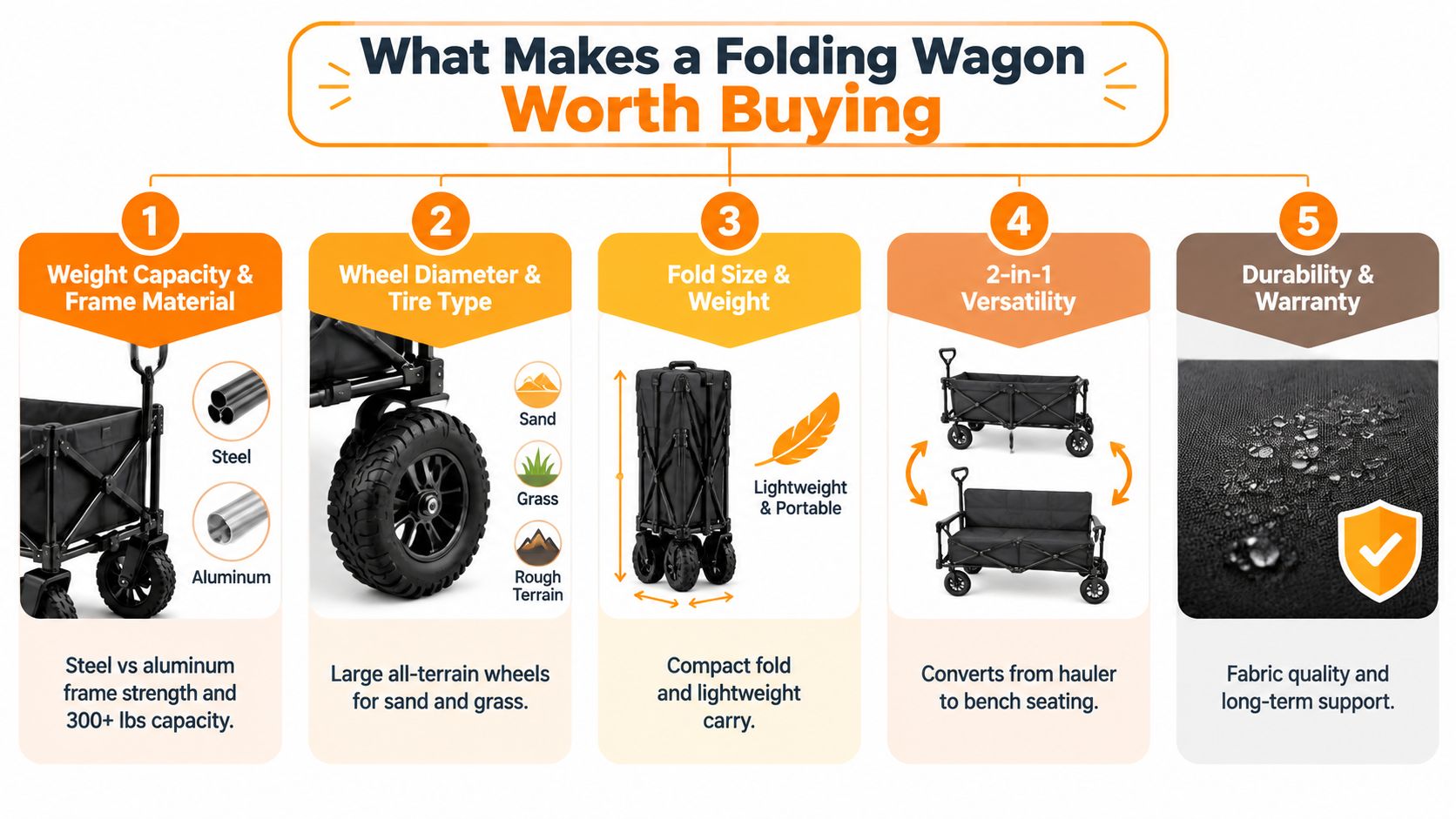
What Makes a Folding Wagon Worth Buying
A folding wagon earns its place by doing more than holding gear. The useful question is whether its frame, wheels, folded size, and comfort features match the places you use it. A high payload rating paired with narrow wheels can struggle on soft sand, while a smaller wagon with sensible storage may serve well on pavement and short grass.
Start with the load and frame
Capacity affects both safety and movement. Mainstream folding wagons commonly handle 150 to 220 lb, while heavy-duty models may reach 330 to 560 lb. Higher ratings usually work best when paired with larger all-terrain wheels and a stronger frame. The independent folding wagon payload and wheel analysis provides a useful comparison of those factors.
A reinforced steel frame gives the body more support when coolers, tents, chairs, and bags are loaded together. A 1000D Polyester body helps contain bulky equipment and resist ordinary abrasion. The practical benefit is fewer decisions about what to leave behind, plus less frame flex when the load shifts over uneven ground.
Treat wheel geometry as a primary specification
Wheel diameter and tire width determine how the wagon meets the surface. 10-inch puncture-proof wheels provide more clearance and rolling surface than small street-style wheels, helping the wagon cross grass, gravel, and uneven paths with fewer catches.
Reviews identify 7-inch all-terrain wheels as a minimum for grass, gravel, and packed sand. Smaller wheels can roll easily on pavement, then sink or stall on loose surfaces. Wider tires spread the load across more ground, reducing the pulling force required. That difference becomes obvious on Florida Gulf Coast sand, where a wagon can feel manageable on firm sand and suddenly drag through a softer patch.
Check the folded footprint
Outdoor performance does not guarantee convenient storage. Measure the folded wagon against your trunk, garage shelf, or storage closet before buying. A quick fold matters after a hot beach day, and a compact footprint makes it more likely the wagon stays accessible rather than buried behind other equipment.
Weight also requires a trade-off. Families hauling substantial loads may accept a heavier frame for greater support. Market shoppers who stay on pavement may value easier lifting instead. The right choice depends on whether the wagon spends more time being pulled, carried, or stored.
Look beyond the cargo compartment
Small features matter during long outings. Cup holders keep drinks off wet grass and sand. Storage pockets hold phones, sunscreen, keys, and snacks where you can reach them without opening the main compartment. For a useful task-based way to sort outdoor equipment, the Zero Sports product range groups gear around activities rather than specifications alone. Apply that same approach to wagons by asking whether your priority is hauling, sitting, or switching between both.
A long-duration sit test should also be part of the review. Check whether the bench supports an adult comfortably, whether the padding stays useful after extended use, and whether the seating position works beside a field or at an event. These details can matter more than a small difference in folded size.
Practical rule: Capacity tells you what fits. Wheel geometry tells you whether it moves.
Lounge Wagon vs Generic Folding Wagons Head to Head
Generic folding wagons can handle groceries, pavement, light park use, and short gear hauls well. Their limits appear when an all-terrain label is treated as proof of equal performance on soft sand, grass, gravel, and extended seating.
The comparison below places the Lounge Wagon's stated design beside common generic-wagon patterns. It is a buying framework, not a universal test result for every competing model.
Folding Wagon Spec Comparison
Feature
Lounge Wagon
Typical Folding Wagon
Weight Capacity
500 lb capacity
Ratings commonly cluster around 150 to 220 lb, with some heavy-duty versions reaching 330 to 560 lb
Seating
Converts into a double-seater padded bench
Usually cargo-focused, with seating absent or secondary
Wheel Size
10-inch puncture-proof wheels
Varies widely, with smaller street-style wheels less capable on loose surfaces
Frame
Reinforced steel frame
Construction varies by model and price
Transformation
Converts from hauler to seating configuration
Often remains a cargo carrier unless accessories are added
The Lounge Wagon combines hauling and sitting in one frame. Its 500 lb capacity leaves room for a family beach setup, such as chairs, towels, a cooler, toys, and field gear, while the 2-in-1 seating provides a place to rest after arrival. The rating describes the wagon's stated load limit, so the practical result still depends on how bulky, uneven, or concentrated that load is.
Where generic wagons still make sense
A basic folding wagon remains a sensible choice for pavement-focused use. It fits shoppers who need a compact carrier, carry modest loads, do not need seating, or keep the wagon near the vehicle.
The Lounge Wagon's reinforced steel frame and larger wheels suit users who move equipment across mixed surfaces and then stay beside it for hours. That combination matters at tournaments, festivals, beaches, and events where the wagon can serve as both transport and a resting point. A comfortable bench also changes the sit test. An adult should be able to use it without treating the seat as a brief emergency perch.
Capacity alone does not show whether the wagon fits your day. Wheel design, frame purpose, and seating setup determine how many separate jobs one product can handle.
What matters most: Compare the jobs the wagon eliminates, not capacity alone.
The Lounge Wagon and WonderFold beach comparison offers another view of the trade-offs among family hauling, beach use, and seating. Choose a generic carrier for straightforward transport, or choose the Lounge Wagon when one trip also needs a mobile base camp.
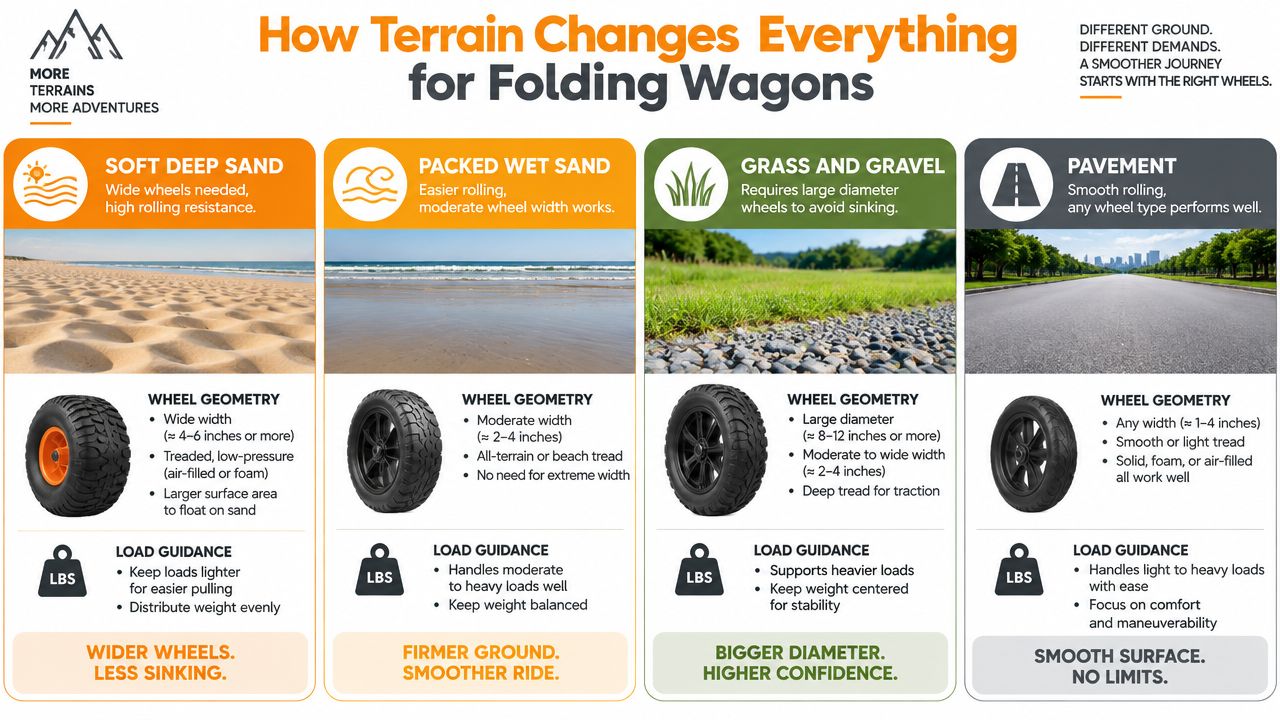
How Terrain Changes Everything for Folding Wagons
A wagon that rolls easily on pavement can become a tiring pull across Florida Gulf Coast sand. Surface firmness, wheel shape, and load placement determine how much force reaches the handle.
Soft deep sand
Deep, dry sand is the hardest field test. Expert coverage recommends balloon tires of at least 9 inches for soft sand, while 12- to 13-inch balloon tires perform better in fluffier dunes. A separate test found that a wagon with 12-inch rear and 8-inch front wheels rolled well over most terrain but still struggled in deep, dry sand. These findings appear in Bob Vila's folding wagon testing.
The practical lesson is clear. A wagon can have a high stated capacity and still lose mobility when its tires are narrow, its wheels are small, or the load sits near the limit. For beach trips, wide tires and balanced packing matter more than the capacity number alone.
Packed wet sand
Packed or wet sand still resists more than pavement, but it usually gives the wheels a firmer base than dry powder. Moderate width can work when the wagon stays balanced and the load remains below its rating.
The route to the shoreline matters as much as the destination. A wagon may cross a firm access path easily, then bog down where the surface turns soft. Judge the entire route by its loosest section, not by the pavement beside the vehicle.
Grass and gravel
Grass and gravel expose different wheel weaknesses. Grass rewards diameter and clearance, while gravel also benefits from a wider tread that spreads pressure and reduces the chance of dropping between stones. A narrow wheel can roll across packed grass yet catch repeatedly on loose gravel.
That difference shows up at youth soccer complexes. Larger wheels help the wagon cross field edges and uneven walkways without forcing a parent to lift the front end over every rough patch. The 10-inch wagon wheel guide explains why wheel size can make mixed-surface hauling easier.
Pavement and event routes
Pavement is the forgiving environment. On a smooth path, folded size, storage access, frame feel, and seating may matter more than maximum tire width.
Crowded festivals add a cleanliness concern. A wagon becomes a shared surface for bags, drinks, children, and outdoor equipment, so these outdoor concert hygiene tips provide useful complementary guidance.
Load guidance: Keep the wagon around 60% to 70% of rated capacity when mobility matters, especially on sand. A lighter, balanced load gives the wheels a better chance of staying on top of the surface.
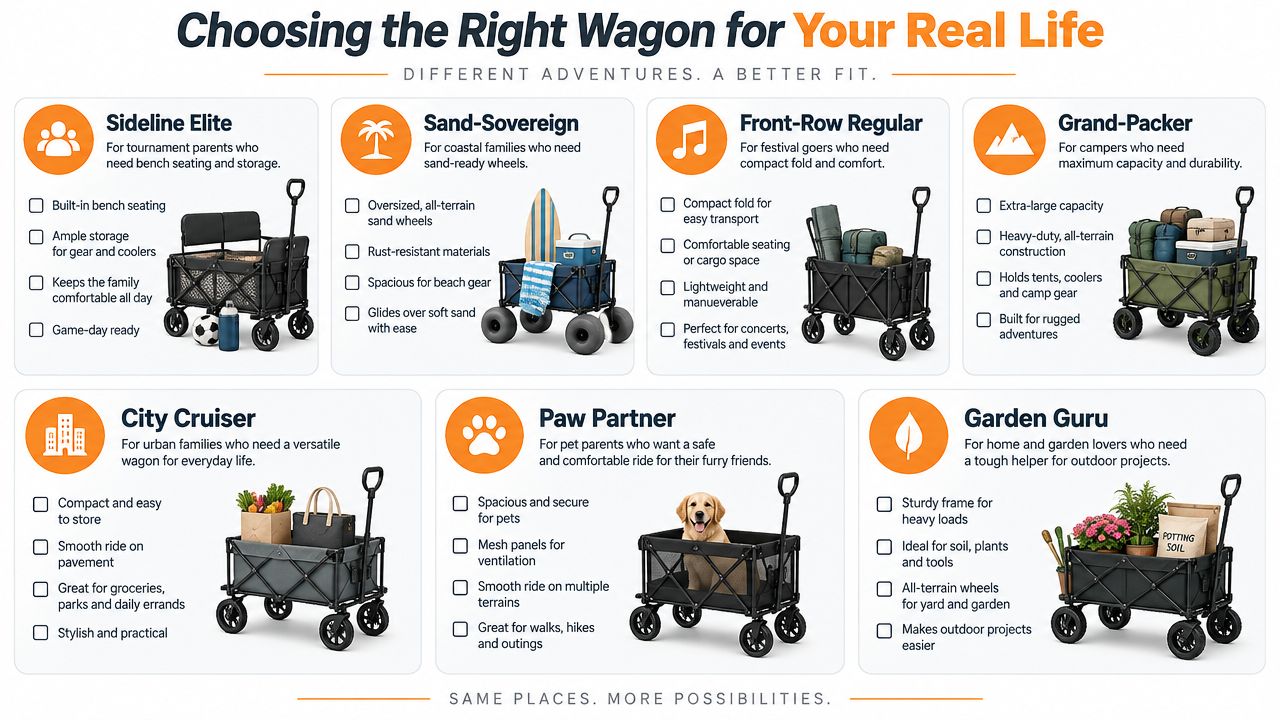
Choosing the Right Wagon for Your Real Life
The right folding wagon depends less on a universal winner and more on the job waiting at the end of the path. A tournament parent, beach family, festival regular, and event volunteer may all need a wagon, but they won't value the same features.
Seven use cases
Sideline Elite tournament parents need storage for coolers, tents, balls, and personal bags, plus a bench for the gaps between games. The trade-off is accepting a sturdier wagon that may take more room than a minimal pavement carrier.
Sand-Sovereign coastal families should prioritize wide, capable wheels and balanced loading. They need room for umbrellas, towels, toys, and refreshments, but deep powdery sand still demands realistic expectations.
Front-Row Regular festival goers benefit from seating, cup holders, pockets, and a fold that fits their vehicle. Compact transport matters, but a low seat or poor back support can undermine a full-day outing.
Grand-Packers traveling with multiple generations should value stable construction and usable seating height. A wagon that lets older adults rest without dropping close to the ground can reduce fatigue, even when the family still needs to carry a broad mix of supplies.
Mobile Anglers need space for tackle boxes, bait buckets, rods, and drinks. The seating function can replace a separate stool, but rocky jetties and steps remain limitations for any wheeled wagon.
Weekend Warriors use wagons for tailgates, camping, and car-based outings. Their main calculation is whether one product can replace separate hauling and seating gear without overwhelming available vehicle space.
Event Pros moving signs, water jugs, and supplies across fields need frame strength, wheel clearance, and accessible storage. Seating helps during registration pauses or setup downtime, but industrial tasks may require specialized equipment.
A quick decision matrix
Use this checklist before comparing brand names:
Beach route: Choose wider, larger wheels and leave mobility margin below the rated load.
Sports complex: Prioritize field-friendly wheels, storage, and a comfortable bench.
Festival: Favor seating, pockets, cup holders, and manageable folding.
Multigenerational outing: Check seat height and entry comfort, not just cargo volume.
Fishing trip: Look for stable hauling, accessible organization, and seating that replaces a stool.
Tailgate or camp: Compare the folded footprint with your vehicle and storage space.
Event work: Focus on frame support, wheel clearance, and easy access to supplies.
The family wagon cart guide is a useful resource for matching wagon features to family logistics. The best choice is the one that removes the most repeated work from your specific outing.
Why Comfort and Seating Matter More Than Specs Suggest
Most folding wagon reviews measure cargo first. They discuss capacity, wheel design, fold size, and frame construction, but they rarely test whether an adult can sit comfortably for a long tournament, festival, or beach day.
That omission matters because transport is only one part of the experience. Parents often remain at the destination for hours, older users need practical rest points, and festival-goers want a home base rather than a container they abandon after unloading.
The sit test
A useful seating evaluation should consider:
Seat height: A higher, easier entry can be more comfortable than a low-to-ground floor.
Bench support: Padding and a stable surface matter when sitting between activities.
Back support: A seat that leaves adults hunched may not work for extended downtime.
Personal storage: Cup holders and pockets keep drinks and essentials reachable.
Shared space: A double-seater should accommodate two adults without turning every movement into a negotiation.
Lounge Wagon's 500 lb capacity supports its role as a substantial gear hauler, while its 2-in-1 seating gives the same product a second purpose after setup. The benefit isn't just fewer items in the trunk. It can mean fewer chairs to carry, fewer objects scattered around the sideline, and a more comfortable place to wait.
The category is also moving toward larger, feature-rich family designs, including double-decker and family-oriented wagons. Yet available reviews still don't consistently quantify adult comfort, seat height, or fatigue during long use. Buyers should treat those omissions as a reason to inspect the seating design closely, not as proof that every bench will work equally well.
A wagon that keeps you seated comfortably can extend the useful part of the outing, not merely simplify arrival.
Customer feedback can be helpful here, but it should be read as experience rather than laboratory measurement. Look for comments about staying longer at tournaments or beaches, comfortable waiting, and reduced need for separate chairs. Those details answer a question that star ratings alone can't: whether the wagon fits the entire day.
Final Verdict and Your One Trip Solution
The strongest folding wagon reviews match the wagon to the route, the load, and the hours you will spend at the destination. Capacity and fold size matter, but soft-sand movement and usable seating can decide whether one wagon replaces several pieces of gear.
Best matches by setting
For beach sand, look for wide all-terrain wheels, a stable frame, and enough capacity for the load you will carry. A wagon that handles pavement may bog down when the surface turns soft. Lounge Wagon suits families who want seating after unloading, although any wagon will struggle in deep powder when loaded to its limit.
For sports sidelines, field mobility and a place to sit work together. A wagon that carries the cooler, tent, balls, and bags, then converts into a bench, can reduce the separate equipment parents bring. Explore the Lounge Wagon for team and sideline use.
For festivals and markets, storage layout matters as much as hauling space. Cup holders, pockets, and a usable resting place help when the wagon carries blankets, purchases, and drinks through a long day. Review the Lounge Wagon storage features before choosing a design that may leave essentials buried under the main load.
For all-around 2-in-1 value, use both functions often enough to justify them. Lounge Wagon's 500 lb capacity and 2-in-1 bench seating fit people who regularly haul substantial gear and remain at the destination. A simpler folding wagon may make more sense for short pavement trips with lighter loads.
Start the decision with your route. Measure the vehicle space, identify the softest surface, estimate the load you will carry, and decide whether separate chairs are part of the problem you want to eliminate. Then test the sitting position for a full break, not just a quick perch.
The one-trip solution earns its place when it moves reliably across your terrain, carries the gear without awkward overloading, and gives adults a comfortable place to wait. Ready to stop hauling and start lounging? Choose a wagon that helps you haul more, sit better, and stay longer, then visit Lounge Wagon to choose the product or bundle for beach days, tournaments, festivals, and outdoor events.
Choosing a selection results in a full page refresh.
This pad is perfect for kids or dogs to be comfortable inside the moving wagon, and very nice after you set everything up and want to sit for extra padding.
Having the umbrella this summer has been easy to use and a must to make sitting and watching the parade so nice when there isn't any shade. My dogs laid on the wagon padding and enjoyed the day without getting too hot. I enjoyed the shade too.