The right collapsible wagon for kids matches the job and the ground beneath it. Choose a tested stroller wagon for child passengers, and a cargo wagon with bench seating for hauling gear and resting afterward. A huge load rating doesn't prove child safety, and soft sand demands more than marketing.
Last Updated: April 2026
Meta description: Choose a collapsible wagon for kids by safety, sand performance, trunk fit, and seating. Compare your options and plan your next outing.
The exhausting walk from a hot car to the sand starts with chairs, a cooler, towels, toys, and children who need your attention. After another return trip, you've spent the morning hauling instead of settling in. Lounge Wagon addresses the gear-and-seating problem: carry the beach pile, then convert the wagon into a bench once you're parked.
Wagon Classes Compared for Hauling and Seating
Cargo hauling, adult seating, and child transport are different jobs. Buying one product that handles the first pair can simplify a family outing, but it doesn't automatically solve the third.
The idea for Lounge Wagon started with beach chairs, towels, coolers, bags, sand toys, boogie boards, umbrellas, and a five-year-old and one-year-old to get to the beach. That's a familiar packing problem, not proof that every member of the family should ride in the cargo bed. Explore the beach hauling and seating setup if your main frustration is carrying equipment and then finding somewhere to sit.
Collapsible wagon classes by load, seating, wheels, and job
Class
Load and seating
Wheels and fold
Best job
Compact fold wagon
Use the model's cargo limit; an open tub isn't a harnessed seat
Check wheel width and folded dimensions against your route and trunk
Light park gear and short paved paths
Stroller wagon
Follow individual seat and total-load limits; occupants need designated restraints
Confirm brakes, wheel attachment, and folding locks
Young riders within the model's stated limits, with compliance documentation
Heavy utility wagon
Rated for equipment; passenger permission must be explicit
Select wheels for the surface and inspect locking joints
Team coolers and equipment, not unsupervised play
Lounge Wagon
500 lb capacity; 2-in-1 hauling and double-bench seating
10-inch puncture-proof wheels; folds in seconds
Beach, sideline, and travel days needing hauling plus parent seating
Read the compact-folder row as a convenience choice. If you're moving a picnic bag over pavement and already have chairs, extra bench hardware may not earn its space in your trunk.
Read the stroller-wagon row as a passenger decision. You're buying containment, restraints, and documented child-transport performance, not just a deeper basket.
The heavy-utility row suits bulky equipment. The Lounge Wagon adds a parked double bench, so the same object that carries the cooler provides a place for adults to sit afterward.
Look beyond the headline capacity
The CPSC carriage and stroller guidance treats stability, brakes, restraints, folding mechanisms, structural integrity, and wheel attachment as separate safety concerns. A high payload doesn't establish that a product performs adequately in those other areas.
Compare usable room, empty weight, wheel tread, brakes, restraints, and folded dimensions before choosing. If a specification mentions 1000D-style fabric or powder-coated steel, verify the actual material and care instructions. Tough fabric helps with abrasion, while a protected frame finish helps with outdoor wear, but neither establishes passenger suitability.
Buying rule: A cargo limit tells you how much the structure is rated to hold. It doesn't tell you whom the product is designed to carry.
If a small child will ride, settle the passenger question before comparing accessories or bench comfort.
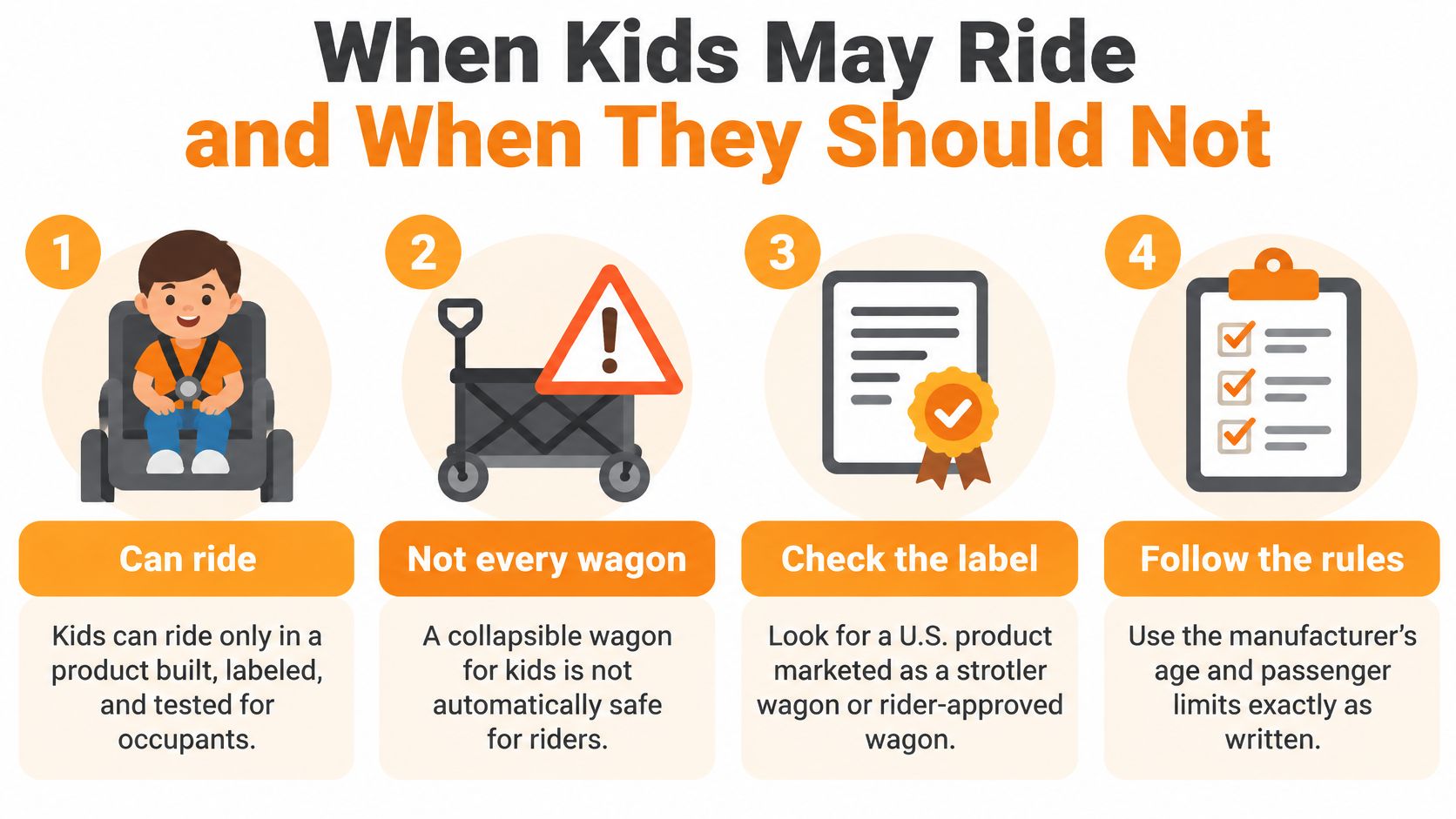
When Kids May Ride and When They Should Not
Kids should ride only in a product built, labeled, and tested for occupants. A product title containing “family” or “kids” isn't enough, and a tough-looking frame doesn't replace a designated seat and restraint.
For products within the U.S. carriage or stroller definition, 16 CFR Part 1227 incorporates the accepted ASTM F833 standard, covering hazards including stability, restraint performance, brakes, folding mechanisms, openings, and wheel detachment. A cargo-only wagon can have a different classification, so intended use matters.
Use this visual as a starting checklist, then follow the exact model's manual.
Set passenger rules before departure
The CPSC safety alerts describe strollers as normally used from infancy through 36 months, warn that unsecured children can slip through seat openings, and call for special care with infants younger than 12 months. That general description isn't permission to use any stroller wagon from birth.
Use the harness every time: Adjust it for the child rather than leaving loose straps around bulky clothing.
Stay within reach: Never leave a child unattended, even when parked.
Inspect seat openings: Pay attention to gaps around trays, handrests, and containment panels.
Set the parking brake: Engage it before loading, unloading, or letting go of the handle.
Follow occupant limits: Use the stated age, weight, seating position, and occupancy rules.
Check infant suitability explicitly: A flat-looking bed or added cushion doesn't create an infant seat.
A vague safety-tested statement leaves important questions unanswered. Request:
Product identity: Exact model and manufacture date.
Applicable standard: The ASTM revision and regulatory classification.
Testing record: Laboratory identity and test scope.
Certification: The applicable Children's Product Certificate and recall-registration information.
The CPSC Pack-N-Stroll utility-wagon recall illustrates the boundary: an entrapment opening and missing restraint are stop-use issues, not problems to solve with improvised straps.
For buying purposes, a 500 lb rating and a parent bench do not create a ride-in seat. Lounge Wagon's parked bench serves adults, or supervised older children where the manual permits, rather than replacing a harnessed stroller. For infant transport, choose a compliant product explicitly suitable for that infant's age and setup.
Sand Grass Gravel and How the Pull Feels
An all-terrain label doesn't tell you how hard the handle will pull through dry sand. Wheel width, diameter, tread, load height, and handle position all affect the effort you feel.
The CPSC stroller safety guidance identifies wheels, stability, brakes, and structural integrity as distinct concerns. That's a useful way to evaluate outdoor mobility: don't assume one strong specification compensates for every other weakness.
Terrain failures and the spec that actually helps
Surface
What goes wrong
Spec that helps
Field note
Soft dry sand
Narrow wheels sink and the pull becomes a drag
Broad wheel contact area and a low, balanced load
Diameter alone doesn't prove flotation
Firm or wet packed sand
Easier rolling, but salt and moisture reach components
Serviceable wheel assemblies and cleanable fabric
Remove salt and sand as the care instructions permit
Wet grass
Wheels slip sideways during a turn
Suitable tread, controlled steering, and a parking brake
Common around youth soccer fields
Gravel or cracked lots
Repeated jolts expose loose hardware
Secure folding locks and a rigid frame
Check connections after rough approaches
Curb, ramp, or slope
A high load destabilizes; an unattended wagon can roll
Low load placement and an effective parking brake
Choose a gentler route rather than forcing a curb
On a Florida Gulf Coast beach approach, deep dry sand is the demanding stretch. Ten-inch puncture-proof wheels remove air-pressure maintenance and puncture concerns, but width and load still determine whether you roll forward or dig in. Pack the cooler low rather than stacking it above bags.
Wet grass requires slower turns. A wheel that grips while another slides can make a tall load feel unsettled, so keep bulky bags centered and avoid hanging equipment off one side.
Gravel tests connections as much as tires. A reinforced steel frame supports rigidity, but it still needs securely engaged joints and properly maintained hardware; steel alone doesn't prevent a loose latch.
A parking brake matters when you stop to unpack, particularly beside a sloping sideline. Don't assume every cargo wagon has one, and don't use a parking brake as a substitute for controlling a moving load.
“We love our wagon! Big kids tend to haul big things and this wagon fit everything we needed for a day at the beach. It was so easy pull on the beach.” Renee B, website review
That's useful customer feedback, not a guarantee for every beach or payload. Soft sand and uneven grass are meaningful pass-fail surfaces; a smooth showroom floor isn't.
Folded Size Interior Room and Trunk Fit
Measure the car before trusting a compact-fold claim. The folded wagon must clear the hatch opening, fit beneath anything you keep in the cargo area, and leave room for the rest of the outing.
Start with usable interior length and width, wall height, empty weight, and folded length, width, and depth. Don't substitute outside frame measurements for usable cargo space. A wheel hub or handle can also protrude beyond the folded fabric bundle.
Dimensions to check before a wagon goes in the trunk
Measurement
What to confirm on any wagon
Usable interior length and width
Cooler, bag, and toys fit without unstable stacking
Wall height
Balls and bags remain contained over ordinary surface transitions
Empty weight
The adult loading the car can lift it comfortably
Folded length, width, depth
The package clears the hatch and shares space with other gear
Wheel diameter
The wheel setup suits the intended sand, grass, or paved route
Brake and latch
The wagon stays parked and remains securely open
Interior room changes packing more than a broad capacity claim. A cooler that fits only diagonally can leave awkward pockets around it, while enough width allows soft bags to fill the remaining space.
Empty weight changes who can manage the outing alone. Lift height matters too: moving a folded wagon into a crossover is different from sliding it across a garage floor.
Lounge Wagon collapses quickly for a trunk or garage, but read the current specifications for exact folded measurements. Check the folding wagon and seating configuration before deciding what else can travel alongside it.
Run a driveway check
Repeat the fold and opening sequence. Fully engage the latch each time and keep children away from the mechanism.
Lift the folded package to trunk height. Test the movement, including clearing the bumper.
Load a cooler low in the bed. Walk normally and confirm the handle clears your stride.
Inspect hinges without placing fingers inside them. Look for exposed pinch zones and damaged or misaligned parts.
Check the parking brake under controlled conditions. Keep hold of the wagon, exclude passengers, and follow the manufacturer's procedure.
Never use a child as test ballast or ask someone to rock an occupied wagon to check tipping.
Our optional Cargo Pad adds comfort in the cargo bed and extra padding after bench setup. It's intended for children or dogs inside the moving wagon, but padding itself doesn't establish passenger approval, containment, or infant suitability. Apply the exact model's occupant instructions independently of accessory comfort.
Beach Days Sports Complexes and Travel
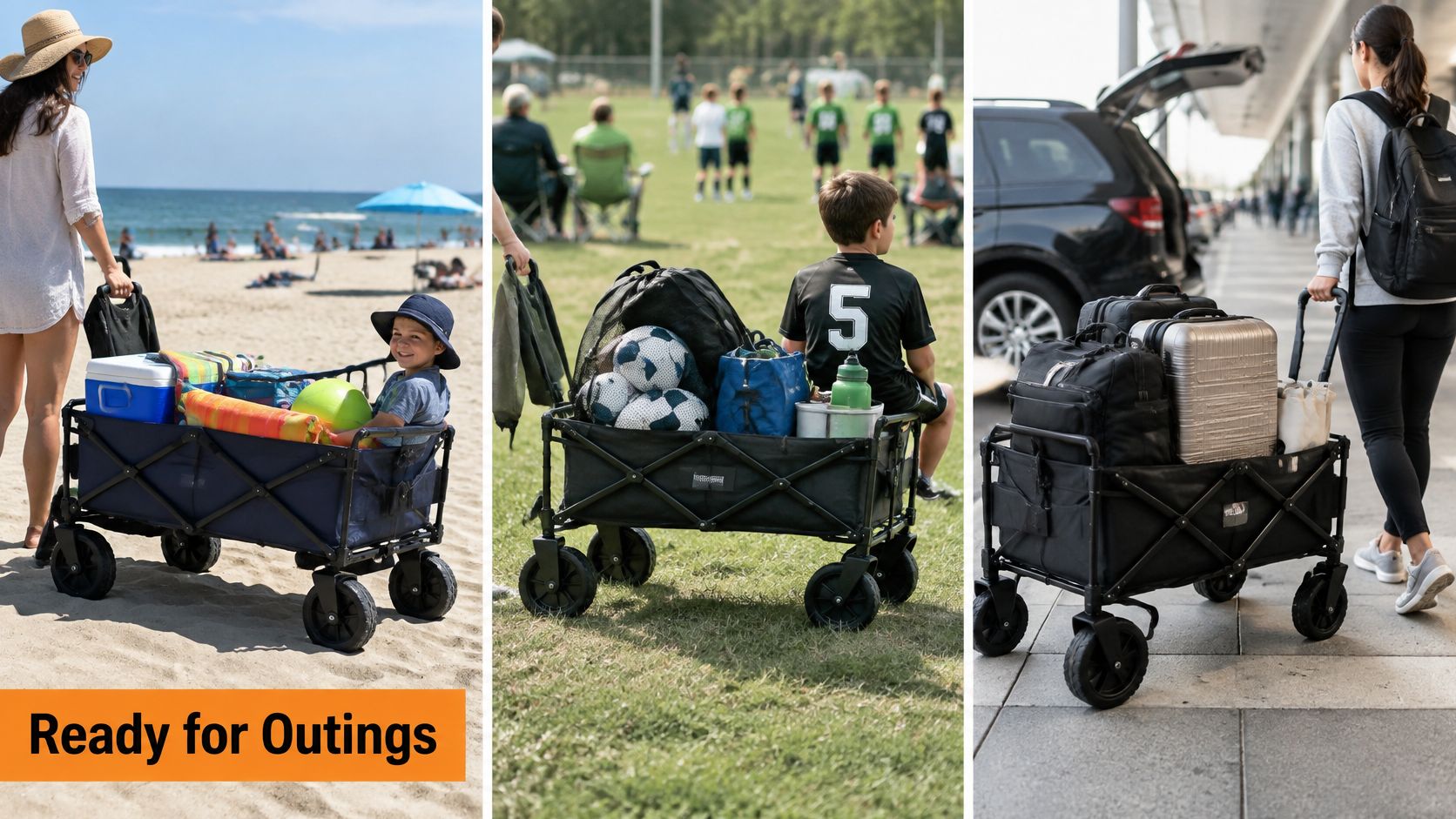
Outdoor outings are a regular part of family life, not an occasional packing exercise.
The useful question is what your family needs between the car and the place you'll settle. Beach mornings, tournament days, and festival stops all combine hauling and rest, but each needs a different load arrangement.
Pack for where you'll stop
For a beach morning, place the cooler on the floor, tuck towels around it, and keep toys accessible without balancing them on top. Secure the umbrella so it doesn't project into other walkers' space.
On soft sand, leave unnecessary weight in the car rather than treating available capacity as a target. A load that rolls easily across a paved lot can become a hard pull the moment the wheels hit dry sand, so judge the route surface by surface instead of trusting an all-terrain label. I'd rather make two lighter trips across loose sand than one overloaded drag.
At a youth soccer complex, arrange the load so you can unload without blocking the pedestrian path:
Cooler and drinks: Low and centered, with lids accessible.
Shade equipment: Secured along the bed, not swinging from the handle.
Snacks and small essentials: In accessible storage so you aren't unpacking everything between games.
Loose balls and clothing: Contained rather than perched above the sides.
Once parked on suitable ground, the wagon becomes the seating spot between games. Lounge Wagon is built to haul the gear and then seat two adults once parked, so one piece of kit covers the gear-plus-rest problem without adding a separate pair of chairs to the load. Keep the roles distinct: bench conversion is for sitting down after you arrive, and a strong load rating on its own says nothing about whether a child may ride inside.
Use the bench where it earns its space
For festivals, markets, and multigenerational travel, a wagon that becomes a double bench can replace separate hauling and seating pieces. Confirm venue access before packing, and keep circulation space clear when you stop.
A canopy or umbrella earns its place at a parade or an exposed noon field. Follow its wind and securing instructions, and never leave a raised umbrella unattended. Reviewing the Wagon & 6' XL Sports Umbrella Setup, Beth Ritchey wrote that the shade made watching a parade comfortable where none existed, and that her dogs rested on the wagon padding without getting too hot.
Melissa Dominguez described the wagon as "easy to maneuver," with unpacking and folding that is "quick and easy." In her umbrella review she added, "Love that my family and friends can sit on it as well while we watch the kids play," and rated the setup for year-round use.
See the conversion and packing layout before deciding how it fits your outing.
Renee B's review adds the beach side: big kids haul big things, the wagon fit everything her family needed for a day at the beach, and it pulled easily across the sand. Reviews like these speak to hauling capacity and parked seating. Passenger rules come from each model's own occupant instructions, and no cargo rating or bench conversion turns a gear hauler into approved child transport.
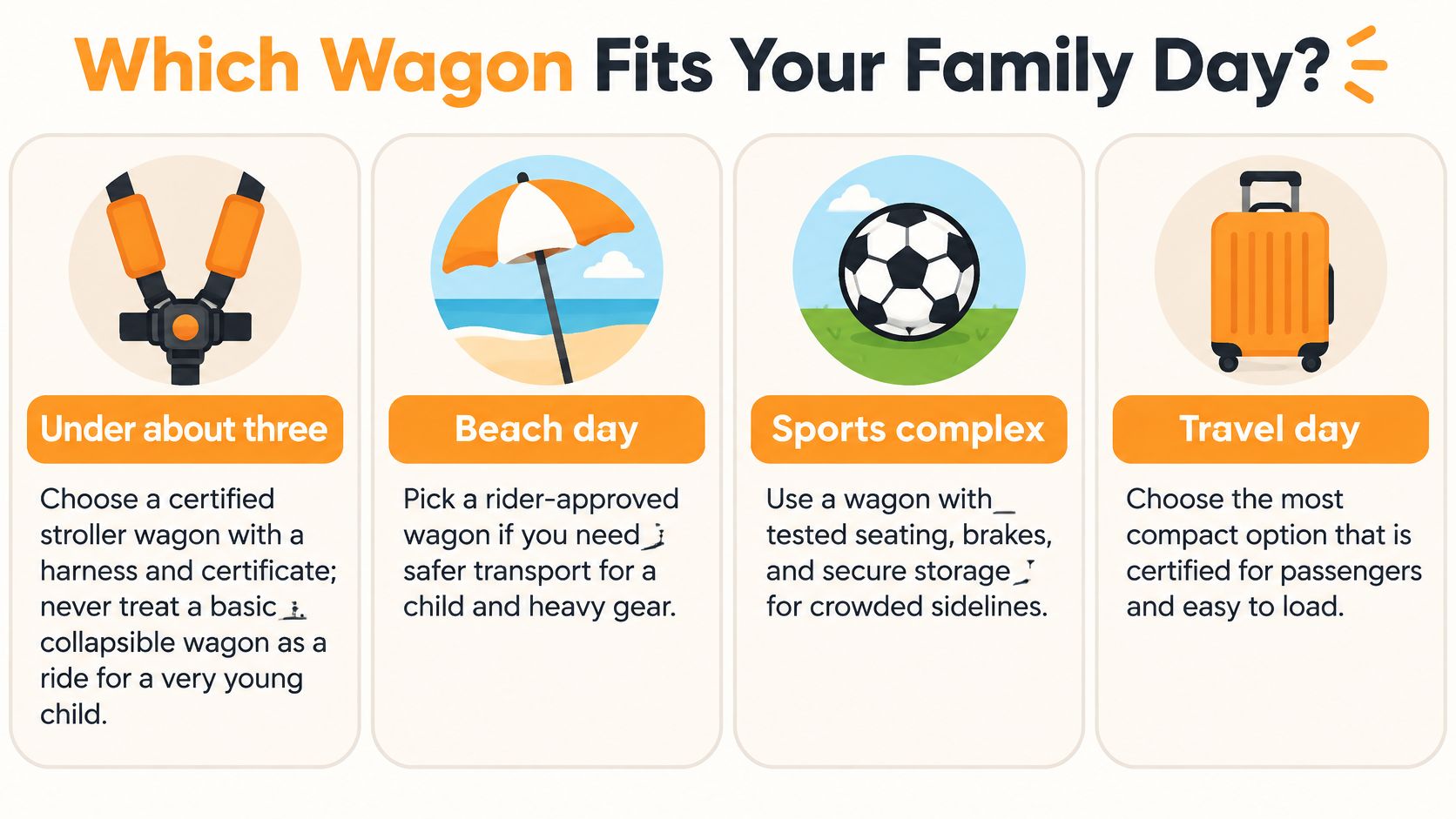
Which Wagon Fits Your Family Day
Choose the wagon for the task you repeat, not the largest specification on the page. A design that solves your usual parking-lot-to-sideline routine is more useful than one loaded with features you rarely deploy.
For a young child who will ride, choose a compliant stroller wagon with the correct harness, documentation, and age suitability. Infant compatibility must be explicit; don't infer it from a broad stroller label, a cushion, or the space available inside.
For gear over pavement, a straightforward cargo wagon can be enough. If you already own comfortable chairs and don't mind carrying them, bench conversion may not solve an actual problem.
Choose hauling plus seating when both are missing
For beach families and tournament parents, Lounge Wagon makes sense when the painful part is carrying everything and then having nowhere comfortable to sit. I'd prioritize a setup that carries the cooler and becomes the parked seat over one with a longer accessory list.
For grandparents, festival regulars, and family travel, judge the lift into the vehicle and the comfort of the parked bench. A multifunctional wagon only saves effort if the adult using it can load, steer, open, and store it without an awkward struggle.
Use this decision graphic to identify the category, then verify the specific model's manual and certification. A graphic or category label never grants passenger approval to an otherwise cargo-only wagon.
A higher weight rating is not a safety rating.
Make the final checks practical
Before buying, turn the appealing features into questions you can answer:
Passengers: Does the exact model permit the intended rider and provide the required restraint and documentation?
Surface: Do wheel width, diameter, and tread suit the difficult part of your route, not just the parking lot?
Stops: Can the parking arrangement hold securely where you'll unload?
Storage: Can you operate the fold repeatedly and lift the result into your vehicle?
Seating: Is the bench intended for the people who'll use it, and can you deploy it on suitable ground?
Our named setups are The Sideline Wagon, The Beach Wagon, and The Family Wagon. Confirm current photos, capacity, bench configuration, wheel size, and folded dimensions before choosing, rather than assuming every setup includes the same accessories.
If tomorrow means sand, sports, or a family outing, Lounge Wagon is designed for hauling gear and sitting after arrival. It combines 500 lb of cargo capacity with 2-in-1 seating for two adults, without turning that cargo rating into a child-transport claim. It folds in seconds for the trunk or garage. Choose it for that pair of jobs, and keep an appropriate stroller or other approved transport for children who need one.
Lounge Wagon offers a collapsible gear hauler that converts into a parked double bench for beach days, games, and family adventures. Visit Lounge Wagon to compare the setups with your route, packing list, and vehicle space. Ready to stop hauling and start lounging? Get your Lounge Wagon today and make it a one-trip walk to the shore.
Choosing a selection results in a full page refresh.
This pad is perfect for kids or dogs to be comfortable inside the moving wagon, and very nice after you set everything up and want to sit for extra padding.
B
Wagon & 6' Xl Sports Umbrella Setup Beth Ritchey
Umbrella is a must
Having the umbrella this summer has been easy to use and a must to make sitting and watching the parade so nice when there isn't any shade. My dogs laid on the wagon padding and enjoyed the day without getting too hot. I enjoyed the shade too.