TL;DR: A beach wagon toy should be treated as family beach gear, not a novelty plaything. Choose wide, large-diameter wheels for soft dry sand, confirm that the wagon is approved for child riding, and prioritize a 500 lb capacity, 2-in-1 seating, reliable brakes, and storage. The Lounge Wagon fits families who want one hauler and seat.
Last Updated: September 2026
The three-trip walk from the car to the surf is how a beach morning goes wrong. You're carrying the cooler in one arm, an umbrella in the other, and trying to keep a toddler from dragging a towel through the parking lot. By the time you reach the sand, your pockets are full of grit and everyone's already tired.
A beach wagon toy usually isn't a literal toy. Parents searching for one generally want a practical wagon that carries chairs, towels, toys, refreshments, and umbrellas, then gives a tired child somewhere stable to rest. The useful category is a family beach hauler first and a kid-friendly product second.
For families comparing options, the Beach Day Bundle is a sensible place to review a wagon, sand wheels, shade, and cooler setup together. The right build solves the hauling problem instead of adding another small item to pack. For a broader look at family-focused outdoor equipment, see creating effortless family outdoor gear.
What a Beach Wagon Toy Really Means for Parents
The phrase creates confusion because it blends three different products: a child's pull toy, a utility cart, and a stroller-style child carrier. Those products can look similar in a product photo, but they don't offer the same wheel performance, load stability, seating, or safety controls.
Start with the job, not the label
Ask what you need the wagon to do during a real beach day. If the main job is carrying sand toys, a small pull cart may be enough. If you're moving a cooler, chairs, towels, shade, and children across a long access path, you need a true all-terrain beach wagon with a stable frame and wheels designed for loose ground.
The distinction matters most after the family arrives. A cargo-only cart may carry equipment well but offer no approved seating, restraint system, or parking brake. A child transport wagon should clearly state that children may ride in it and should provide the controls needed for that use.
A useful parent test is to describe the end of the day. Your child is hot, sandy, and too tired to walk. You're carrying wet towels and empty containers, while the wagon needs to roll back across the same terrain. If the product can't handle that moment, it isn't the right beach wagon toy for your family.
For play: Choose a small, light pull wagon intended for toys.
For hauling: Choose a cart with useful cargo volume and terrain-matched wheels.
For riding: Choose only a product with explicit child-use guidance, stable seating, restraints, and braking.
For mixed use: Look for a genuine 2-in-1 hauler and bench, not a cargo cart with a thin fabric flap.
Parents also need to separate hard-packed shoreline sand from soft dry sand. Independent beach-wagon coverage notes that wet, firm sand is relatively easy to cross, while dry sand exposes narrow-wheel designs quickly, with guidance ranging from 8 to 9 inch all-terrain wheels for light use to 10-inch wide rubber wheels or balloon-style tires for heavier or deeper-sand work (independent beach-wagon guidance).
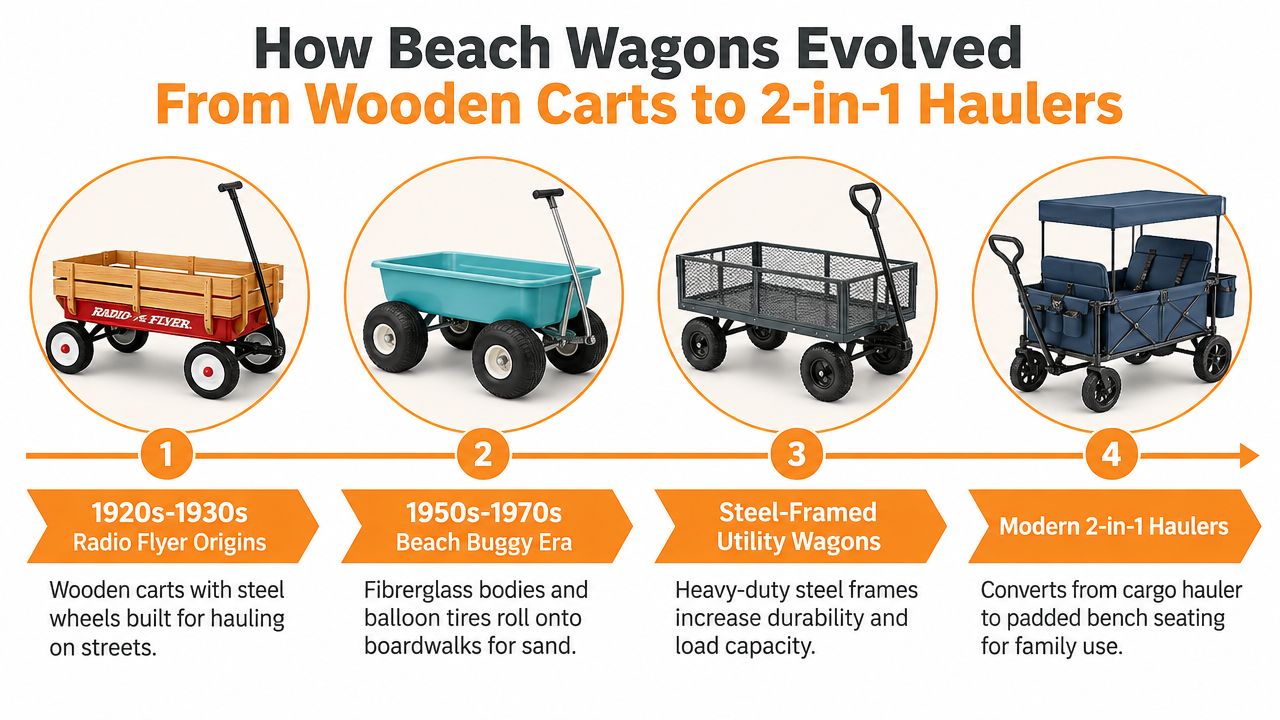
How Beach Wagons Evolved From Wooden Carts to 2-in-1 Haulers
The modern family wagon has a long history. Toy wagons have existed since the late nineteenth century, and early versions were made from wood. One historical account places early toy-wagon production in the 1880s, while Radio Flyer founder Antonio Pasin began making wagons in 1917. The company became a national hit after the 1933 Chicago World Fair (toy wagon history).
From beach carts to beach buggies
Early beach carts were simple two-wheeled wooden carriers for towels and bags. During the 1950s and 1960s, the design shifted toward beach buggies with four inflatable tires. By the 1970s, folding designs and cooler racks made these carts easier to store and carry (vintage beach-cart history).
That progression reflects a practical change in family routines. A rigid wooden cart could work for a local walk, but families driving to the coast needed gear that fit in a vehicle, carried more equipment, and moved over changing surfaces. Folding frames and fabric sides made the category more useful without turning every beach trip into a trailer operation.
Modern products continue that compromise. A steel frame supplies structure, while fabric panels reduce bulk and create flexible cargo space. A padded bench adds a second function, allowing the same wagon to carry chairs and a cooler in the morning, then provide a place to sit when the family reaches the blanket.
Why 2-in-1 designs make sense
The 2-in-1 hauler-and-seat format is a response to the space problem parents face. A separate cart, two beach chairs, and a child seat take room in the trunk and require more setup at the shore. A convertible design consolidates those jobs.
The Lounge Wagon is built around that format, combining a reinforced steel frame, cargo hauling, and bench seating. Its stated design includes a 500 lb capacity, 10-inch puncture-proof wheels, integrated cup holders, and storage pockets, with the seating function intended for two adults. Review the Lounge Wagon product details before deciding whether that configuration matches your beach routine.
Why Wheels and Sand Type Decide Whether Your Wagon Works
Frame color and fabric pattern won't get a wagon through dry dune sand. Wheel diameter, width, pressure, and contact area decide whether you roll forward or pull a trench behind you.
Soft sand creates a mechanical problem because the wheel presses into a deformable surface. Research on wheel sinkage in soft sand identifies vertical wheel load, longitudinal slip ratio, and inflation pressure as significant factors. In related experiments under the same setup, sinkage rose from 17.8 mm at 0% slip to 37.9 mm at 60% slip (soft-sand wheel-sinkage study).
Match the wheel to the beach
Hard-packed wet sand near the surf line is far more forgiving than loose dry sand behind the dunes. A narrow, rigid wheel may track acceptably on firm ground, then dig in as soon as the surface loses density.
Classic wheel-soil interaction research connects greater slip with increased sinkage and motion resistance. The models also consider sinkage relative to wheel diameter and wheel width relative to diameter, which supports the practical preference for large, broad wheels on loose sand (wheel-soil interaction research).
Sand Type
Min Wheel Diameter
Tire Width
Max Comfortable Load
Hard-packed wet shoreline sand
7 inches
Standard or moderate width
Light to moderate
Firm dry sand
8 to 9 inches
All-terrain width
Light use
Deep soft dry sand
9 inches or more
Wide or balloon-style
Match the manufacturer's rating and keep heavy items low
The wheel-size guidance above reflects independent outdoor-cart recommendations, which distinguish 7-inch wheels for hard-packed sand, 8 to 9 inch all-terrain wheels for firm dry sand, and 9-inch-plus balloon tires for deeper soft sand (folding beach-cart guidance).
The practical choice
If your route crosses parking pavement, grass, packed shoreline, and loose sand, choose wide wheels with a larger diameter and terrain-appropriate pressure. Standard wheels can manage grass, gravel, and packed dirt, but independent gear coverage warns that deep loose sand is where general-purpose carts struggle (outdoor hauling guidance).
Before buying, inspect the tire surface and width. A label saying “all-terrain” doesn't compensate for a narrow contact patch. The soft-sand beach cart guide is useful for comparing wheel choices against the kind of shoreline you visit.
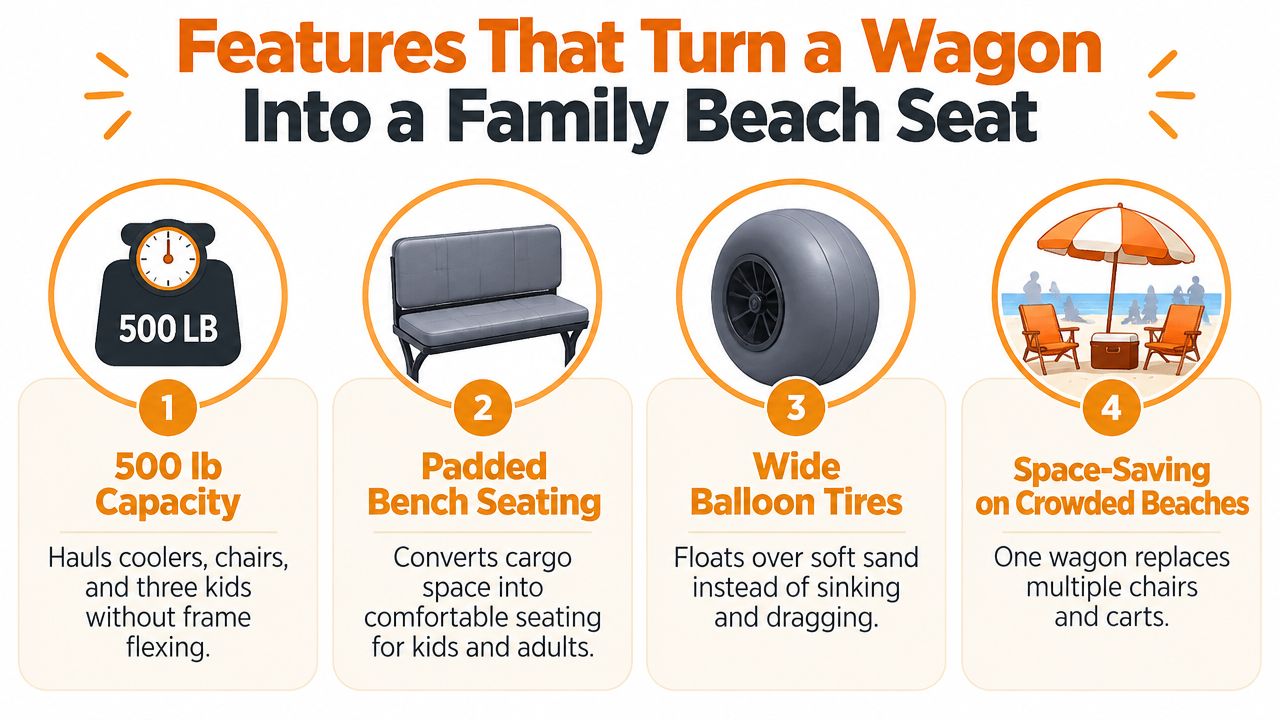
Features That Turn a Wagon Into a Family Beach Seat
A wagon becomes family furniture when its features work together. The capacity matters because a beach load includes more than toys. The seating matters because children and adults need a break. The wheels matter because a comfortable seat is useless if you can't reach the shoreline.
Read the specification as a beach scenario
A 500 lb capacity gives a family room to combine cargo and people instead of choosing between them. That can mean a cooler, towels, umbrellas, chairs, sand toys, and children in one load, provided the manufacturer's instructions and seating limits allow the intended use. The number describes rated capacity, not permission to exceed approved seating or ride configurations.
The 2-in-1 seating function adds value at the point where most carts become dead weight. A padded bench can serve as a rest stop between swims, a changing surface for gear, or a place for adults to sit while children play. It also reduces the need to pack separate seats.
Cup holders: Keep drinks upright and within reach, so the cooler doesn't become a constant search zone.
Storage pockets: Separate sunscreen, goggles, wipes, and small toys from heavy cargo.
Canopy compatibility: Creates shade for breaks, but it must be secured properly in wind.
Removable liners: Make it easier to remove wet towels, crumbs, and sand after the trip.
Corrosion-conscious hardware: Helps the wagon tolerate salty environments when you rinse and dry it after use.
Skip thin wheels marketed with broad terrain claims and seats that lack padding. Those features look acceptable on a driveway but become uncomfortable and inefficient on a crowded beach.
A tested beach-wagon review found that wheel surface area and a smooth texture made a meaningful difference on dunes, allowing some wagons to roll through deep dry sand instead of plowing through it (tested beach-wagon review).
The wagon that converts to chairs shows the key design idea clearly. A wagon earns its space when the cargo body becomes useful seating, rather than remaining an empty container beside the family.
Safety and Age-Appropriate Use for Kids on the Sand
The label beach wagon toy can hide the most important question: is your child riding, pulling, or playing around the wagon? Those uses require different decisions, and a cargo cart shouldn't become a stroller substitute just because a child fits inside it.
Separate hauling from child transport
A product intended for child riding should clearly say so. Look for stable seating, seat belts or harnesses where appropriate, a parking brake, and age guidance from the manufacturer. A recent independent guide makes the central point plainly: utility carts should only carry children when the product explicitly allows child use (child-safety beach-wagon guidance).
Toddlers need especially careful supervision. A young child shouldn't perch on a padded edge or stand while the wagon moves. If the product has no restraint system, don't treat it as a stroller or ride-on carrier.
Soft sand creates an additional risk because the wheels can slow suddenly. The adult pulling may stop, while an unrestrained child continues moving. Keep the load low, avoid abrupt turns, use the brake whenever the wagon is parked, and never leave a child unattended in the wagon.
Before leaving the parking area, run this quick check:
Brake test: Load the wagon lightly and confirm the parking brake holds on a gentle slope.
Belt check: Fasten every approved restraint and inspect the buckle before the child climbs in.
Frame check: Look for loose hardware, damaged fabric, or a seat that doesn't lock securely.
Route check: Choose firm access paths where possible and avoid steep cross-slopes.
Load check: Keep heavy coolers low and don't exceed the stated capacity or seating limit.
For children who aren't riding, pack a few durable activities instead. This guide to engaging toys for on-the-go kids can help you choose compact play items that stay separate from the wagon's safety role.
Comparing the Lounge Wagon to a Generic Beach Cart
A generic folding mesh cart can be the right purchase for a narrow job. It typically folds compactly, weighs less, and may cost less than a heavier family hauler. If you're moving towels across a firm shoreline and never need seating, that simplicity has real appeal.
The trade-off appears when the cart carries people and gear together. Mesh utility carts often prioritize cargo volume over padded seating, braking, wheel flotation, and adult comfort. A family that already owns one may eventually add chairs, a cooler, and a separate child solution, which defeats the original space-saving purpose.
Compare the actual use case
The available Lounge Wagon information supports a reinforced steel frame, 500 lb capacity, 10-inch puncture-proof wheels, integrated cup holders, storage pockets, and conversion into a padded seat for two adults. Generic carts vary widely, so the comparison below uses typical category traits rather than invented competitor specifications.
A lighter folding cart makes sense if trunk space is your primary constraint and the route stays on packed ground. It also works for occasional towel and bag transport when no one needs to sit in it.
Choose the heavier 2-in-1 format when you're carrying a mixed load, setting up at crowded sports complexes, or replacing separate chairs with one piece of equipment. The 500 lb capacity and 2-in-1 seating matter because the wagon keeps doing useful work after the gear is unloaded. You're not dragging an empty cart while carrying the seats separately.
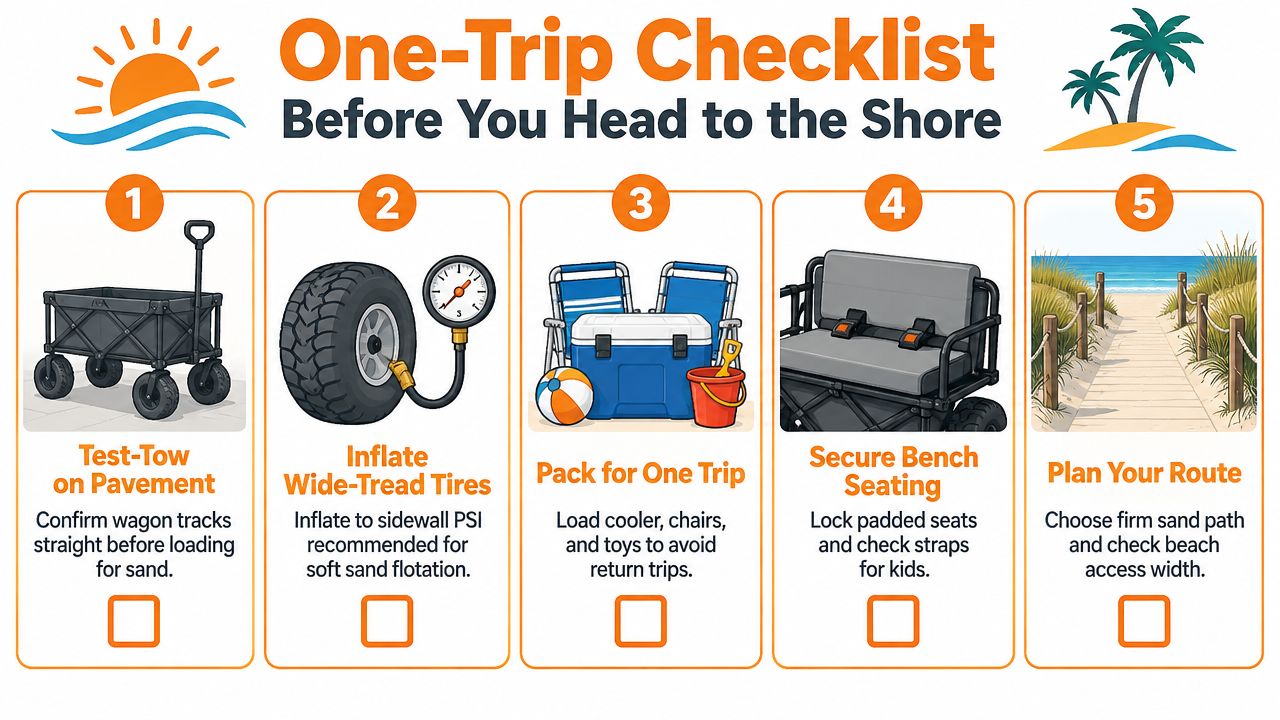
One-Trip Checklist Before You Head to the Shore
A wagon only becomes a one-trip solution when you prepare it for the route. Test it before loading, distribute weight deliberately, and pack according to what you'll need first at the blanket.
Prepare the rolling system
Start on pavement. Pull the empty wagon in a straight line, make a controlled turn, and check that the wheels track without wobbling. A problem that feels minor on asphalt becomes exhausting in sand.
Inflate wide-tread tires only to the pressure recommended for the specific tire. For air-filled wheels, follow the manufacturer's sidewall guidance and any product instructions for soft sand. Don't improvise pressure changes if the wheels are puncture-proof or polyurethane.
Use this short mechanical check before every busy outing:
Tracking: Confirm the wagon moves straight without repeated correction.
Wheel hardware: Check that bearings, hubs, and fasteners are secure.
Brake: Engage the brake on a gentle slope and verify that the wagon stays put.
Seating: Lock the bench or seat panels and inspect every strap.
Clearance: Make sure umbrellas, poles, and handles won't catch on access gates or people.
Pack from the ground up
Place the heavy cooler low and close to the axle. That keeps the center of gravity down and reduces the tendency to tip when the wagon turns or crosses uneven sand.
Put chairs, folded shade equipment, and dense bags around the cooler instead of stacking them high. Slide umbrellas and poles vertically along the side rails, securing them so they can't fall into the wheel path. Add towels, clothing, toys, and lightweight kid gear last.
The first items you'll use should stay accessible. Put water, sunscreen, snacks, and a small towel near the top, while spare clothes and end-of-day cleanup supplies can sit lower in a separate bag. Families also benefit from planning skin protection before the walk, including age-appropriate skincare routines per skin type.
Pack for the return trip
The walk home is when poor organization shows. Keep a dry bag for phones and keys, a separate place for wet items, and a rinse or wipe available for sand-covered hardware. Salt and moisture should be removed from metal parts after the outing, then the wagon should dry before storage.
Use the beach day packing list to build a repeatable loadout. The objective is simple: the wagon carries the equipment, provides its 2-in-1 seating, and keeps the family moving without abandoning bags at the access path.
The Lounge Wagon combines a 500 lb capacity gear hauler with padded seating, integrated storage, and large all-terrain wheels for family beach days, sports sidelines, and outdoor events. Visit Lounge Wagon to choose the configuration that turns your next shoreline walk into one organized trip.
Choosing a selection results in a full page refresh.
This pad is perfect for kids or dogs to be comfortable inside the moving wagon, and very nice after you set everything up and want to sit for extra padding.
Having the umbrella this summer has been easy to use and a must to make sitting and watching the parade so nice when there isn't any shade. My dogs laid on the wagon padding and enjoyed the day without getting too hot. I enjoyed the shade too.