A true beach gear hauler should do more than carry chairs and coolers. It needs wide wheels for soft sand, enough capacity for a full family load, and a useful second role after arrival. The Lounge Wagon combines a 500 lb capacity with 2-in-1 seating, turning one beach trip into a simpler haul and a more comfortable basecamp.
Meta description: Find the right beach gear hauler for soft sand, mixed terrain, and all-day comfort. Explore Lounge Wagon and make beach hauling easier.
The Exhausting Walk From Car to Sand
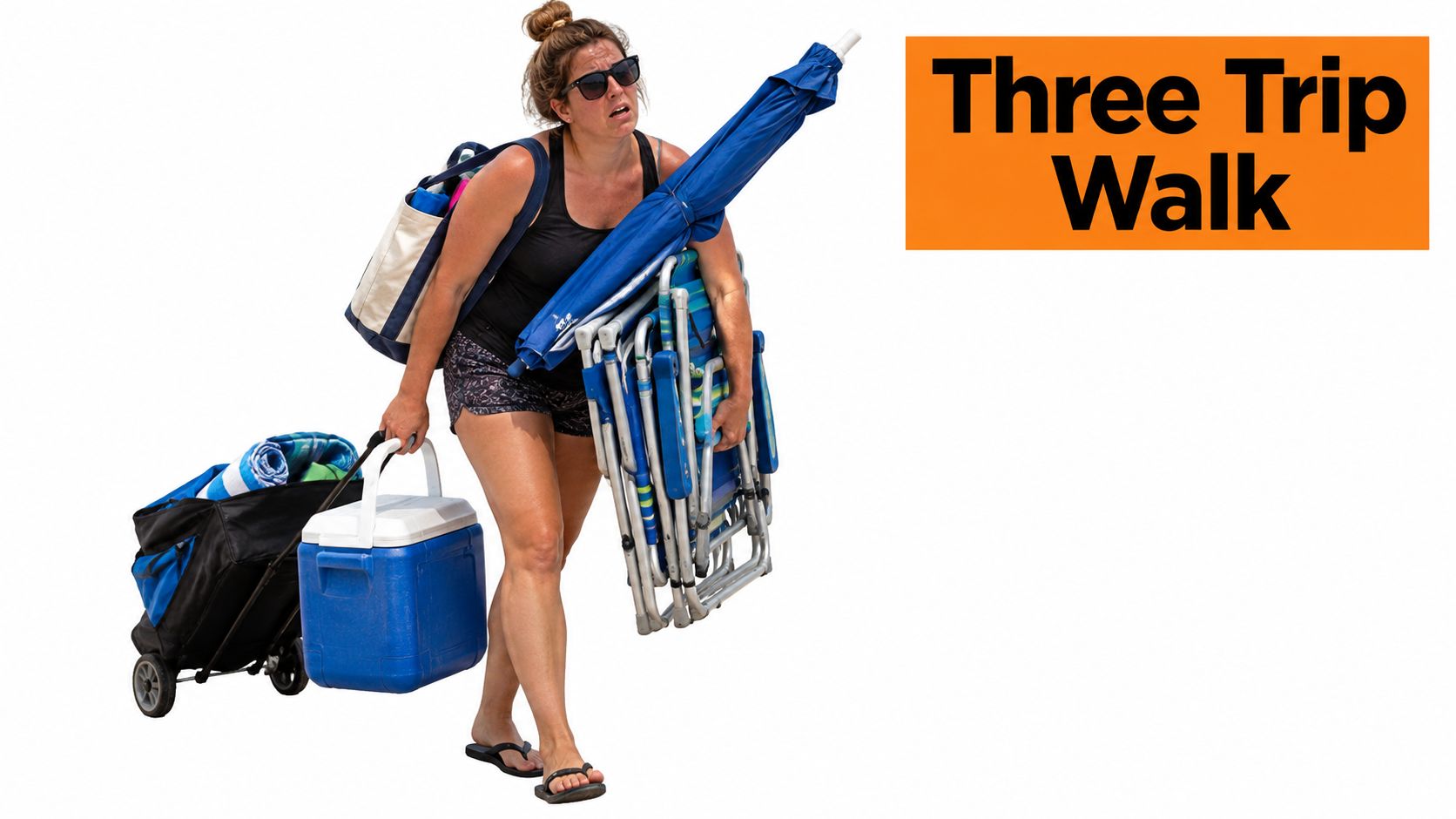
The first beach trip often starts with a familiar mistake. One person carries the cooler, another grabs the umbrella, someone balances chairs and towels, and the children somehow need their toys before anyone has reached the shoreline. Then somebody walks back to the car for the gear that didn't fit in the first load.
That three-trip walk can drain the morning before the family has even found a patch of sand. Hot parking lots, shifting dunes, wet towels, shade equipment, food, and toys create a heavy, awkward load. A standard folding cart may look helpful beside the trunk, but narrow wheels often sink into dry powder and force you to drag rather than roll.
The cart has to earn its place
A capable beach gear hauler changes the job from carrying separate objects to moving one balanced load. The Lounge Wagon is designed as a heavy-duty cart with a 500 lb capacity, then converts into a padded double-seater bench with integrated cup holders and storage pockets. That 2-in-1 seating matters because a cart that becomes a place to sit keeps working after the walk is over.
The practical test is simple. Can one adult load the cooler, beach chairs, umbrella, towels, and toys without making a second trip? Can the hauler then provide a comfortable rest point for parents, grandparents, or anyone who needs a break? If you're planning a complete setup, view the Beach Day Bundle and compare the included beach gear with the hauling job you face.
A beach outing can involve more walking than expected, especially when the route from parking to water includes paths, boardwalks, or uneven ground. For a useful perspective on walking demands during a coastal activity, read how much walking for snorkeling. The lesson applies beyond snorkeling: distance and surface matter as much as the weight in your hands.
Field rule: If your cart only works on pavement, it isn't solving the hardest part of a beach day.
For a solo parent managing the entire load, the difference is especially noticeable. The guide to hauling heavy gear to the beach alone focuses on the actual logistics, not just the cart parked in a product photograph.
What Defines a True Beach Gear Hauler
A true beach gear hauler solves two separate problems. First, it moves bulky cargo over unstable surfaces without forcing the user to lift, drag, or make repeated trips. Second, it remains useful once the load reaches the beach, field, pier, or event space.
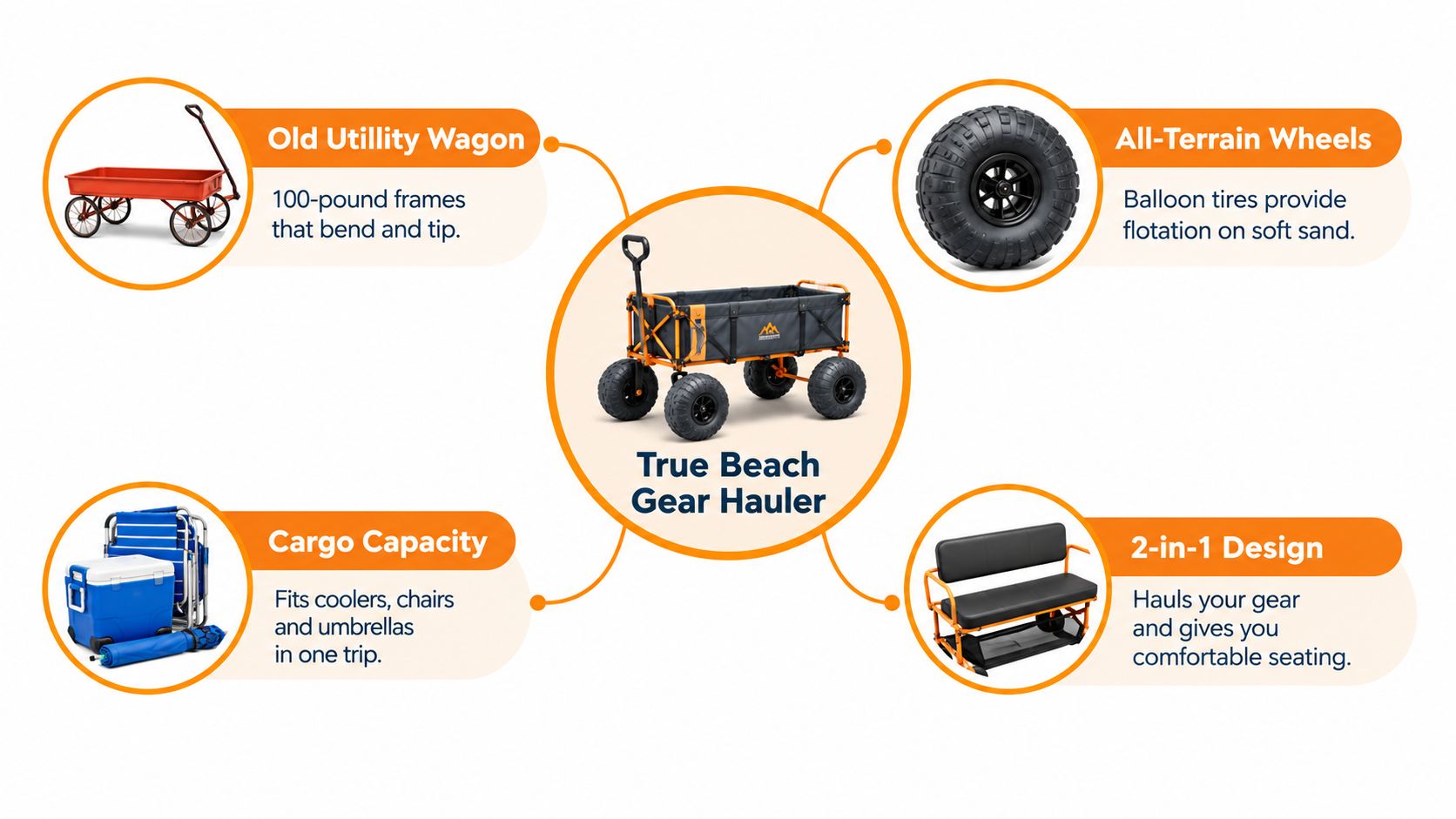
Older utility wagons were often built around light cargo and ordinary ground. Their narrow wheels and modest frames could handle a short trip over pavement or firm grass, but they weren't designed for deep sand or a family-sized beach load. Modern specialized haulers reflect a different buying priority, portability combined with higher capacity and terrain-specific wheel design.
The market is moving toward capable cargo systems
One independent market report estimates the global beach cart market at about $0.4 billion in 2025, with a projection of roughly $0.6 billion by 2034 at a 4.5% compound annual growth rate. The same report places folding beach carts at 38.2% of the market, North America at 32.5% of revenue, and heavy-duty carts above 200 lb capacity at 26.6% of share. These figures point to demand for products that fold, carry serious loads, and handle the conditions found in major recreational markets, not merely lightweight baskets on wheels. Read the beach cart market analysis.
Those categories make sense on a real beach. A cooler, shade structure, several chairs, and wet gear quickly become too much for a basic carry solution. The hauler earns its keep when its wheel geometry, frame strength, and storage design work together.
Transport is only half the purchase
The most useful design shift is the move from cart to basecamp. A product that converts into seating can replace one separate item, reduce what must be packed into the vehicle, and give the family a defined place to rest.
Look for these characteristics:
Terrain-ready wheels: The hauler should be designed for loose sand, packed sand, grass, and hard surfaces.
Structural capacity: The frame and handle should support the intended load without feeling fragile when fully packed.
All-day function: Seating, cup holders, pockets, or a stable surface can make the product useful after arrival.
Practical storage: Folding or compact construction matters when the wagon shares trunk space with coolers and beach equipment.
The big-wheel cart guide is useful when comparing ordinary utility wagons with products designed around larger wheels and heavier outdoor loads. The main buying question isn't whether a cart looks rugged. It's whether the design addresses the whole route from vehicle to destination and then supports the hours you spend there.
Essential Features for Sand and Surf
Wheel design determines whether a beach cart rolls or excavates. A 2026 guide for beach carry equipment recommends wheels at least 7 inches in diameter and 3 inches wide for sand, while families carrying chairs, tents, and full coolers may need ratings from 300 to 560 pounds. The same guidance prefers 9-inch balloon wheels for very soft sand. Review the beach carry equipment guidance.
For soft beach sand, several expert guides converge around approximately 9 to 13 inches in diameter and 3 to 5 inches in width. The larger diameter clears shell ridges and small obstacles more effectively, while the extra width spreads the load and reduces sinking. See the beach wagon wheel guide.
Feature and benefit must match
Ten-inch puncture-proof wheels aren't useful merely because the number sounds impressive. Their benefit is practical, they clear small ridges and uneven ground while avoiding the flat-tire problem that can ruin a loaded trip. Wider or balloon-style tires offer another advantage by distributing weight across more sand instead of concentrating it in a narrow track.
A reinforced steel frame supports the cart when a cooler, wet towels, chairs, and shade gear are packed together. The Lounge Wagon is described as using a reinforced steel frame and a 500 lb capacity, which gives the buyer a clear load category to compare against lighter utility carts. Treat any capacity as a working limit, not an invitation to overload the handle or place unstable items high.
The 2-in-1 seating configuration changes the value calculation. The cargo function handles the walk, while the padded bench, cup holders, and storage pockets support the downtime that follows. This is particularly useful at a crowded shoreline, where carrying a separate chair for every adult creates more bulk and more pieces to manage.
Beach Hauler Spec Comparison
Feature
Lounge Wagon
Generic Beach Cart
Weight capacity
500 lb capacity, as described by Lounge Wagon
Capacity varies, often intended for lighter general-purpose loads
Seating
2-in-1 seating, converts into a padded double-seater bench
Usually cargo-only, with no integrated seating
Wheel size
10-inch puncture-proof wheels
Narrower wheels are common and may sink in deep dry sand
Frame
Reinforced steel frame
Construction varies, with lighter frames common
Comfort features
Integrated cup holders and storage pockets
Often limited to a cargo compartment
Best role
Beach hauling plus an all-day basecamp seat
Short-distance transport
A useful comparison point is the broader range reported for modern quality wagons, which commonly support 150 to 450 pounds, well above older ratings of 100 to 150 pounds. Review the folding wagon guidance. The right choice depends on your normal load, but a family that regularly carries a full cooler and several bulky items shouldn't evaluate a cart as if it were carrying only towels.
Mastering Soft Sand and Mixed Terrain
Soft sand rewards flotation. A wide, low-pressure or balloon-style tire spreads the wagon's weight over a larger footprint, reducing the pressure concentrated at any one point. A narrow wheel does the opposite. It sinks, pushes sand forward with each rotation, and turns pulling into a repeated cycle of digging and dragging.
One independent review describes 9-inch balloon wheels as having enough air volume to float across soft sand, while another reports that 10-inch deep-tread wheels provide strong traction on soft sand and rugged dirt trails. Compare all-terrain wagon wheel approaches. Smaller all-terrain wheels can be more nimble on mixed terrain and packed sand, but they struggle in deep powder where flotation matters most. Read the wheel-type comparison.
Load for stability before you pull
The cart's wheel geometry can't compensate for a badly arranged load. Put dense items low, keep the heaviest object near the center, and place tall or loose equipment where it won't tip into the handle path.
Use this loading sequence:
Start with the cooler or dense container. Set it low and central so its weight presses down between the wheels rather than toward one end.
Add chairs, towels, and soft gear. These items can fill gaps and prevent hard objects from shifting.
Secure tall equipment. Umbrellas, tents, and poles should be contained or tied so they don't sway during turns.
Keep access items near the top. Sunscreen, water, and a light towel shouldn't require unloading half the wagon.
The transition from dry sand to packed wet sand changes the feel of the pull. Packed surfaces usually offer more resistance under the wheel, while boardwalks and pavement reward a straight line and controlled speed. Large wheels also help with curbs and rocks. A 2026 folding-wagon review notes that 4-inch-wide, 10-inch-tall wheels can distribute weight on soft surfaces while clearing tall obstructions such as parking-lot curbs and rocks. See the folding wagon obstacle review.
Practical rule: Pull in a steady line, avoid sharp turns in deep powder, and don't place the heaviest item at the rear of the cargo area.
The same principles apply on grass, gravel parking lots, and paths leading to the shoreline. A beach hauler should be judged by the entire route, not only by how it performs once the wheels reach the water's edge.
For a focused look at avoiding wheel sinkage, use this guide to a beach cart that won't sink in soft sand. It complements the loading method above by keeping attention on the surface, not just the advertised cargo rating.
Real World Use Cases for Every Outdoor Adventure
A beach gear hauler becomes much more valuable when it replaces several pieces of outdoor equipment. The same frame that carries beach chairs can transport sports bags, picnic supplies, tackle boxes, or festival equipment, then provide a place to sit.
The Sideline Elite
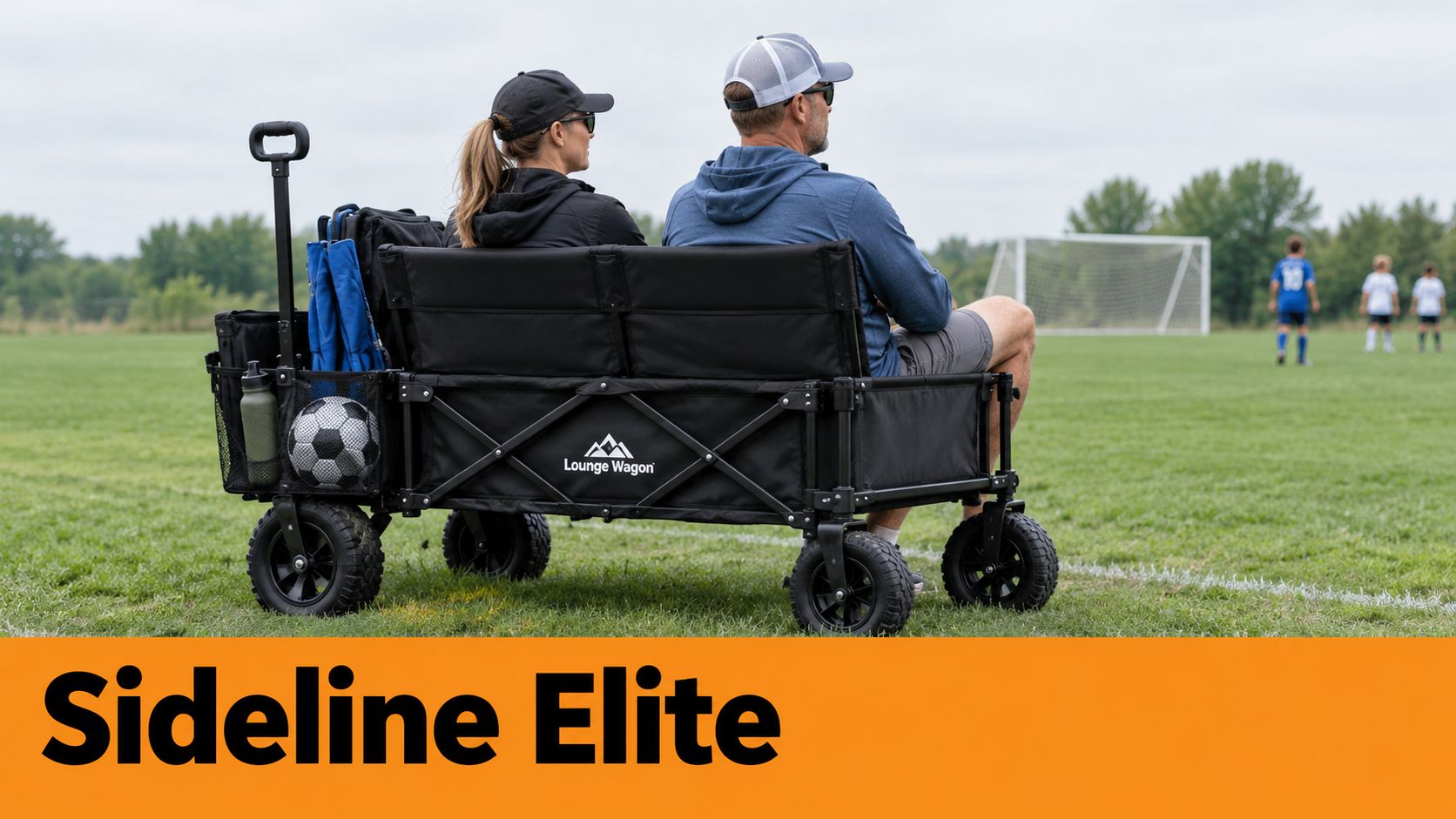
At a long soccer or lacrosse tournament, parents carry a team cooler, shade tent, blankets, sports bags, and personal drinks across grass and gravel. Once the equipment is in place, the 2-in-1 seating becomes the useful part. Parents can sit between matches without bringing a separate bench, and integrated cup holders keep drinks off the ground.
The hauler also creates a visible home base. Children know where water and extra layers are stored, while adults avoid scattering bags around the sideline. At crowded youth sports complexes, that organization can matter as much as the wheel performance.
The Sand-Sovereign
Coastal families tend to carry more than a towel. Umbrellas, sand toys, refreshments, spare clothes, chairs, and shade equipment all compete for trunk space. A 500 lb capacity gives the family a higher load category to consider, although the actual load should still be balanced and kept within safe operating limits.
The best setup places dense food and drinks low, soft items around them, and long shade equipment secured at the top. Once the family reaches the shore, 2-in-1 seating gives parents a better basecamp than sitting directly on hot or wet sand.
The Mobile Angler
A mobile angler may need to move tackle boxes, bait buckets, rods, and a cooler along a pier or rocky access route. A cargo-only cart still leaves the angler standing once the equipment is placed. A hauler with integrated seating can serve as a rest point without adding a separate stool to the load.
Surface matters here. Piers and packed paths may favor maneuverability, while loose shoreline sand calls for wider flotation-oriented wheels. The useful buying comparison isn't only beach cart versus fishing cart. It is whether one system handles the route and the waiting time.
Beyond the beach
The same logic works for several outdoor routines:
Festival regulars: Haul blankets, food, and personal gear, then keep a defined seat in crowded areas.
Grandparents: Carry the children's supplies and take a rest break without lowering themselves onto the ground.
Weekend campers: Move coolers, cookware, bedding, and chairs from the vehicle to a campsite.
Tailgaters: Replace a separate cargo wagon and bench when trunk space is limited.
Event volunteers: Transport water, signage, and supplies across grass or gravel, then sit during registration or downtime.
Outdoor transport choices often involve a trade-off between walking distance, cargo, and maneuverability. A bike comparison guide from PADL offers useful context for thinking about how people choose equipment around a destination, terrain, and the way they want to spend time outdoors.
The strongest case for a convertible hauler isn't that every outing needs maximum capacity. It's that the product remains useful after the difficult transport portion ends.
Keeping Your Hauler in Top Condition
Saltwater and fine sand are persistent enemies of outdoor equipment. Salt can accelerate corrosion on exposed metal, while silica sand can work into wheel axles, hinges, and folding joints. A short cleaning routine after each beach day protects the moving parts that make a cargo hauler and bench convenient to use.
The post-beach routine
Rinse the fabric and frame. Use fresh water to remove salt, grit, and spilled drinks from the 1000D Polyester fabric and steel components. Avoid storing the hauler while sand remains trapped in seams or pockets.
Clear the wheel axles. Blow or brush loose sand away from the axle areas and wheel connections. Rotate the wheels while checking for grinding or resistance.
Clean the folding joints. Fine particles can collect where the frame folds. Wipe those areas before closing the wagon for storage.
Lubricate moving points. Apply a suitable lubricant to the folding mechanism according to the product's care guidance. Wipe away excess so it doesn't attract more sand.
Dry before storage. Leave the wagon open until fabric and frame surfaces are dry, especially after saltwater exposure.
The seating conversion deserves the same attention as the wheels. If sand gathers in the hinges or latch points, the transition from cargo mode to 2-in-1 seating can become stiff and frustrating. The wagon maintenance guide provides a practical reference for keeping the system ready for the next outing.
Don't treat maintenance as a cosmetic step. A clean axle rolls more predictably, a clear hinge folds more smoothly, and a dry frame is less likely to develop avoidable corrosion.
Choosing the Ultimate Gear Hauler for Your Needs
Start with the route and the day you are planning. Deep, dry sand calls for wide wheels and flotation. A route that includes grass, gravel, pavement, packed sand, and a shoreline requires a hauler that can change surfaces without making you unload the cart.
Arrival matters just as much as the walk. A cargo wagon handles the transport, while 2-in-1 seating can replace a separate bench or pair of chairs once the family settles in. The Lounge Wagon combines that seating function with a 500 lb capacity, reinforced steel frame, 10-inch puncture-proof wheels, cup holders, and storage pockets, according to the publisher's product description.
Match the hauler to the day
A lighter cart can suit a short outing with limited gear. Families carrying coolers, chairs, shade equipment, towels, and sports supplies should assess the frame, handle, wheel width, and load distribution instead of relying on an “all-terrain” label. Capacity matters, but so does the support beneath that load. An overloaded cart with narrow wheels may perform poorly before it reaches the sand.
Use this checklist before buying:
Sand performance: Are the wheels wide and tall enough for the surfaces you cross?
Load planning: Can it carry your cooler, chairs, shade, towels, and personal gear without unstable stacking?
Frame strength: Does the construction suit repeated outdoor use and the intended load?
Comfort after arrival: Does it provide seating, cup holders, pockets, or another useful basecamp function?
Mixed-terrain handling: Can it move from dry sand to packed sand, grass, gravel, and pavement?
Maintenance access: Can you rinse the fabric, clear the axles, and reach the folding joints?
Storage fit: Will it fold or store without taking over the trunk or garage?
Actual use case: Are you buying for a beach, sports complex, pier, festival, campsite, or several of these?
The 2026 all-terrain wagon reviews can help compare terrain priorities before you commit. For families who repeatedly make the parking-lot-to-shoreline walk, the strongest value usually comes from reducing carrying effort and eliminating separate furniture from the packing list.
The Lounge Wagon's 500 lb capacity and 2-in-1 seating address both jobs. Load it for the trip, pull it across the route with wheels suited to the surface, then convert it into a padded seat for the hours that follow.
Ready to stop hauling and start lounging? Lounge Wagon offers a heavy-duty beach gear hauler that combines cargo transport with comfortable seating. Choose a setup that helps you reach the shore in one trip and stay longer once you arrive.
Choosing a selection results in a full page refresh.
This pad is perfect for kids or dogs to be comfortable inside the moving wagon, and very nice after you set everything up and want to sit for extra padding.
Having the umbrella this summer has been easy to use and a must to make sitting and watching the parade so nice when there isn't any shade. My dogs laid on the wagon padding and enjoyed the day without getting too hot. I enjoyed the shade too.