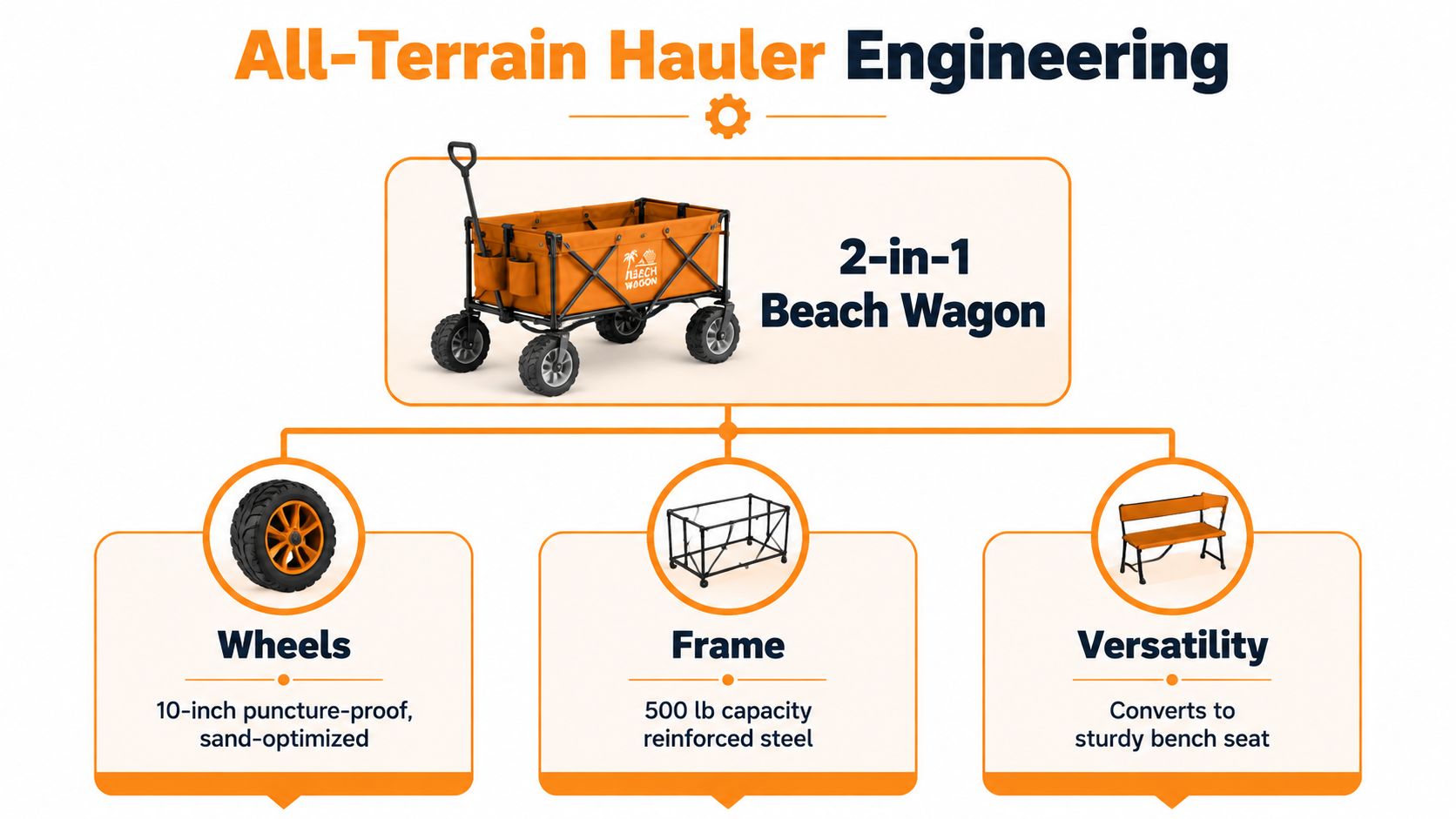
TL;DR: A 2-in-1 beach wagon combines heavy-duty gear transport with built-in seating, helping families make one trip from the car to the shore. The Lounge Wagon pairs 500 lb capacity, a reinforced steel frame, 10-inch puncture-proof wheels, and a bench configuration for two adults.
Last Updated: August 2026
The three-trip walk from the car to the sand is how many beach days begin. One trip carries the cooler, another handles chairs and umbrellas, and someone still ends up balancing towels, toys, and bags against their chest. By the time everyone reaches the shoreline, the day already feels like work.
A 2 in 1 beach wagon changes that routine by combining hauling and seating in one mobile base camp. Instead of transporting a cart and separate chairs, you can load the gear, pull it across the route, then convert the wagon into a place to rest. For families, tournament parents, anglers, and older beachgoers, that second function can matter as much as the cargo space.
The End of the Multi-Trip Trek
A beach setup rarely stays small. Even a supposedly simple outing can include towels, a cooler, sand toys, sunscreen, shade equipment, water, and spare clothing. Add children who tire quickly or grandparents who need regular rest breaks, and the distance between the parking area and the shoreline becomes a logistical problem rather than a pleasant walk.
The common workaround is to divide the load among people. One adult carries the chairs, another pulls a small cart, and the children carry whatever they can manage for a few minutes. Then somebody returns to the vehicle for the items that didn't fit. That cycle wastes energy before anyone has unpacked.
Why seating belongs in the hauling plan
A regular beach cart solves only the approach. Once you reach your spot, it remains a gear carrier while separate chairs still need to be transported, positioned, and packed away. A convertible wagon uses the same frame for the second half of the outing, giving adults a more comfortable place to sit without adding another bulky item to the vehicle.
The Lounge Wagon is designed as a heavy-duty gear hauler and double-seater bench. Its published product description lists a reinforced steel frame, 500 lb capacity, 10-inch puncture-proof wheels, storage pockets, and integrated cup holders. The seating mode is especially useful during long family days, sports events, festivals, and shoreline breaks.
Practical rule: Judge a beach wagon by what it does after you arrive, not only by how much it carries on the way in.
The category has also moved well beyond novelty. One market estimate values the global beach wagon market at USD 1.42 billion in 2024 and projects USD 2.44 billion by 2033, at a projected 6.3% CAGR from 2025 to 2033. Another report estimates the broader beach carts market at USD 1.82 billion in 2025 and forecasts USD 3.01 billion by 2034, at a projected 5.8% CAGR. These are projections from separate market reports, but both point toward continuing demand for multifunctional outdoor transport products, not just basic carts. (Beach wagon market estimate)
For a closer look at choosing a larger carrier, see this guide to large beach carts. The practical goal is simple: carry the full setup once, establish a comfortable base, and avoid sending someone back to the car.
Engineering the Ultimate All-Terrain Hauler
A beach wagon's performance depends more on wheel geometry, ground pressure, and frame stiffness than on accessory count. Cup holders and pockets improve convenience, but they won't rescue narrow wheels that dig into dry sand or a flexible frame that twists under a shifting load.
Wheels that spread the load
The Lounge Wagon uses 10-inch puncture-proof wheels, a specification intended to provide greater clearance and a more stable rolling surface than small utility-cart wheels. Larger wheels can make heavy loads easier to move over uneven routes because they approach ruts, shells, grass, and transitions with less abrupt resistance.
Soft sand is governed by contact pressure. Wider, low-pressure wheels spread the load over a larger patch, reducing sinkage and rolling resistance compared with narrow, hard wheels that concentrate force and cut into the surface. Engineering research on wheel-soil interaction also shows that pressure distribution changes materially at inflation pressures around 4 psi, while separate research identifies wheel width as a major factor in sand rolling resistance. (Pressure-sinkage model research) (Wheel-width research)
Current beach-cart guidance commonly recommends wheels at least 9 inches in diameter and at least 4 inches wide for very soft sand. (Beach cart history and design guidance)
Frame strength affects comfort
A reinforced steel frame supports the wagon's stated 500 lb capacity, but the benefit isn't limited to carrying more equipment. A stiffer frame helps maintain the load path between the cargo bed, axles, and wheels, reducing unwanted twisting when the contents shift over uneven ground.
The bench function adds another requirement. Two adults don't remain perfectly still, especially on grass, gravel, or a rutted access path. Structural seating guidance emphasizes stiffness and support for changing loads, while sand-traction research warns that additional mass increases sinkage. The useful design balance is enough frame strength for a stable seat without turning the seated configuration into an unnecessarily heavy burden. (Utility seating and structural load guidance)
A recent independent beach-wagon test evaluated products across dry, soft, firm, and wet sand. Reviewers repeatedly found that larger wheels made loaded wagons easier to move, while smaller wheels sank more readily. That distinction matters because “beach-ready” can mean packed shoreline sand, soft dunes, or a mixed route from asphalt to grass to sand. (Beach wagon testing)
For a practical explanation of wheel selection, explore carts with big wheels. The feature-to-benefit connection is direct: larger, sand-capable wheels can reduce dragging, while a reinforced frame can make both hauling and seating feel more controlled.
Lounge Wagon vs Generic Utility Carts
Generic utility carts can be perfectly adequate for short hauls on pavement, firm grass, or compact paths. Their weakness appears when the outing requires soft-sand mobility, substantial equipment, and a useful destination mode after unloading.
The table below compares the published Lounge Wagon configuration with the typical role of a generic utility cart. Because generic products vary widely, their entries are qualitative rather than assumed specifications.
2-in-1 Wagon Comparison Matrix
Feature
Lounge Wagon
Generic Cart
Weight capacity
500 lb capacity
Varies by model and terrain
Seating integration
Converts into seating for two adults
Usually hauling only
Wheel size
10-inch puncture-proof wheels
Often varies, with no universal beach standard
Frame material
Reinforced steel frame
Material and stiffness vary
Comfort features
Padded bench configuration, integrated cup holders, and storage pockets
Usually focused on cargo transport
Best use
Beach days, sports complexes, festivals, parks, and mixed outdoor routes
Moving gear where seating isn't required
The most important difference isn't the cargo bed. It's the integrated second job. A generic cart may carry a cooler, shade equipment, or sports supplies, but once the load comes out, you still need somewhere to sit. That means separate chairs occupy trunk space and create another item to carry over the same difficult route.
Where a generic cart still makes sense
A basic cart may be the sensible choice if you only need occasional transport, travel mostly on firm ground, or already own compact seating that fits your routine. A two-wheel beach cart can also suit a user who prioritizes a straight pull and carries a deliberately light load.
The Lounge Wagon makes a stronger practical case when the equipment list is long and the day includes extended downtime. A 500 lb capacity can accommodate a substantial family or event load, while 2-in-1 seating gives the wagon continued value after arrival. That combination reduces the need to pack a separate bench or pair of chairs.
The right comparison isn't only purchase price. Count the separate carrier, chairs, storage space, and effort your setup requires.
The buyer should also inspect how a product behaves on the exact route they use. Dry sand, packed sand, grass, gravel, and pavement each expose different weaknesses. Wheel width, axle placement, frame rigidity, and handle control matter more than the label printed on the box.
Real-World Scenarios for Every Adventurer
A long outdoor day exposes the value of a 2 in 1 beach wagon quickly. Parents move gear across several surfaces, then spend hours waiting, eating, watching games, or helping tired children. The wagon earns its space by changing from a carrier into a practical rest point without requiring a second bulky item.
The Sideline Elite
Tournament parents often travel from a parking lot to a youth soccer complex, then across grass and gravel with a team cooler, shade equipment, balls, bags, and personal items. After setup, the same adults may wait through several games with nowhere comfortable to sit.
The Lounge Wagon's 500 lb capacity covers the heavy-load side of that routine. Its 2-in-1 seating handles the recovery side, giving parents an integrated bench instead of forcing them to leave chairs in the vehicle. Storage pockets and cup holders keep smaller items within reach, which reduces clutter around the tent or field boundary.
Crowded sports complexes also test control. A wagon that turns predictably and parks close to the setup is easier to manage than one that becomes an obstruction after unloading. Frame stiffness, handle response, and wheel tracking matter as much here as cargo volume.
The Sand-Sovereign
Families heading to the Florida Gulf Coast or another coastal destination usually carry more than towels and snacks. Umbrellas, toys, drinks, spare clothes, and changing supplies fill the bed quickly, while children may need a break before reaching the shoreline.
Dry, soft sand is a demanding surface because rolling resistance depends on more than wheel diameter. Sand mobility research examined speeds from 2.1 to 18 m/s and loads from 4,534 to 10,266 N, showing how speed, load, and tire behavior affect performance. (Sand mobility study)
Match the wagon to the entire route rather than judging it on a short showroom pull. Wide, sand-oriented wheels help on loose ground. A rigid frame, controlled handle, and balanced load help when moving from dry sand to packed shoreline or pavement. After arrival, the bench gives parents somewhere to sit while children play, snack, or change out of wet clothes.
For solo beach logistics, this guide to hauling heavy gear to the beach alone shows how combining transport and seating can reduce the number of separate objects handled on the route.
The following video shows the wagon's convertible use in an outdoor setting.
The Mobile Angler
Anglers carry dense, awkward equipment rather than a simple pile of soft bags. Tackle boxes, bait buckets, rods, coolers, and landing gear can be difficult to balance on a narrow cart, particularly along a pier or rocky approach.
The seat becomes useful when movement stops. It supports rigging, sorting tackle, waiting for a bite, or relieving leg fatigue during a long session. A separate stool can provide the same basic function, but it takes cargo space and adds another item to carry, position, and protect.
The Grand-Packer
Multigenerational families need rest options that do not depend on every person walking at the same pace. Grandparents may manage part of the route before needing a break, while children tire suddenly and carry small items inconsistently.
Outdoor bench guidance places comfortable seat heights between 17 and 19 inches above the ground, with at least 50% of benches meeting that range in the cited accessibility guidance. (Outdoor bench accessibility guidance) A wagon seat still requires an individual check. Transfer technique, stability, terrain, and the user's strength affect whether the bench is practical.
A beach wagon is not a substitute for a beach wheelchair or formal accessibility equipment. Government and council programs have expanded inclusive options such as beach wheelchairs, floating wheelchairs, and mobi-matting for people with reduced mobility and their carers. (Bass Coast accessible beach equipment) The bench can provide a useful rest point for some families, but users who need specialized support should choose equipment designed for mobility access.
Buyer's Checklist and Maintenance Guide
A soft-sand route, a long walk from the car, and a tired child expose weak wagon designs quickly. Choose the 2 in 1 beach wagon around the surfaces and users it must serve, rather than its color or accessory bundle.
What to inspect before buying
Check these points before comparing brands:
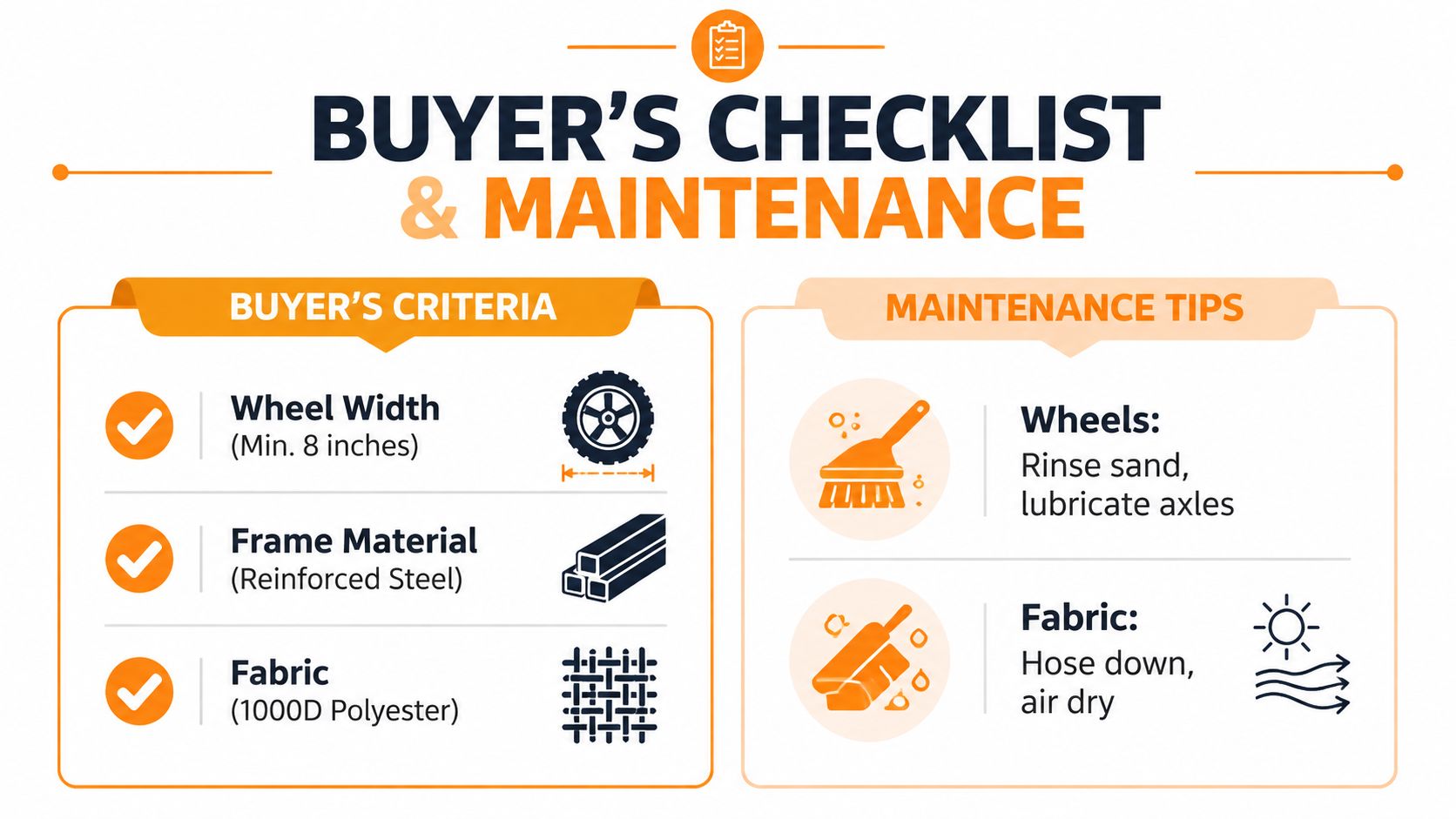
Wheel width: Wide, sand-oriented wheels resist sinking better than narrow hard casters. For very soft sand, look for wheels around 9 inches in diameter and 4 inches wide.
Frame material: Reinforced steel can provide the stiffness required for heavy cargo and bench mode. Inspect how the frame, axles, and seat supports distribute weight.
Fabric durability:1000D Polyester suits repeated exposure to sand, moisture, sunlight, and loading. Examine seams and attachment points as well as the fabric rating.
Seat height: If older adults will use the bench, compare its height with the 17 to 19 inch comfort range cited for outdoor seating. A suitable height can reduce strain during sitting and standing, but terrain and transfer ability still matter.
Conversion process: The bench should deploy without a separate chair, loose support, or complicated assembly. Test the switch with the wagon loaded if possible.
Storage details: Integrated pockets and cup holders keep small items from being buried under beach gear.
A useful seat must also remain stable on uneven ground. Check the brake or wheel-lock design, the seat support, and whether the cargo shifts when someone sits down. These details determine whether the integrated bench reduces fatigue instead of creating another setup task.
Care after every beach trip
Sand and salt can work into folds, wheel hubs, and axles, where they restrict movement and accelerate wear. Rinse the wheels and frame with fresh water, then remove visible grit before storage.
Let the fabric dry fully before folding the wagon for an extended period. Use a soft brush on dry sand caught in seams, and rinse away salt or surface residue from the fabric. Do not leave the wagon outdoors indefinitely, especially when moisture can remain inside folded layers.
Follow this wagon maintenance guide for a consistent inspection routine. Rinse, inspect, dry, and store after each outing instead of waiting for a wheel to bind or a persistent odor to develop.
Making the One-Trip Switch
The most common objections are storage, cost, and whether a multifunctional wagon will be used often enough. Those questions deserve a practical answer. A product that replaces separate hauling and seating can earn its space when the family regularly attends beach days, sports tournaments, festivals, markets, camping trips, or park events.
Storage is a planning issue
A folding frame helps reduce the wagon's footprint between outings, but the right storage location still matters. Keep it somewhere dry and accessible, such as a garage, utility room, or protected vehicle-storage area. If the wagon is difficult to reach, you'll leave it behind even when the route would benefit from it.
The same principle applies to accessories. A beach bundle can keep the core items together rather than forcing you to search for a cooler, umbrella, or sand wheels before every trip. The Beach Day Bundle is built around that beach-oriented setup, while the Lounge Wagon product page details the wagon's hauling and seating configuration.
Value comes from replacement, not decoration
The useful calculation is qualitative but straightforward. Ask whether the wagon replaces a separate cart, chairs, and repeated carrying effort. If it does, its value comes from fewer objects in the trunk and less physical work at the destination.
A 500 lb capacity and 2-in-1 seating also make the product relevant beyond beach use. The same unit can move supplies across a sports field, carry picnic equipment through a park, or create a place to sit at a festival. That broader use helps justify bringing it regularly rather than treating it as seasonal beach gear.
For a detailed buying overview, read how to buy an all-terrain Lounge Wagon. Before purchasing, confirm that the intended users can safely enter, sit, and exit the bench, and remember that specialized accessibility equipment may be more appropriate for people who need supported beach mobility.
A one-trip setup won't eliminate every challenge. Deep sand still demands appropriate wheels, heavy loads still require sensible packing, and saltwater environments still require maintenance. But combining the haul with the rest stop removes one of the most persistent sources of outdoor-day fatigue.
Ready to stop hauling and start lounging? Lounge Wagon offers a high-capacity gear hauler that converts into comfortable seating for two, helping simplify beach days, sports events, and outdoor gatherings. Visit Lounge Wagon to choose a setup built around the one-trip walk to the shore.
Choosing a selection results in a full page refresh.
This pad is perfect for kids or dogs to be comfortable inside the moving wagon, and very nice after you set everything up and want to sit for extra padding.
Having the umbrella this summer has been easy to use and a must to make sitting and watching the parade so nice when there isn't any shade. My dogs laid on the wagon padding and enjoyed the day without getting too hot. I enjoyed the shade too.